




Medical education
Lessons from practice
Volume 214 - Issue 1
Sudden onset vision loss: an atypical presentation of giant cell arteritis and myeloproliferative neoplasm
Authors: Khizar Rana, Carmen Oakley, David M Ross and Sumu Simon
Med J Aust 2021; 214 (1): 14-15.e1. || doi: 10.5694/mja2.50888
Published online: 18 January 2021
Published online: 18 January 2021
A 75-year-old man was referred to our centre with a history of sudden onset painless loss of vision in the right eye, on a background of recent jaw claudication and weight loss
Clinical record
A 75‐year‐old man was referred to our centre with a history of sudden onset painless loss of vision in the right eye, on a background of recent jaw claudication and weight loss. The visual loss developed suddenly 5 days before presentation. His medical history included hypertension, hyperlipidaemia, prior ischaemic stroke, and a 40‐pack‐year smoking history.
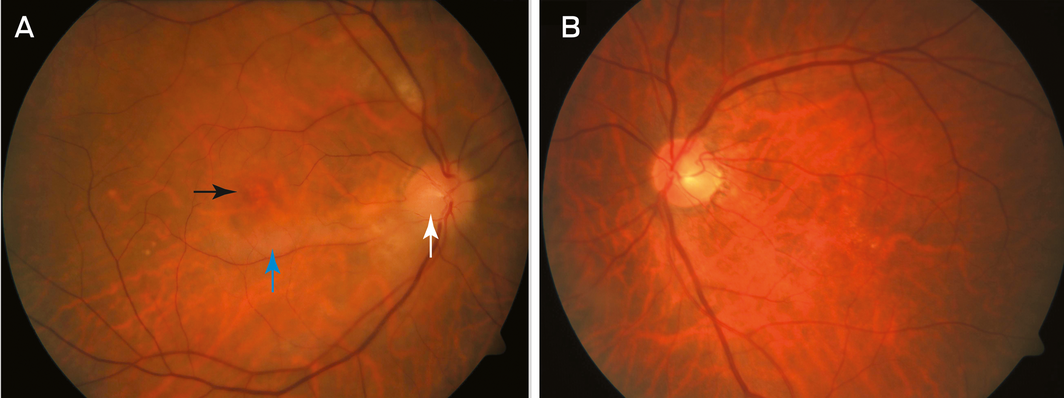
Visual acuity was reduced to hand movements in the right eye and 6/7.5 in the left eye. The swinging light test demonstrated a right relative afferent pupillary defect. Fundus examination of the right eye demonstrated a pale swollen disk, retinal oedema and pallor, and a mild “cherry red” spot (Box), suggestive of a central retinal artery occlusion (CRAO). The fundus of the left eye appeared normal (Box).
CRAO can be caused by in situ thrombosis, embolism or arteritis. Initial investigations included non‐contrast head computed tomography scan, magnetic resonance imaging brain scan, electrocardiogram, and carotid ultrasound. These were all normal, as were serial inflammatory markers to screen for giant cell arteritis (GCA). The patient had a 13‐year history of unexplained persistent thrombocytosis with more recent leukocytosis. At presentation, the haemoglobin level was normal, with a white cell count of 22.1 × 10⁹/L (normal range, 4.0–11.0 × 10⁹/L) and a platelet count of 1083 × 109/L (normal range, 150–450 × 109/L).
The patient was treated empirically for GCA with intravenous methylprednisolone followed by a tapering course of oral prednisolone. A temporal artery biopsy showed chronic inflammation with occasional multinucleate giant cells, but no granulomata and no luminal thrombosis, confirming the diagnosis of GCA. Further haematological investigation revealed a Janus kinase 2 (JAK2) V617F mutation in the peripheral blood. Bone marrow biopsy showed changes indicative of primary myelofibrosis. Cytoreductive treatment with hydroxyurea was commenced and low dose aspirin was continued. Twelve months later, there was no improvement in visual acuity.
Discussion
CRAO is an uncommon condition with an incidence of one in 100 000.1 In most cases, it results in a visual acuity of counting fingers or worse.2 Pallor of the fundus and a “cherry red” spot due to preservation of the underlying choroidal circulation are characteristic findings. Arteritic CRAO is less common, accounting for about 4.5% of CRAO cases, and is frequently caused by GCA.2 More than 90% of CRAO cases are non‐arteritic, with thromboembolism from the carotid artery being the most common cause.1,2 Risk factors for non‐arteritic CRAO include hypertension, diabetes mellitus, smoking tobacco, and established vascular disease.1 Our patient had many of these risk factors. Although less common, myeloproliferative neoplasms are recognised as a rare cause of both non‐arteritic CRAO and central retinal vein occlusion.3
Myeloproliferative neoplasms including polycythaemia vera, essential thrombocythaemia, and primary myelofibrosis are rare haematopoietic cancers with a combined incidence of less than six per 100 000.4 They are often discovered incidentally when abnormal blood counts are detected. Some patients present with fatigue, itching, bleeding or thrombosis. Splenomegaly is common in myelofibrosis.4
Our patient’s diagnosis of primary myelofibrosis was delayed for more than a decade after thrombocytosis was first seen. A delayed diagnosis of myeloproliferative neoplasm is common, with many patients having asymptomatic blood count abnormalities, whose significance may not be appreciated by non‐specialists.5 Furthermore, reactive causes of thrombocytosis are common and may complicate assessment. GCA can also cause reactive thrombocytosis, and antecedent myeloproliferative neoplasm may not have been suspected without review of historical results. A significant proportion of patients with myeloproliferative neoplasm have a diagnosis made after presenting with acute thrombotic complications.5 The JAK2 V617F mutation is seen in around 60% of patients with primary myelofibrosis and is itself an independent risk factor for thrombosis.6 Persistent polycythaemia, leukocytosis or thrombocytosis should prompt a work‐up for myeloproliferative neoplasms. Delays in diagnosis can result in a high incidence of potentially preventable thrombotic complications.5
This case highlights the importance of recognising both GCA and myeloproliferative neoplasm as rare causes of CRAO. These additional risk factors may have been overlooked in this patient given his strong cardiovascular risk factors and prior history of ischaemic stroke. Although a normal erythrocyte sedimentation rate and C‐reactive protein is rare in GCA (< 1% of cases),7 the absence of elevated inflammatory markers does not exclude a diagnosis of GCA when otherwise typical symptoms are present. Jaw claudication is the strongest clinical predictor of a positive temporal artery biopsy for GCA.8 Prompt diagnosis and treatment of GCA are critical because, without treatment, up to 60% of patients with GCA will go blind in the contralateral eye within a few days.7 Earlier recognition of myeloproliferative neoplasm also has the potential to prevent serious morbidity due to thrombotic complications.5
Lessons from practice
- Giant cell arteritis (GCA) is an uncommon cause of central retinal artery occlusion but needs to be excluded in patients over 50 years of age.
- Normal inflammatory markers do not exclude GCA.
- Persistent polycythaemia, leukocytosis or thrombocytosis should prompt a work‐up for myeloproliferative neoplasms.
- Delays in diagnosing myeloproliferative neoplasms can result in potentially preventable thrombotic complications.
Box – Colour fundus of the right eye showing a pale swollen disc (white arrow), retinal oedema and pallor (blue arrow) with a mild “cherry red” spot (black arrow) at the macula due to arteritic ischaemic optic neuropathy and resolving central retinal artery occlusion (A); the fundus of the left eye appeared normal (B)
Competing interests
No relevant disclosures.
Acknowledgements
We thank Alan Hoare, from the Royal Adelaide Hospital, for his help in arranging the fundus image for this manuscript.
References
- Varma DD, Cugati S, Lee AW, Chen CS. A review of central retinal artery occlusion: clinical presentation and management. Eye (Lond) 2013; 27: 688–697.
- Hayreh SS, Zimmerman MB. Central retinal artery occlusion: visual outcome. Am J Ophthalmol 2005; 140: 376–391.
- Langabeer SE. The JAK2 V617F mutation in retinal vein or artery occlusion. EXCLI J 2019; 18: 127–128.
- Rumi E, Cazzola M. Diagnosis, risk stratification, and response evaluation in classical myeloproliferative neoplasms. Blood 2017; 129: 680–692.
- Forsyth C, Melville K, Tiley C. The delayed diagnosis of myeloproliferative neoplasms is common and results in a high incidence of potentially preventable thrombotic complications. Pathology 2018; 50: 775–776.
- Barbui T, Carobbio A, Cervantes F, et al. Thrombosis in primary myelofibrosis: incidence and risk factors. Blood 2010; 115: 778–782.
- Parikh M, Miller NR, Lee AG, et al. Prevalence of a normal C‐reactive protein with an elevated erythrocyte sedimentation rate in biopsy‐proven giant cell arteritis. Ophthalmology 2006; 113: 1842–1845.
- Hayreh SS, Podhajsky PA, Raman R, Zimmerman B. Giant cell arteritis: validity and reliability of various diagnostic criteria. Am J Ophthalmol 1997; 123: 285–296.
Provenance: Not commissioned; externally peer reviewed.
A Diagnostic Headache
Thomas Glynn, Michelle T. Leech, Stacy K. Goergen, Emily Lin, Nadeem Toodayan, Ralph Junckerstorff
Neisseria meningitidis: an uncommon cause of conjunctivitis
Chloe Story, Tina Marinelli, Simeon Crawford, Amrita Ronnachit
Dismantling barriers to research and clinical care for individuals with a vision impairment
Eden G Robertson, Kate Hetherington, Meredith Prain, Julia Hall, Leighton Boyd AM, Rosemary Boyd OAM, Emily Shepard, Hollie Feller, Sally Karandrews, Fleur O'Hare, Kanae Yamamoto, Matthew P Simunovic, Robyn V Jamieson, Alan Ma, Lauren Ayton AM, Anai Gonzalez‐Cordero
The New South Wales Pharmacy Trial for herpes zoster: on the nose?
Christian P Pappas, Timothy R Holmes, Minas T Coroneo
Skin fragility disorder misdiagnosed as child abuse: a cautionary tale
Heather G Mack, Fred K Chen, John R Grigg
Health economic aspects of inherited retinal diseases: looking for cost‐effective treatments
Benjamin Kamien, Rachael Heath Jeffery, Fred K Chen