




Volume 213 - Issue 4
The vitamin D testing rate is again rising, despite new MBS testing criteria
Authors: Louisa Gordon, Mary Waterhouse, Ian R Reid and Rachel E Neale
Med J Aust 2020; 213 (4): 155-155.e1. || doi: 10.5694/mja2.50619
Published online: 8 June 2020
Published online: 8 June 2020
The number of tests for vitamin D deficiency in Australia rose steeply between 2000 and 2011, from 0.4 to 36.5 tests per 1000 population; the cost to Medicare increased from $1.1 million in 2000 to $95.6 million in 2010,1 and peaked at $151 million in 2012–13.2 Consequently, the Medical Benefits Schedule (MBS) items for testing (66608, 66609) were replaced in November 2014 by new items (66833–66837) with the aim of restricting testing to people at particular risk of vitamin D deficiency, including those with a history of osteomalacia or osteoporosis, elevated alkaline phosphatase levels, hyperparathyroidism, hypo‐ or hypercalcaemia, hypophosphataemia, malabsorption, chronic renal failure, deeply pigmented skin or chronic and severe lack of sun exposure, or a diagnosis of vitamin D deficiency, and people who used medications that reduce 25‐hydroxyvitamin D levels.3
The immediate effect of the new criteria was that the rate of vitamin D tests was 47% lower during 2014–16 than during 2013–14.4 However, the proportion of people tested who met none of the new MBS criteria increased from 71.3% to 76.5%, while the proportion with moderate to severe vitamin D deficiency increased only from 5.4% to 6.5%.4
Medicare data5 indicate that the testing rate has since increased, by 34% between 2015 and 2019, from 119 to 159 tests per 1000 population; the cost to Medicare rose 42%, from $73.7 million to $104.7 million (Box). The testing rate increased in all states; the rate for women increased by 30% (from 164 to 214 tests per 1000 population), and for men by 40% (from 74 to 105 tests per 1000 population) (Supporting Information, figures 1A,B). The most marked increases were for people aged 85 years or more, for whom the 2019 testing rate (women, 447 tests per 1000 population; men, 364 tests per 1000 population) exceeded the 2012 levels (women, 388 tests per 1000 population; men, 276 tests per 1000 population). Testing rates for people aged 0–25 years did not markedly change between 2015 and 2019 (Supporting Information, figures 1C,D).
The Royal College of Pathologists of Australasia,6 like most medical authorities, does not recommend screening for vitamin D deficiency. The marked overall increase in testing since 2015 is not explained by changes in demographic or clinical factors, suggesting that at least some screening is unnecessary and that ordering doctors are either unaware of or do not support the new MBS vitamin D testing criteria. Evidence‐based guidelines6 and MBS policy, accompanied by education and audit activities, have failed to contain the level of vitamin D testing. Further, people who are socio‐economically disadvantaged or at particular risk of vitamin D deficiency, including Indigenous Australians, are still tested less frequently than other Australians.4 Finally, people at clear risk of vitamin D deficiency could be treated without testing, especially as the cost of supplementation ($2.25 per month) is only a fraction of that of a vitamin D test ($30.05).
High quality research is needed to provide evidence for informing interventions that curb the use of low value tests in a health system that encourages a high volume of services, but not necessarily better value care.
Box – Cost to Medicare of vitamin D testing (MBS items 66608 and 66609, 66833 to 66837), January 2000 – December 2019
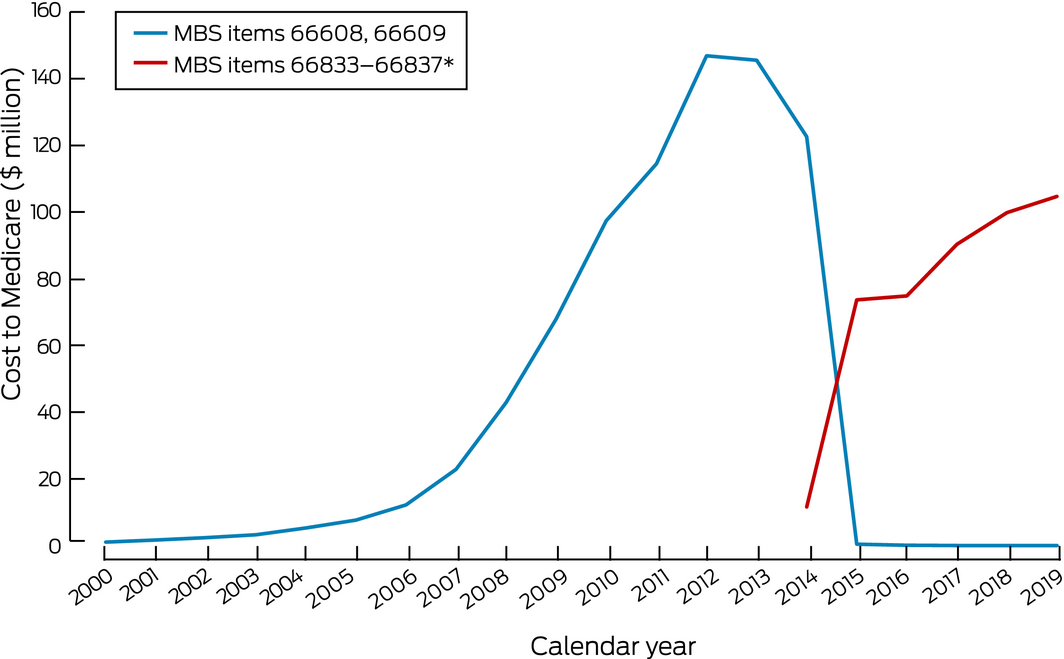
MBS = Medical Benefits Schedule. Source: Medicare item reports.5 Our estimated rates for 2001 (2.3 per 1000 persons) and 2011 (140 per 1000 persons) differ from those estimated by Bilinski and Boyages1 using a different source of Medicare data. * The MBS items 66833 to 66837 were listed on 1 November 2014.
Competing interests
No relevant disclosures.
References
- Bilinski K, Boyages S. Evidence of overtesting for vitamin D in Australia: an analysis of 4.5 years of Medicare Benefits Schedule (MBS) data. BMJ Open 2013; 3: e002955.
- Boyages SC. Vitamin D testing: new targeted guidelines stem the overtesting tide. Med J Aust 2016; 204: 18. https://www.mja.com.au/journal/2016/204/1/vitamin-d-testing-new-targeted-guidelines-stem-overtesting-tide.
- Australian Department of Health. Medicare Benefits Schedule: item 66833. http://www9.health.gov.au/mbs/fullDisplay.cfm?type=item&q=66833&qt=ItemID (viewed Feb 2020).
- Gonzalez‐Chica D, Stocks N. Changes to the frequency and appropriateness of vitamin D testing after the introduction of new Medicare criteria for rebates in Australian general practice: evidence from 1.5 million patients in the NPS MedicineInsight database. BMJ Open 2019; 9: e024797.
- Australian Department of Human Services. Medicare item reports. http://medicarestatistics.humanservices.gov.au/statistics/mbs_item.jsp (viewed Feb 2020).
- Nowson CA, McGrath JJ, Ebeling PR, et al. Vitamin D and health in adults in Australia and New Zealand: a position statement. Med J Aust 2012; 196: 686–687. https://www.mja.com.au/journal/2012/196/11/vitamin-d-and-health-adults-australia-and-new-zealand-position-statement.
Beyond Fibrosis Stratification: Integrating Behavioural, Metabolic and Policy-Level Interventions in Metabolic Dysfunction-Associated Steatotic Liver Disease
Yousef Hakimi, Prarthana Thiagarajan, Michael Braude
Fatty Liver Disease in Australia: A Narrative Review on the Epidemiology, Natural History, Prognostication and Management in People With Metabolic Dysfunction
Karl Vaz, Daniel Clayton-Chubb, William W. Kemp, Stuart K. Roberts, Ammar Majeed
When ‘Liver Enzymes’ Are Not Hepatic: Late-Onset Pompe Disease
Shauna Madigan, Georgina England, Wayne Rankin
Fatty Liver Disease in Australia: A Narrative Review on the Epidemiology, Natural History, Prognostication and Management in People With Metabolic Dysfunction
Karl Vaz, Daniel Clayton-Chubb, William W. Kemp, Stuart K. Roberts, Ammar Majeed
The early implementation phase of the Omega‐3 Test‐and‐Treat Program for reducing the risk of preterm birth, South Australia, 2021–22: an implementation evaluation study
Karen P Best, Celine Northcott, Lucy A Simmonds, Philippa Middleton, Lisa N Yelland, Vanessa Moffa, Khoa Lam, Penelope Coates, Cornelia Späth, Carol WK Siu, Karen Glover, Rhiannon Smith, Robert Gibson, Maria Makrides
Cause‐specific mortality among Queensland people with cirrhosis, by cirrhosis aetiology and decompensation status, 2007–22: a retrospective cohort study
Vikas Bhasker, Jessica R Fong, Paul J Clark, Gunter F Hartel, Richard Skoien, James O’Beirne, Elizabeth E Powell, Patricia C Valery