




Volume 212 - Issue 6
Breathing life into Australian diabetes clinical guidelines
Authors: Heath White, Britta Tendal, Julian Elliott, Tari Turner, Sofianos Andrikopoulos and Sophia Zoungas
Med J Aust 2020; 212 (6): 250-251.e1. || doi: 10.5694/mja2.50509
Published online: 9 March 2020
Published online: 9 March 2020
Living guidelines that incorporate new evidence as it becomes available have the potential to overcome some of the limitations inherent in static guidelines
Diabetes is a complex chronic condition that affects about 1.7 million Australians and represents an estimated $15 billion per annum in direct and indirect costs to the Australian economy.1 Almost $215 million of subsidies were delivered during the 2015–16 financial year to the 1.32 million registrants of the National Diabetes Services Scheme, an Australian Government initiative that provides support to Australians living with diabetes. In 2019, an additional $100 million was announced for funding the Continuous Glucose Monitoring Initiative, which provides fully subsidised continuous glucose monitoring products to patients with diabetes who meet certain criteria.2 In 2017, almost 1.2 million hospitalisations and 11% of all deaths in Australia listed diabetes as the principal or associated cause.3
In addition to the costs associated with diabetes management and prevention, significant funding has been directed towards research into this key priority area, with the National Health and Medical Research Council (NHMRC) providing $375 million from 2013–2018 towards efforts to improve the prevention, diagnosis and management of diabetes.4
With the objective of strengthening diabetes policy and practice, the Australian Government developed the Australian National Diabetes Strategy 2016–2020, which outlines an integrated and coordinated approach for reducing the social, human and economic impact of diabetes.5 One of the key goals within this strategy involves strengthening prevention and care through the use of research, evidence and data. Indeed, developing a nationally endorsed set of diabetes guidelines, assessed against the clinical practice guidelines criteria, was a key recommendation of the Australian National Diabetes Strategy to improve complications and outcomes associated with the disease. Producing new clinical guidelines and implementing a system by which recommendations can be updated and adopted rapidly represents an important means by which this recommendation can be achieved.
Clinical guidelines: is there a better way?
High quality, evidence‐based clinical guidelines are integral to ensuring that health care decisions are based on the best available evidence. Unfortunately, evidence‐based clinical guideline development is an expensive and laborious undertaking in which several years can pass between inception and publication. In Australia, guidelines approved by the NHMRC are valid for 5 years from publication before they are considered outdated, following which they must be either updated or developed anew.6
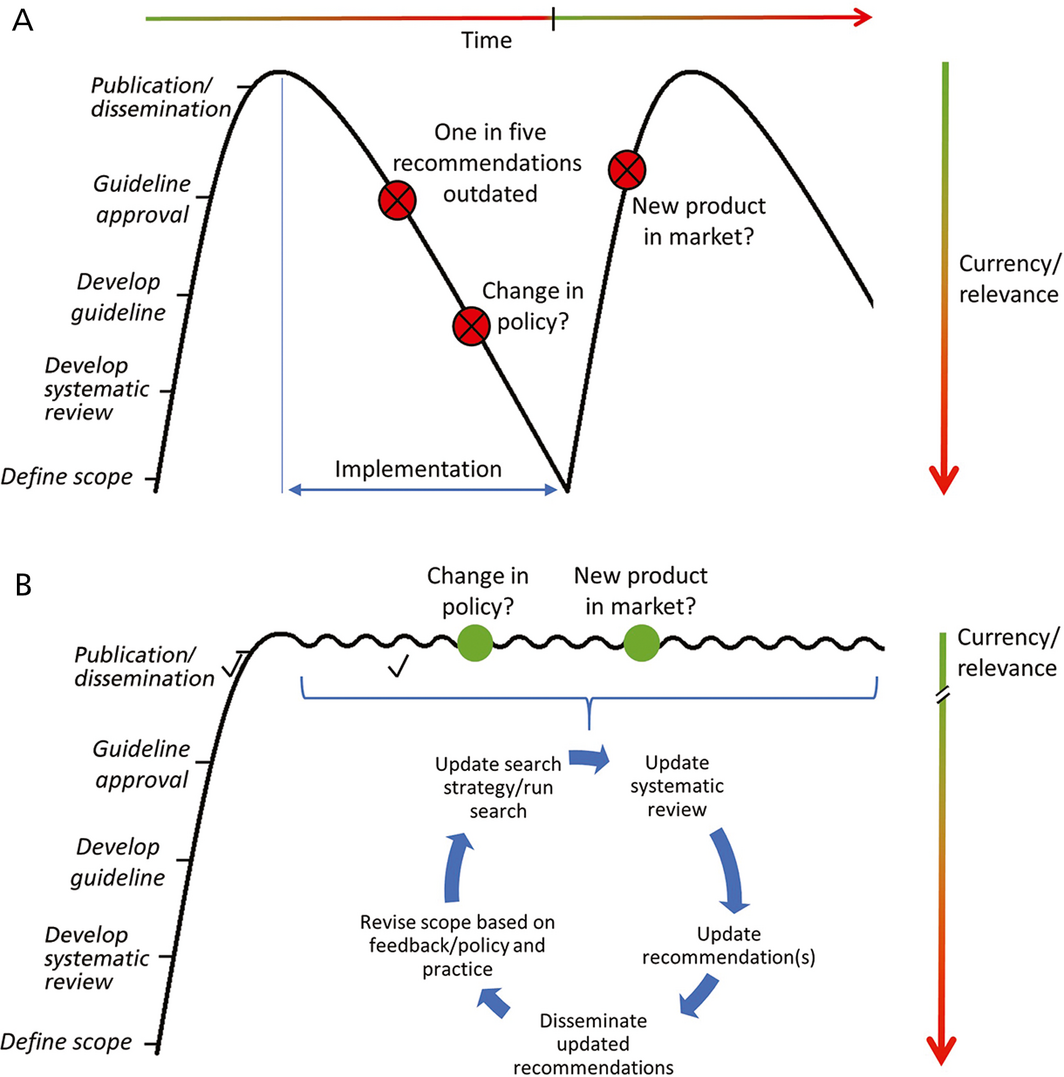
These delays can result in several potential problems. First, new research is continually being generated throughout the development period, which may mean that a guideline is outdated before it is even published. Indeed, it has been demonstrated that one in five guideline recommendations are outdated within 3 years of guideline publication.7 Second, institutional memory of the decision‐making processes through which recommendations are derived can be lost, particularly if a significant period of time has transpired since the original guideline was developed. Third, changes in the policy and practice environment can shift priorities or raise new questions that were not considered when defining the original scope, resulting in the guideline failing to address some of the key current issues relating to the topic of interest (eg, the development of a new therapeutic or withdrawal of a technology from the Australian Register of Therapeutic Goods).
Currently, all but one of the NHMRC‐approved diabetes clinical guidelines are outdated and have been rescinded. As a result, there is no up‐to‐date Australian guidance for clinicians caring for people with diabetes, potentially resulting in the suboptimal management and significant variation in care of this condition.8
Living guidelines
Living guidelines represent an approach to guideline development in which individual recommendations are continually updated as new, relevant evidence becomes available. This is achieved through monthly searches of key databases to identify recently published research. Following analysis of the new data, an impact assessment is conducted to determine whether the evidence is of sufficient relevance, reliability and importance to justify revising recommendations.9 Updated recommendations are then published within a real‐time digital dissemination platform, providing stakeholders with access to the most up‐to‐date version of the guideline.
Although the concept of living guidelines is not new, many of the processes employed in developing living guidelines have been generated through Project Transform, an innovative platform established by Cochrane to address the critical issue of evidence currency within clinical guidelines (https://community.cochrane.org/help/tools-and-software/project-transform/about-project-transform). These processes are supported by the development and refinement of machine learning algorithms (eg, randomised controlled trial classifiers), citizen science initiatives (eg, Cochrane Crowd), new methods for updating statistical analyses,10,11 and the development of online collaborative platforms for systematic review and clinical practice guideline production (eg, Covidence, MAGICApp). The application of these tools significantly reduces the workload of systematic review and guideline authors, and appears to result in the production of updated recommendations at a fraction of the resource and time costs otherwise required. In addition, the establishment of a living guideline development group improves the retention of institutional memory throughout the process of updating, and the feedback mechanisms built into the process provide a means by which the underlying scope can be adapted to changes in policy and practice in Australia (Box 1).
Living evidence for diabetes
Embracing the inherent potential in living guidelines, the Living Evidence for Diabetes Consortium is developing living guidelines that address key priorities relating to diabetes prevention, diagnosis and management (https://livingevidence.org.au/new-index-3#Living-Guidelines-for-Diabetes). Consisting of the Australian Diabetes Society, Diabetes Australia, the Australasian Paediatric Endocrine Group, the Australian Diabetes Educators Association and Cochrane Australia, with representation from the Royal Australian College of General Practitioners and the Australian Government Department of Health, the consortium has selected two proof‐of‐concept topics that fulfil the criteria for living guidelines (Box 2). Two systematic reviews are currently under development to underpin these guidelines, focused on the comparative safety and effectiveness of therapeutics for blood glucose control in adults with type 2 diabetes and the use of technologies (such as insulin pumps and continuous glucose monitors) for the management of type 1 diabetes in adult and paediatric populations. The need for clear guidance relating to these topics is demonstrated by the ongoing uncertainty regarding the most appropriate choice of second line therapies13 and the inception of do‐it‐yourself closed loop systems.14
Although the methods and processes required to produce living guidelines are still evolving, the development of living guidelines for diabetes represents a paradigm shift in the way recommendations are updated and shared with decision makers. Access to this resource should improve the likelihood that patients will consistently receive the best evidence‐based care available, and also provide an avenue through which guideline developers can respond to changes in policy and practice, resulting in guidelines that evolve to keep up with the current practice.
Box 2 – Requirements for converting traditional to living recommendations12
Not all recommendations are suitable for a living evidence approach. Three key requirements should be fulfilled to justify transitioning a static guideline into a living guideline:- the guideline should focus on a priority topic for patient, clinical or policy decision‐making;
- uncertainty should exist regarding the strength and/or direction of recommendations; and
- there should be a high likelihood of new evidence becoming available in the near future which could increase certainty.
Competing interests
No relevant disclosures.
References
- Diabetes Australia. Diabetes in Australia. https://www.diabetesaustralia.com.au/diabetes-in-australia (viewed May 2019).
- Australian Government Department of Health. Access to subsidised continuous glucose monitoring products through the National Diabetes Services Scheme. https://www1.health.gov.au/internet/main/publishing.nsf/Content/health-pbs-healthpro-cgm.htm (viewed May 2019).
- Australian Institute of Health and Welfare. Diabetes. https://www.aihw.gov.au/reports/diabetes/diabetes-snapshot/contents/how-many-australians-have-diabetes (viewed Jan 2020).
- National Health and Medical Research Council. Research funding statistics and data – 2000 to 2018. Canberra: NHMRC 2017. https://www.nhmrc.gov.au/funding/data-research/research-funding-data (viewed Jan 2020).
- Australian Government Department of Health. Australian National Diabetes Strategy 2016‐2020. Canberra: Commonwealth of Australia, 2015. http://www.health.gov.au/internet/main/publishing.nsf/content/3AF935DA210DA043CA257EFB000D0C03/$File/Australian%20National%20Diabetes%20Strategy%202016-2020.pdf (viewed May 2019).
- National Health and Medical Research Council. Procedures and requirements for meeting the 2011 NHMRC standard for clinical practice guidelines. Canberra: NHMRC, 2011. https://www.nhmrc.gov.au/about-us/publications/meeting-2011-nhmrc-standard-clinical-practice-guidelines (viewed May 2019).
- García LM, Sanabria AJ, Àlvarez EG, et al. The validity of recommendations from clinical guidelines: a survival analysis. Can Med Assoc J 2014; 186: 1211–1219.
- Baker IDI Heart and Diabetes Institute. National evidence based guideline on secondary prevention of cardiovascular disease in type 2 diabetes. Canberra: Commonwealth of Australia, 2015. https://www.clinicalguidelines.gov.au/portal/2519/national-evidence-based-guideline-secondary-prevention-cardiovascular-disease-type-2 (viewed May 2019).
- Akl EA, Meerpohl JJ, Elliott J, et al. Living systematic reviews: 4. Living guideline recommendations. J Clin Epidemiol 2017; 91: 47–53.
- Thomas J, Noel‐Storr A, Marshall I, et al. Living systematic reviews: 2. Combining human and machine effort. J Clin Epidemiol 2017; 91: 31–37.
- Simmonds M, Salanti G, McKenzie J, et al. Living systematic reviews: 3. Statistical methods for updating meta‐analyses. J Clin Epidemiol 2017; 91: 38–46.
- Elliott J, Synnot A, Turner T, et al. Living systematic reviews: 1. Introduction – the why, what, when, and how. J Clin Epidemiol 2017; 91: 23–30.
- Davies MJ, D'Alessio DA, Fradkin J, et al. Management of Hyperglycemia in Type 2 Diabetes, 2018. A consensus report by the American Diabetes Association (ADA) and the European Association for the Study of Diabetes (EASD). Diabetes Care 2018; 41: 2669–2701.
- Hng TM, Burren D. Appearance of do‐it‐yourself closed‐loop systems to manage type 1 diabetes. Int Med J 2018; 48: 1400–1404.
Linked content
-
InSight+: Living diabetes guideline to close evidence gap
Provenance: Not commissioned; externally peer reviewed.
Rapid Growth in Diagnostic CT Knee Imaging in Australia: Implications for Imaging Stewardship
Hanwen Chen, Rachelle Buchbinder, Sean Docking, Ian A Harris
Disease‐specific survival for people with chronic myeloid leukaemia, South Australia, 1980–2020: a retrospective cohort study
Kerri Beckmann, Brendon J Kearney, Naranie Shanmuganathan, David Yeung, Tim Hughes
Technological advances in the search for a CURE for asthma
Sara Quon, Timothy M Johanson, Ridhima Wadhwa, Alen Faiz, Anthony Flynn, Gary P Anderson, Amanda J Cox, Nicholas P West, Michael P Menden, Rhys S Allan
Who gets asthma, and why?
Denby J Evans, Peter D Sly, Paul Foster, Chantal Donovan
The first Australian evidence‐based guidelines on male infertility
Darren J Katz, Liza O’Donnell, Robert I McLachlan, Tim J Moss, Clare V Boothroyd, Veena Jayadev, Sarah R Catford
Sex differences in management and outcomes of people with ST‐elevation myocardial infarction, New South Wales, 2011–2020: a retrospective cohort study
Samia Kazi, Simone Marschner, Haeri Min, Desi Quintans, James JH Chong, Ehsan Khan, David B Brieger, Clara K Chow