




Volume 211 - Issue 6
Public health and economic perspectives on acute rheumatic fever and rheumatic heart disease
Authors: Jeffrey Cannon, Dawn C Bessarab, Rosemary Wyber and Judith M Katzenellenbogen
Med J Aust 2019; 211 (6): 250-252.e1. || doi: 10.5694/mja2.50318
Published online: 16 September 2019
Published online: 16 September 2019
With the care costs for the thousands of new cases predicted to occur by 2031, can we afford “business as usual”?
With the care costs for the thousands of new cases predicted to occur by 2031, can we afford “business as usual”?
The group A streptococcus (GAS) bacterium causes possibly the most diverse range of diseases compared with any other pathogen. Resulting from an autoimmune reaction to GAS throat infection, and possibly skin infection, acute rheumatic fever (ARF) and its common consequence of rheumatic heart disease (RHD) have been described as “diseases of poverty” because they are highly prevalent in socio‐economic disadvantaged settings.1 Although there is a clear gradient between disease prevalence and socio‐economic disadvantage, ARF and RHD were once also prevalent in low and high socio‐economic settings, including in Melbourne, among non‐Indigenous Australians during the 1930s and 1940s.2 That ARF rarely, if at all, occurs in modern Melbourne is testament to the reality that ARF and RHD can be eliminated Australia‐wide, but what will elimination of ARF and RHD take and can we afford “business as usual”?
RHD differentials between Aboriginal and Torres Strait Islander and non‐Indigenous Australians consistently emerge as among the highest across all diseases, whether based on mortality,3 hospitalisations, notifications4 or disability‐adjusted life years.5 School‐based echocardiographic screening in settings at both low and high risk of RHD confirm this disparity and reveal a substantial burden of subclinical RHD.6
Disparity in incidence and outcomes persist despite the Australian Government's Rheumatic Fever Strategy, which has been ongoing since 2009. The focus of the Rheumatic Fever Strategy has been on secondary prophylaxis, whereby people at risk of recurrent ARF (ie, those who have previously been diagnosed with ARF or RHD) receive intramuscular injections of penicillin every 21–28 days for at least 10 years. This strategy undoubtedly provides a crucial role in reducing the burden of ARF and RHD. However, it only prevents the worsening of disease in established cases rather than preventing new cases of ARF, and the effectiveness of using penicillin for the secondary prevention of ARF is derived from suboptimal trials.7
A key part of eliminating ARF and RHD in Australia is augmenting the current prevention strategy with a bigger focus on upstream determinants of health.8 Among the social and environmental determinants of GAS infection, ARF and RHD, the strongest evidence for prevention targets are crowding and socio‐economic disadvantage and, to some extent, dwelling characteristics.9 In addition to social and environmental determinants, prompt assessment and antibiotic treatment of skin sores (which are reportedly normalised in many Indigenous communities10) and sore throats have a major role. These activities will require substantial financial investment in addition to that already committed,11 but the net cost of such investment will be offset in part by the costs that would no longer be required to manage ARF and RHD.
A rigorous analysis of the cost of inaction on RHD has recently been undertaken using linked hospitalisation and mortality data to investigate the incidence and prevalence of ARF and RHD across four jurisdictions with the highest recorded burden of disease: the Northern Territory, Queensland, Western Australia and South Australia.12 In these jurisdictions, Commonwealth‐funded RHD control programs have been incrementally introduced as part of the Rheumatic Fever Strategy. The cost of inaction analysis found that, in mid‐2016, there were 4540 Aboriginal and Torres Strait Islander people living with a history of ARF or RHD hospitalisation across the NT, SA, Queensland and WA. Of these patients, 3420 were hospitalised within the prior 10 years (ie, between 2007 and mid‐2016), and active disease management is recommended for such cases (Box). The analysis also found that the number of actively managed patients is highest in the 15–24 years age group — an age when people are assuming new cultural, economic, educational and social roles.
Further, the cost of inaction analysis found that the incidence of first ARF and first RHD hospitalisations had increased between 2011 and 2016, predominately in the NT and SA. Extrapolating these incidence trends into the future, 10 211 disease‐free individuals (many yet unborn, given this is predominantly a disease acquired in youth) are expected to develop ARF or RHD between mid‐2016 and 2031 (Box).12
In addition to the prevalence and incidence of disease, a model of ARF and RHD progression, which used the new analyses of linked data combined with recently published epidemiological and economic analyses, was used to predict the medical care‐related cost of ARF and RHD for Aboriginal and Torres Strait Islander people. It was predicted that at least $26.7 million worth of health resources will be used to manage ARF and RHD in people currently expected to be undergoing medical management (Box). For the 10 211 individuals projected to develop ARF or RHD between mid‐2016 and 2031, the associated cost of medical care will total $317 million (Box). Overall, the combined projected cost of ARF and RHD resulting both from existing cases and from new cases estimated to develop by 2031 is $343.7 million (Box). These cost estimates included the cost of valvular surgery that is predicted to occur in 901 people in the NT and SA (combined), 390 people in Queensland and 79 people in WA.12
Yet, these medical care‐related costs do not include a broader scope of economic and social costs. For example, a Brazilian study of children with RHD reported that nearly one‐quarter of these children were kept back a year at school, and the same proportion of parents took time off work to care for their child, with several parents losing their jobs as a result.13 Further, a multicentre study in Africa reported that more than half of adults with RHD had prolonged periods absent from work or lost their jobs.14 These studies not only demonstrate that RHD has a direct impact on educational attainment and labour force productivity and participation, but the impact of RHD may also be intergenerational because both the new (child with RHD) and current (parent) generations are affected within the family unit.
The human and financial outcomes of ARF and RHD are not inevitable. Evidence emerging from in‐depth studies into the experiences and perceptions of communities regarding RHD reveal that health sector efforts to improve health literacy and understanding of RHD need to draw on Indigenous knowledge systems; once the messages make sense, communities appreciate the value of early action and the importance of treatment.15 This requires two‐way learning and exchange, allowing both health professionals and individuals and family members to weave a meaningful narrative as a basis for actions and behaviour.16 Furthermore, engagement with community elders and leaders are central to tackling the disease at the community level. Sharing of understanding between communities at leadership and extended family levels will also make dissemination of understanding more sustainable.
Clinicians and clinical practices need to reciprocate the efforts made by community members and leaders. ARF is still being missed. Efforts to rationalise the use of antibiotic treatment for pharyngitis among people at low risk of ARF may at times inadvertently rule out people who have the greatest capacity to benefit. There are anecdotal reports that Aboriginal and Torres Strait Islander children are not receiving recommended antibiotic treatment for pharyngitis when it is indicated, possibly due to the increasing promotion of antimicrobial stewardship in order to curtail growing antimicrobial resistance, and that requests from family members with high risk of RHD for antibiotics for throat infections are not always heeded.
In summary, efforts to eliminate ARF and RHD in Australia over the past decade have so far been unsuccessful, but this can change. Change requires departing from “business as usual” to invest in upstream prevention strategies that include a two‐way learning and exchange approach between health providers and community members, taking into account Indigenous worldviews, which differ from non‐Indigenous understandings, and addressing the social and environmental determinants of health
Efforts to pursue this new way of working have begun in communities and within the Commonwealth government. Community‐led action is underway with funding from the Rheumatic Fever Strategy and new research projects.11 Bilateral political commitments to addressing RHD have commenced, including the development of a roadmap to end RHD commissioned by the Minister for Indigenous Health and a resolution to eliminate RHD recently passed by the Opposition.17,18 As described by the former Minister for Indigenous Health, Ken Wyatt, the RHD Roadmap will include addressing environmental health, housing and education in a holistic approach to eliminating RHD.17
Sustained and substantial funding commitments will be needed to support Aboriginal and Torres Strait Islander organisations to maintain this momentum and achieve disease control. However, the net cost of implementing strategies that eliminate ARF and RHD will be reduced by the averted medical care cost of new cases, which was estimated to be in excess of $300 million for the more than 10 000 new cases predicted to occur between mid‐2016 and 2031.12 These savings in medical costs are only the tip of the iceberg. Not only would ending ARF and RHD have immediate health benefits but a broader range of economic and social benefits are also likely to flow to Aboriginal and Torres Strait Islander people, progressing efforts to Closing the Gap.
Box – Number of Aboriginal and Torres Strait Islander people with or projected to develop acute rheumatic fever or rheumatic heart disease and the associated medical care cost
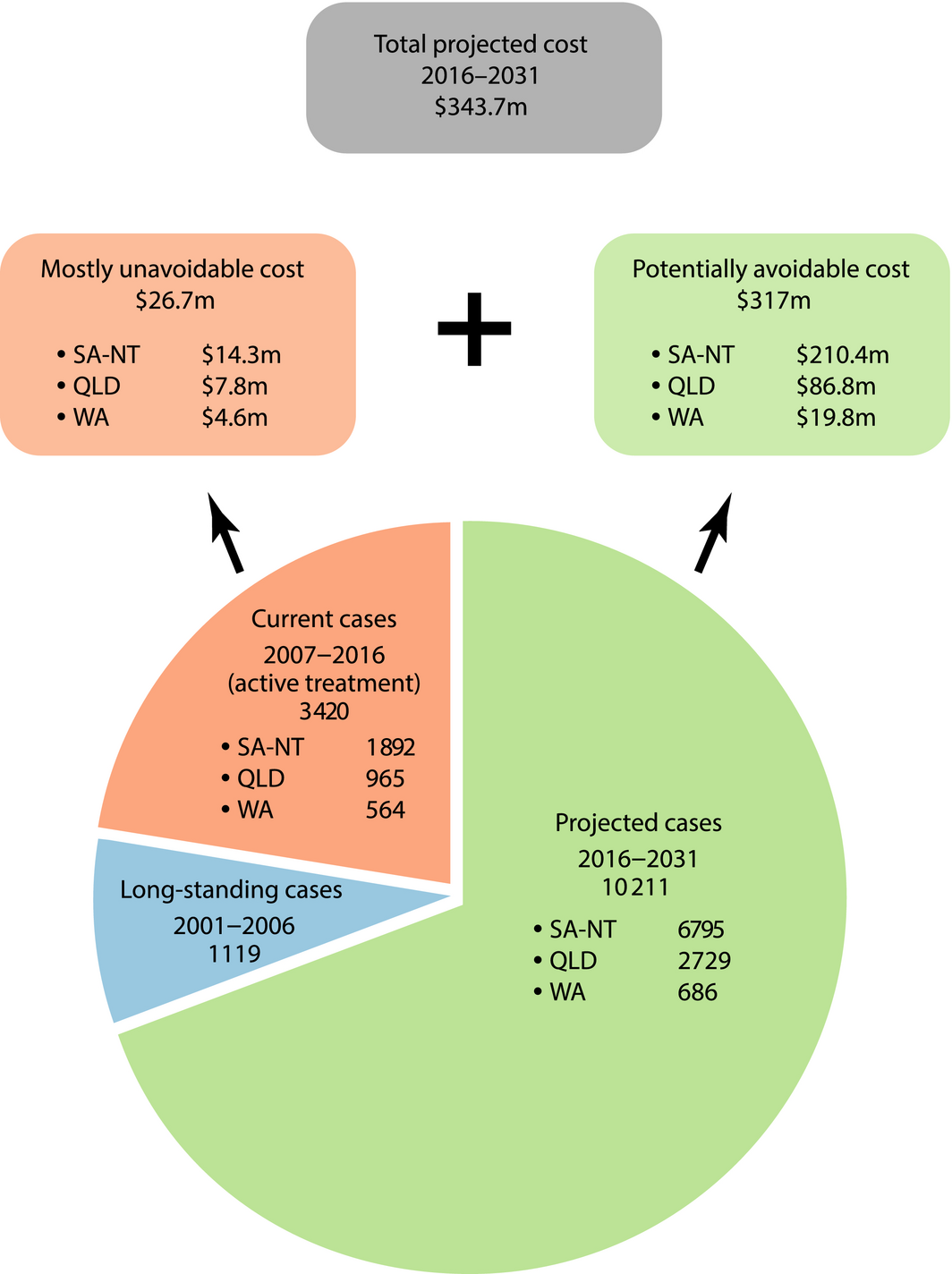
NT = Northern Territory; QLD = Queensland; SA = South Australia; WA = Western Australia. Source: the data used in the figure were derived from Cannon et al.12
Competing interests
No relevant disclosures.
References
- Carapetis JR, Beaton A, Cunningham MW, et al. Acute rheumatic fever and rheumatic heart disease. Nat Rev Dis Primers 2016; 2: 15084.
- Holmes MC, Rubbo SD. A study of rheumatic fever and streptococcal infection in different social groups in Melbourne. J Hyg (Lond) 1953; 51: 450–457.
- Colquhoun S, Condon J, Qin Li S, et al. Disparity in mortality rates from rheumatic heart disease in the Australian indigenous and non‐indigenous populations. Global Heart 2014; 9: e259–e260.
- Australian Institute of Health and Welfare. Rheumatic heart disease and acute rheumatic fever in Australia: 1996–2012 (AIHW Cat. No. CVD 60). Canberra: AIHW, 2013. https://www.aihw.gov.au/reports/heart-stroke-vascular-disease/rheumatic-heart-disease-and-acute-rheumatic-fever/contents/table-of-contents (viewed July 2019).
- Australian Institute of Health and Welfare. Australian Burden of Disease Study: impact and causes of illness and death in Aboriginal and Torres Strait Islander people 2011 (AIHW Cat. No. BOD 7). Canberra: AIHW, 2016. https://www.aihw.gov.au/reports/burden-of-disease/australian-bod-study-2011-indigenous-australians/contents/table-of-contents (viewed July 2019).
- Roberts K, Maguire G, Brown A, et al. Echocardiographic screening for rheumatic heart disease in high and low risk Australian children. Circulation 2014; 129: 1953–1961.
- Manyemba J, Mayosi BM. Penicillin for secondary prevention of rheumatic fever. Cochrane Database Syst Rev 2002; (3): CD002227.
- Health Policy Analysis. Evaluation of the Commonwealth Rheumatic Fever Strategy — final report. Canberra: Commonwealth Department of Health, 2017.
- Coffey PM, Ralph AP, Krause VL. The role of social determinants of health in the risk and prevention of group A streptococcal infection, acute rheumatic fever and rheumatic heart disease: a systematic review. PLoS Negl Trop Dis 2018; 12: e0006577.
- Yeoh DK, Anderson A, Cleland G, Bowen AC. Are scabies and impetigo “normalised”? A cross‐sectional comparative study of hospitalised children in northern Australia assessing clinical recognition and treatment of skin infections. PLoS Negl Trop Dis 2017; 11: e0005726.
- Wyatt K. Local action funded to eliminate rheumatic heart disease [media release]; Oct 2018. Office of the Hon Ken Wyatt. http://pandora.nla.gov.au/pan/159736/20181031-0031/www.health.gov.au/internet/ministers/publishing.nsf/Content/health-mediarel-yr2018-wyatt140.html (viewed Dec 2018).
- Cannon J, Katzenellenbogen JM, Wyber R, et al. The cost of inaction on rheumatic heart disease: Technical report of the predicted human and economic toll of rheumatic heart disease for Aboriginal and Torres Strait Islander people by 2031. Perth: The END RHD CRE, Telethon Kids Institute, 2018.
- Terreri MT, Ferraz MB, Goldenberg J, et al. Resource utilization and cost of rheumatic fever. J Rheumatol 2001; 28: 1394–1397.
- Kingué S, Ba SA, Balde D, et al. The VALVAFRIC study: a registry of rheumatic heart disease in Western and Central Africa. Arch Cardiovasc Dis 2016; 109: 321–329.
- Mitchell AG, Belton S, Johnston V, et al. “That heart sickness”: young Aboriginal people's understanding of rheumatic fever. Med Anthropol 2019; 38: 1–14.
- Marika M, Mitchell A, Ralph A, et al. Words from Arnhem land: Aboriginal health messages need to be made with us rather than for us. The Conversation. 2018; 22 Nov. https://theconversation.com/words-from-arnhem-land-aboriginal-health-messages-need-to-be-made-with-us-rather-than-for-us-100655 (viewed July 2019).
- Wyatt K. New Roadmap to Eliminate Rheumatic Heart Disease [media release]; Feb 2018. Office of the Hon Ken Wyatt. http://pandora.nla.gov.au/pan/159736/20181031-0031/www.health.gov.au/internet/ministers/publishing.nsf/Content/health-mediarel-yr2018-wyatt022.html (viewed Feb 2019).
- Australian Labor Party. A fair go for Australia. Labor National Platform: 2018. https://www.alp.org.au/media/1539/2018_alp_national_platform_constitution.pdf (viewed Feb 2019).
Provenance: Commissioned; externally peer reviewed.
Fatty Liver Disease in Australia: A Narrative Review on the Epidemiology, Natural History, Prognostication and Management in People With Metabolic Dysfunction
Karl Vaz, Daniel Clayton-Chubb, William W. Kemp, Stuart K. Roberts, Ammar Majeed
Sex Differences in Management and Outcomes of People With ST-Elevation Myocardial Infarction, New South Wales, 2011–2020: A Retrospective Cohort Study
Adam C. Livori, Jedidiah I. Morton, Dianna J. Magliano, Jonathan E. Shaw
Rethinking Rheumatic Fever Diagnosis: Progress, Pitfalls and the Path Towards a Definitive Test
Anna P. Ralph, Rachel Webb, Tom Parks, Nicole J. Moreland, Asha C. Bowen, Benjamin Jones, Emma Ndagire, Andrea Z. Beaton
Sex Differences in Management and Outcomes of People With ST-Elevation Myocardial Infarction, New South Wales, 2011–2020: A Retrospective Cohort Study
Samia Kazi, Simone Marschner, Clara K. Chow
Distribution of Cardiovascular Disease Risk Based on the Updated 2023 Guideline-Recommended Australian Cardiovascular Disease Risk Algorithm and Comparison With the 2012 Algorithm: An Observational Study
Nina Lazarevic, Meghana Bhat, Grace Joshy, Danielle C. Butler, Mark Woodward, Anushka Patel, Rod T. Jackson, Garry Jennings, Rosemary Wyber, Ellie Paige, Emily Banks
They Brought the Hospital to Me
Hugh N. Burrill