




Volume 211 - Issue 6
Concussion risk and suicide prevention: balancing the risks and benefits of youth sport
Authors: Amanda Clacy, Daniel F Hermens, Kathryn Broadhouse and Jim Lagopoulos
Med J Aust 2019; 211 (6): 247-249.e1. || doi: 10.5694/mja2.50319
Published online: 2 September 2019
Published online: 2 September 2019
Young people who play sport are exposed to a range of neurological, emotional and developmental benefits but are also at risk of injuries that can threaten these
Young people who play sport are exposed to a range of neurological, emotional and developmental benefits but are also at risk of injuries that can threaten these
Recent population data have identified that young Australians are now more likely to take their own life than die in a motor vehicle accident.1 Suicide accounts for over one‐third of deaths (36%) among 15–24‐year‐old Australians.1 The need to understand the neurobiological mechanisms underpinning suicidality in youth, as well as potential strategies that can be implemented to address these, is of great importance. Consequent to the dramatic hormonal, neurological and psychosocial changes that typically occur during adolescence, adolescents present a unique population within which to explore the potential neurophysiological and biological mechanisms of suicidality. It is well known that the prefrontal cortex and hippocampal regions undergo substantial development during adolescence (Box, A).2 Within the complex networks of interconnected brain regions (Box, C), the hippocampus and the prefrontal cortex stand out as particularly relevant to understanding the neurobiological mechanisms underpinning depression and suicidality in youth. Abnormality or dysfunction in these areas contributes to behavioural disinhibition, poor problem solving, impaired decision making and emotional instability, all of which are risk factors for suicidal behaviour.3 While the milieu of clinical youth suicide prevention strategies continues to develop, it is important to consider the promotion of youth engagement with activities that may protect against depression and suicide from a fundamental biological level, outside of clinical settings.
Physical activity has been shown to significantly benefit adolescent psychological health, including improvements in depressed mood, suicidality, anxiety and stress.4 Physical activity in the context of team sports even affords additional protection against negative affect by facilitating social support and integration.4 In youth populations especially, integrating team sport into the treatment of depression and mood disorders presents the opportunity to improve patient adherence as there is less stigma associated with physical activity interventions compared with psychotherapy or drug therapy. Participation in sport has also been found to be associated with lower levels of depression and suicidality in adolescents, including emotional distress, misuse of drugs and alcohol, and disengagement with school and education.5,6 These psychosocial benefits may have a neurophysiological underpinning through the effect of social stimulation on resilience and stress regulation in the brain. Social integration has been shown to support healthy neuronal functioning and plasticity in adolescents, especially of the prefrontal cortex, inferior frontal gyrus, hippocampus and amygdala (Box, B).7 However, the specific neurobiological mechanisms through which team sport might present an adjunctive or alternative treatment option for depression and suicidality in adolescents remain largely unknown. Nevertheless, the neurobiological impact of physical activity on neuronal integrity and brain plasticity offers future research a promising place to start.
The positive effect of physical activity on all aspects of neurogenesis, such as cell proliferation, differentiation and survival, and enhancing synaptic plasticity through alterations to brain‐derived neurotrophic factor availability has been well demonstrated in research but has never been investigated in regard to treating or preventing mood disorders in adolescents.8 Physical activity interventions that promote brain plasticity and brain‐derived neurotrophic factor availability may have a twofold benefit in adolescent populations by supporting normal, healthy neurological development, and also in protecting against the onset of depressive disorders through the increased availability of neurotrophic factors such as brain‐derived neurotrophic factor and nerve growth factor. Currently, much of the research exploring the role of physical activity on neurotrophic factor availability in the treatment of depression and suicide has not considered adolescent‐related neurological development.9 Further research is needed to better explore this interaction in adolescent populations, with consideration of the benefits of physical activity on improved neurotrophic factor availability and healthy development, as well as protection against the onset of suicidality and depressive disorders.
Unfortunately, the benefits of participation in sport and the associated risk of injury present potentially contrasting outcomes when it comes to the risk of developing a mood disorder. Over the past decade, sport‐related concussion has become a growing concern for participants, parents and medical professionals alike. Current literature regarding the specific neurobiological mechanisms involved in concussion recovery in adolescent populations is sparse, which is particularly concerning when the protracted symptomology of youth sport‐related concussion is considered. Symptoms of concussion include disturbances in cognitive (eg, loss of memory or concentration), physical (eg, loss of balance, nausea) and emotional (eg, irritability, depressed state) function. The functional disturbances (eg, cognitive and emotional disturbances) caused by concussion can remain for months after injury, despite athletes becoming otherwise asymptomatic. This discrepancy may be the result of functional re‐allocation of neurocognitive resources as a compensatory mechanism, followed by a more prolonged period of microstructural recovery.10 A longitudinal understanding of the neurobiological mechanisms associated with concussion recovery in adolescents is urgently needed, as the same structures in the frontal cortices and hippocampus that are known to undergo rapid development throughout adolescence are also implicated following concussion and in young people experiencing depression and suicidal behaviours (Box, A, C and D).11 Thus, prolonged functional disruptions in regions such as the prefrontal cortex and hippocampus caused by concussion can lead to long term emotional complications due to this developmental sensitivity.
Indeed, adolescents with a history of concussion have been found to be up to 3.3 times more likely to experience depression in their lifetime than their uninjured counterparts.12 It is also important to note the other aetiological mechanisms potentially underpinning concussion‐related mood dysregulation, such as genetic predisposition or family history of mental illness, as well as the secondary psychosocial consequences of concussion. The latter are especially important in young athletes who have been shown to develop persistent emotional disruption following concussion due to the decrease in their ability to participate in regular activities and withdrawal from social encounters during their recovery.13 Many current concussion management strategies promote complete withdrawal from everyday activities, including school, work, physical activity and training, and screen time (which includes communication technologies). This withdrawal from routine may, however, contribute to mood deterioration, perceived vulnerability, avoidance behaviour, anxiety and an overall protracted recovery from injury. It is perplexing then, for the treatment of sport‐related concussion to revolve around withdrawal rather than neurobiological recovery. This presents a juncture at which an empirical evidence base is required to ensure that concussion management practices are minimising the long term impact of injury while also supporting healthy recovery.
Given the overlap in the regions of the brain (ie, dorsolateral prefrontal cortex, anterior cingulate cortex, amygdala, hippocampus and hippocampal gyrus) significantly associated with depression and concussion and those most sensitive during development (Box, C and D), two main concerns are raised. First, whether these developmental neurophysiological changes render adolescents more susceptible to emotional disturbances following concussion; and second, what can be done to make these mechanisms more resilient to adverse and ongoing consequences of concussion. Regarding the first concern, previous research has explored the possible neural substrates underlying depressive symptoms following concussion in professional and collegiate athletes;13 however, this has not been investigated longitudinally in adolescent populations. This presents a significant oversight, as findings from adult data cannot be applied to child and adolescent samples, given the dynamic structural and functional neurobiological changes that occur during this period. Regarding the second concern, there are grounds to consider concussion‐related mood disturbance as comparable to general mood disorders, based on the implications of the prefrontal cortex, anterior cingulate cortex and limbic regions of the brain in both (reflecting the fronto‐limbic model of depression; Box, C and D).14,15 The many benefits of physical activity in improving emotional regulation and mental health should therefore not be disregarded when considering appropriate treatment and “return to play” protocols. The improvements to neurotrophic factor availability and neural plasticity provided by physical activity may support neurological recovery from concussion, and provide some protection against post‐injury emotional disturbance. By exploring this neuropsychological crossover and looking at the key neurobiological mechanisms associated with suicidality in youth, longitudinal imaging research may be useful in expanding our aetiological understanding of depression and suicidality in adolescence, and may enable the introduction of tangible targets of physical activity‐based treatment and intervention.
Current literature presents a complex picture regarding the interactions between sport participation, mood disorders and concussion risk. Our review identifies three key gaps in knowledge. First, the neurophysiological mechanisms involved in sport‐related concussion recovery in adolescents have not been explored longitudinally. Consequently, current concussion management protocols do not have a strong evidence base in terms of neural recovery or appropriateness for the developmental uniqueness of adolescents. Second, the neurobiological concussion recovery profile has not been considered with regard to the onset of mood disorders such as depression and suicidality. Furthermore, current management often overlooks the treatment of pervasive emotional disturbance, limiting the potential for early intervention and management. Finally, the efficacy of physical activity and team sport interventions as both prevention and treatment tools for concussion‐related and general mood disorders in adolescents has not been explored from a neurological perspective. Research into this area could inform both the treatment of mood disorders in general as well as those that develop as a consequence of concussion. An improved understanding of the neurological and developmental benefits of physical activity for the treatment of mood disorders in adolescents would offer the opportunity to concurrently promote neurological development and recovery while also mitigating many of the known risks of depression and suicidality, such as social isolation and lack of engagement.
Box – Risks and benefits of youth sport: neurobiological mechanisms
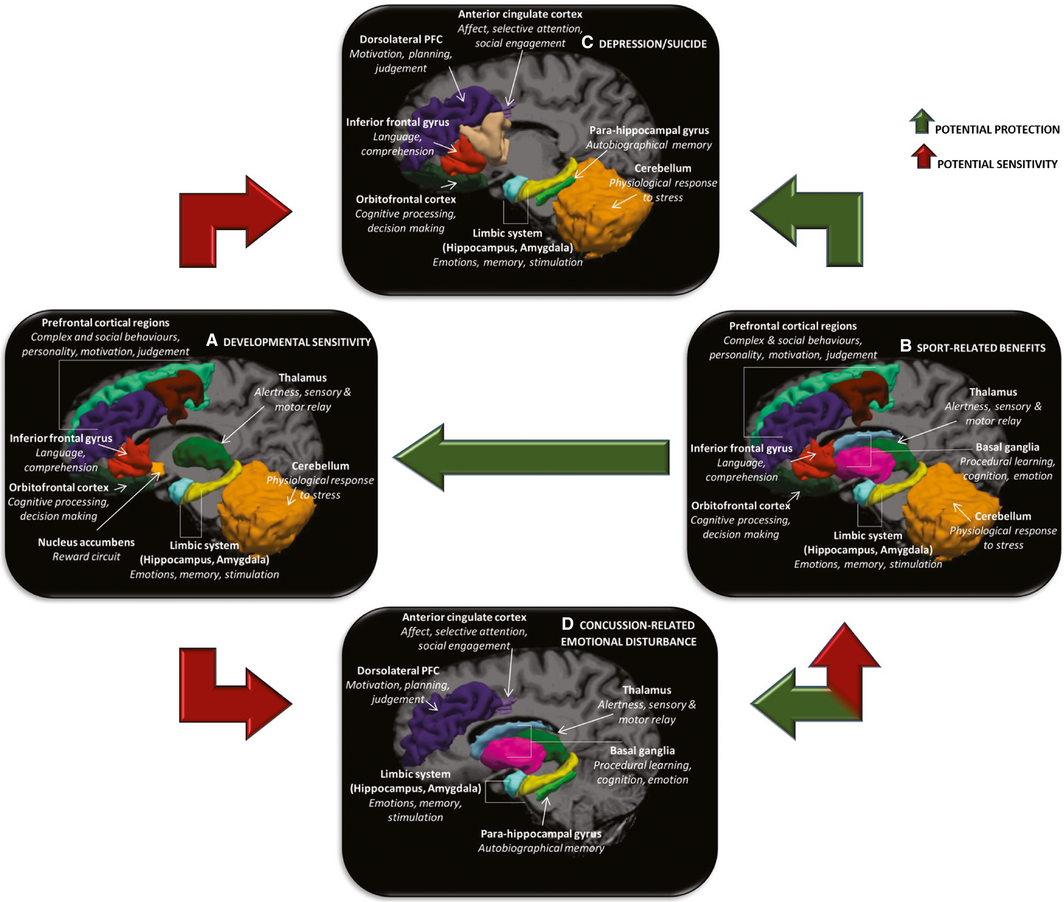
The neurophysiological overlap in the brain regions that are (A) potentially more sensitive to disruption during adolescent development and (B) those that benefit from sport participation compared with (C) depression and suicidality and (D) concussion‐related emotional disruption. Developmentally, adolescents may have a heightened sensitivity to disruptions in the dorsolateral prefrontal cortex and limbic systems, making them more susceptible to depression and suicide as well as emotional disruptions following concussion. Conversely, neurophysiological integrity may be reinforced in these regions through participation in sport. Additionally, the benefits of sport participation may support development in regions such as the cerebellum, orbitofrontal cortex, inferior frontal gyrus and thalamus. Concussive injury may, however, compromise some of the neurophysiological benefits of sport participation on regions such as the limbic system, basal ganglia and thalamus.
Competing interests
No relevant disclosures.
Acknowledgements
We thank Glenn Holmes, PhD student, Sunshine Coast Mind and Neuroscience ‐ Thompson Institute, University of the Sunshine Coast, for his input.
References
- Australian Bureau of Statistics. Causes of death, Australia, 2017 (Cat no. 3303.0). Canberra: ABS, 2018. https://www.abs.gov.au/ausstats/abs@.nsf/mf/3303.0 (viewed July 2019).
- Ostby Y, Tamnes CK, Fjell AM, et al. Heterogeneity in subcortical brain development: a structural magnetic resonance imaging study of brain maturation from 8 to 30 years. J Neurosci 2009; 29: 11772–11782.
- Keilp JG, Gorlyn M, Russell M, et al. neuropsychological function and suicidal behavior: attention control, memory and executive dysfunction in suicide attempt. Psychol Med 2013; 43: 539–551.
- Eime RM, Young JA, Harvey JT, et al. A systematic review of the psychological and social benefits of participation in sport for children and adolescents: informing development of a conceptual model of health through sport. Int J Behav Nutr Phys Act 2013; 10: 98.
- Taliaferro LA, Rienzo BA, Pigg RM, et al. Associations between physical activity and reduced rates of hopelessness, depression, and suicidal behavior among college students. J Am Coll Health 2009; 57: 427–436.
- Harrison PA, Narayan G. Differences in behavior, psychological factors, and environmental factors associated with participation in school sports and other activities in adolescence. J Sch Health 2003; 73: 113–120.
- Nelson EE, Leibenluft E, McClure EB, Pine DS. The social re‐orientation of adolescence: a neuroscience perspective on the process and its relation to psychopathology. Psychol Med 2005; 35: 163–174.
- Saraulli D, Costanzi M, Mastrorilli V, Farioli‐Vecchioli S. The long run: neuroprotective effects of physical exercise on adult neurogenesis from youth to old age. Curr Neuropharmacol 2017; 15: 519–533.
- Szuhany KL, Bugatti M, Otto MW. A meta‐analytic review of the effects of exercise on brain‐derived neurotrophic factor. J Psychiatr Res 2015; 60: 56–64.
- Cubon VA, Putukian M, Boyer C, Dettwiler A. A diffusion tensor imaging study on the white matter skeleton in individuals with sports‐related concussion. J Neurotrauma 2011; 28: 189–201.
- Gosnell SN, Velasquez KM, Molfese DL, et al. Prefrontal cortex, temporal cortex, and hippocampus volume are affected in suicidal psychiatric patients. Psychiatry Res Neuroimaging 2016; 256: 50–56.
- Chrisman SP, Richardson LP. Prevalence of diagnosed depression in adolescents with history of concussion. J Adolesc Health 2014; 54: 582–586.
- Stazyk K, De Matteo C, Moll S, Missiuna C. Depression in youth recovering from concussion: correlates and predictors. Brain Inj 2017; 31: 631–638.
- Chen JK, Johnston KM, Petrides M, Ptito A. Neural substrates of symptoms of depression following concussion in male athletes with persisting postconcussion symptoms. Arch Gen Psychiatry 2008; 65: 81–89.
- Koenigs M, Grafman J. The functional neuroanatomy of depression: distinct roles for ventromedial and dorsolateral prefrontal cortex. Behav Brain Res 2009; 201: 239–243.
Linked content
-
MJA Podcast: Dr Amanda Clacy
-
InSight+: Adolescent concussion: sport’s risks and benefits
Provenance: Not commissioned; externally peer reviewed.
Mild traumatic brain injury and concussion and persisting post‐concussion symptoms: new guidelines to support evidence‐based assessment and management in Australia and Aotearoa New Zealand
Karen M Barlow, Jennie L Ponsford, Alice Theodom, Gill Cowen, Gavin A Davis, Vicki Anderson, Franz E Babl, David Cole, Jennifer Cullen, Stuart R Dalziel, Melinda Fitzgerald, Howard Flavell, Caroline Yates, Rebecca Kimble, John H Olver, Rhonda Orr, Mark Ralfe, Michael Rose, Nick Rushworth, Julia Treleaven, Gary Browne, Nathan Delang, Sarah Harris, Gary Mitchell, Sean Tweedy
Physical activity interventions to prevent and manage type 2 diabetes in Aboriginal and Torres Strait Islander people: a systematic review
Raymond J Kelly, Rona Macniven, Leonid Churilov, Margaret J Morris, David O'Neal, Elif I Ekinci
The economics of a national anterior cruciate ligament injury prevention program for amateur football players: a Markov model analysis
Andrew Ross, Joosup Kim, Marnee McKay, Evangelos Pappas, Natalie Hardaker, Matt Whalan, Kerry Peek
Concussion in Aboriginal and Torres Strait Islander peoples: what is the true epidemiology?
Jonathan Bullen, Trish Hill‐Wall, Elizabeth Thomas, Richard Norman, Gill Cowen
Chronic traumatic encephalopathy in Australia: the first three years of the Australian Sports Brain Bank
Catherine M Suter, Andrew J Affleck, Maggie Lee, Alan J Pearce, Linda E Iles, Michael E Buckland