




Volume 211 - Issue 10
Ebola virus disease preparedness and response in Central East Africa
Author: Luke J Vos
Med J Aust 2019; 211 (10): 449-451.e1. || doi: 10.5694/mja2.50360
Published online: 21 October 2019
Published online: 21 October 2019
The current Ebola outbreak is a public health emergency of international concern, and while international risk remains low, we need to remain vigilant for symptomatic travellers
Frontline challenges in the world's second largest Ebola outbreak, with regional and global implications
As the second largest recorded Ebola outbreak passes its one‐year anniversary, sustained transmission continues, with wide national distribution and isolated instances of regional spread. The Ebola virus disease (EVD) outbreak in the Democratic Republic of the Congo (DRC) presents numerous challenges, while Ebola preparedness measures continue in surrounding nations. Since the 2013–2016 West African outbreak, advances against EVD include new management guidelines, along with extended access to vaccination and investigational therapies. On 17 July 2019, the World Health Organization declared the outbreak a public health emergency of international concern (PHEIC).1 While the risk of international spread remains low, Australia and other nations must remain vigilant in identifying symptomatic travellers with potential Ebola virus exposure.
Current situation
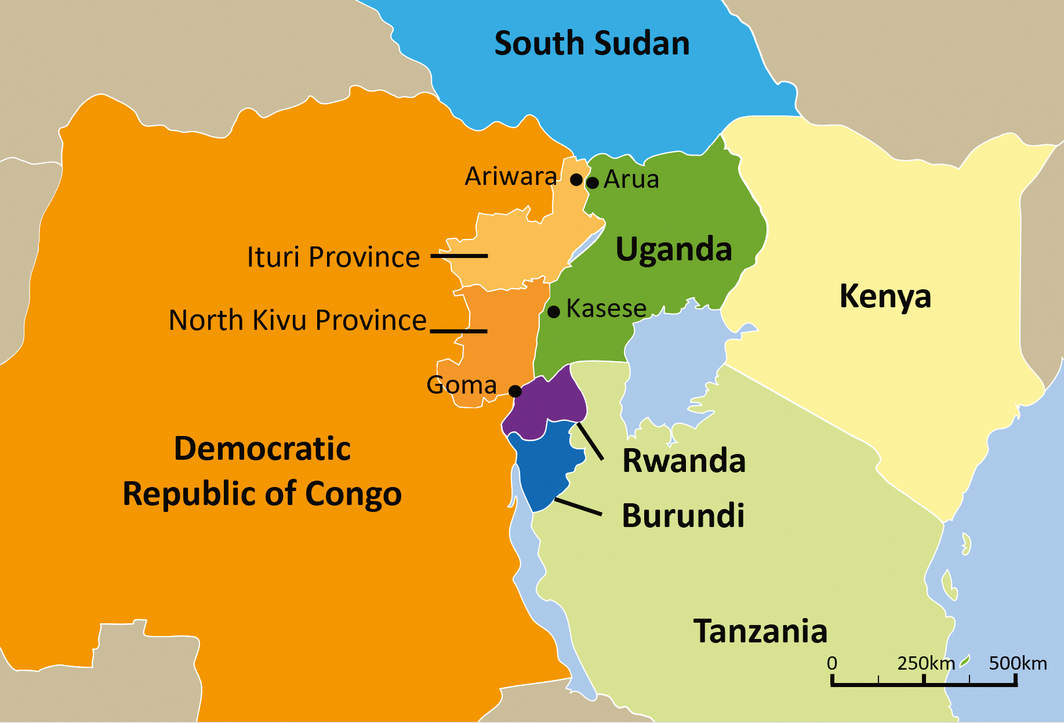
On 1 August 2018, the DRC notified the WHO of a new outbreak of EVD in North Kivu province, eastern DRC (Box). As of 25 August 2019, the WHO reported a total of 2976 cases and 1990 deaths in the DRC outbreak, with a total of 155 health care workers infected.2 Uganda identified the first instance of regional spread on 11 June 2019, with a confirmed case of EVD in Kasese district, western Uganda, with a total of three cases identified.3 Ebola preparedness efforts continue in other neighbouring countries, including South Sudan, Rwanda and Burundi. An isolated EVD case was identified on 30 June 2019 in Ariwara town, DRC, 70 km from South Sudan. This, along with a case identified on 14 July 2019 in Goma, DRC, a city bordering Rwanda, highlights the potential for further regional spread.
The DRC EVD outbreak constitutes multiple humanitarian and public health crises, with response limited by conflict, population displacement, community distrust, violence against health care workers, resource limitations, and inadequate international funding. Three mortality surveys conducted by Médecins sans Frontières in Ituri province, DRC, indicate mortality rates above emergency levels, with deaths predominately due to preventable diseases, including malaria, measles and diarrhoeal illnesses.4 In June 2019, the WHO Executive Director for Health Emergencies stated that, under a worst‐case scenario, the DRC outbreak may take a further 2 years to control.5
The apparent containment of the EVD outbreak identified in Kasese district, western Uganda, highlights the benefits of Ebola preparedness and a stable environment in outbreak response. Preparedness in Uganda has included risk communication activities, screening at points of entry, community surveillance, education and training of health care workers, infection prevention and control strengthening, provision of psychosocial support and the establishment of Ebola treatment centres. In addition, under the WHO expanded access framework, Uganda immunised 4699 health care and frontline workers with recombinant vesicular stomatitis virus (rVSV) vaccine against Zaire ebolavirus (ZEBOV) before the detection of the first EVD case.3
As an Australian trained physician working in Uganda, I have observed many of the resource limitations faced by Ugandan health care centres and hospitals. Daily challenges include lack of running water; an intermittent electricity supply; inadequate staff numbers; shortages of essential medicines, including antimalarials; and a lack of basic personal protective equipment, such as gloves and masks. A longer term focus on health system strengthening will assist in the detection and containment of future EVD outbreaks, but will also ensure a high level of preparedness to mitigate any health crisis.
On 30 June 2019, an EVD case was confirmed in Ariwara town, DRC, about 10 km from the border with Arua district, West Nile subregion, Uganda. Vaccination of health care and frontline workers with rVSV‐ZEBOV in Arua District commenced on 6 July 2019. The West Nile subregion, which until 1914 formed part of present‐day DRC, presents unique challenges. With a highly porous border making screening at all points of entry impossible, EVD case detection relies on effective surveillance and community alerts. In addition, the West Nile subregion currently hosts over 1.27 million refugees from South Sudan and DRC, with an average of 444 new arrivals per day in May 2019.6
Recent cases imported into Goma — a provincial capital with a population of over one million — cause additional concern. Goma records over 15 000 people movements into Rwanda per day and has an airport with international flights.1 However, the challenges in DRC would likely be eclipsed by those faced by health care workers should the outbreak spread to South Sudan. Civil war, mass people displacement, a shattered health care system, and poverty in South Sudan raise the prospect of widespread, uncontrolled EVD transmission.
Response advances
New developments in EVD treatment and prevention since the West African outbreak include updated management guidelines, along with extended access to vaccination and investigational therapies. In May 2019, the WHO published new clinical management standard operating procedures for the optimised supportive care of patients with EVD.7 The guidelines recommend the empirical treatment of malaria and empirical antibiotic treatment of bacterial sepsis in all patients with EVD. In addition, the guidelines emphasise regular systematic assessment of all patients with EVD and the importance of fluid, electrolyte and nutrition management. The optimised supportive care of patients with EVD improves survival, with a rate of 81.5% in 27 patients with EVD managed in the United States and Europe in 2014 and 2015.8
Four investigational treatments were employed in the DRC outbreak under the WHO ethical framework Monitored Emergency Use of Unregistered and Investigational Interventions. A multicentre, randomised controlled trial in Beni, DRC, compared the safety and efficacy of three trial agents against the triple monoclonal antibody combination ZMapp in patients with EVD. The treatment agents included mAb114 (a single monoclonal antibody), REGN‐EB3 (a triple monoclonal antibody combination), and the antiviral agent remdesivir (ClinicalTrials.gov identifier: NTC03719586).
On 9 August 2019, preliminary results from 499 participants indicated that individuals receiving REGN‐EB3 or mAb114 had a greater chance of survival compared with the other agents. Overall mortality rate was 29% for REGN‐EB3 and 34% for mAb114, compared with 49% for ZMapp and 53% for remdesivir (P = 0.002).9 An independent monitoring board recommended the trial be stopped, with all future patients to receive REGEN‐EB3 or mAb114. Despite media reports of a cure, these agents are more appropriately referred to as promising treatments. The agents act only against the ZEBOV strain and are less effective in late presenters, with the full trial results yet to be released.
While a number of vaccine candidates against EVD have been previously investigated, clinical development accelerated rapidly in the West African Ebola outbreak. Investigators in Guinea, West Africa, conducted a ring vaccination trial with rVSV‐ZEBOV between 2015 and 2016. The trial reported high vaccine efficacy (100%; 95% CI, 68.9–100; P = 0.0045), although uncertainty remains about the degree of efficacy.10 The vaccine appears well tolerated, with headache, fatigue, myalgia and arthralgia being the most commonly reported side effects.
Although presently unlicensed, under an expanded access protocol over 197 000 EVD contacts and contacts of contacts have been vaccinated in the DRC to date.2 Interim data released by the WHO in April 2019 from the current outbreak indicate 97.5% efficacy (95% CI, 95.8–98.5%).11 Health care and frontline workers in DRC, Uganda, South Sudan, Rwanda and Burundi have also received the vaccine under ongoing clinical trials. While vaccination offers an additional layer of protection, it should it not lead to complacency in infection prevention and control measures.
International concern
The West African Ebola outbreak demonstrated that high income countries remain susceptible to the importation and transmission of EVD. Since the current DRC outbreak began, the WHO Emergency Committee has met on four occasions to consider if the outbreak constitutes a PHEIC. In the most recent meeting, held on 17 July 2019, the WHO declared the DRC outbreak a PHEIC, but cautioned against applying restrictions on travel and trade.1 The committee acknowledged shortages of the rVSV‐ZEBOV vaccine and recommended working with member states and manufacturers immediately to increase supplies.
Australia has capacity to deliver acute medical relief in local and overseas disasters through multidisciplinary Australian Medical Assistance Teams (AUSMATs). However, Australia's approach to responding to international public health emergencies remains to be articulated.12 Despite the need for international investment and partnership, the past decade has seen Australia's overseas development assistance decline to 0.21% of gross national income in 2019–2020, the lowest level in over 60 years.13
Australian health systems invested substantial time, effort and financial resources on Ebola preparedness over 2013–2016.14 Given the current Central East African Ebola outbreak and unrestricted international travel, Australian health care workers must remain vigilant in identifying symptomatic travellers with potential Ebola virus exposure. In the event of the rVSV‐ZEBOV vaccine receiving licencing approval or the importation of EVD into Australia, health care and frontline workers at Ebola‐receiving hospitals in Australia should be considered for vaccination.
Conclusion
Despite advances in the armamentarium against Ebola, the challenges faced in the current DRC epidemic suggest it will require months to years to control. The risk of further regional spread is very high, while the potential for international spread, although low, persists. Integration of research into the outbreak response has enabled further assessment of investigational therapies and vaccine candidates, while contributing to disease control. It remains incumbent on the international community to commit funding to control the current outbreak, along with long term commitment to health system strengthening in resource‐poor countries.
Competing interests
No relevant disclosures.
References
- World Health Organization. Statement on the meeting of the International Health Regulations (2005) Emergency Committee for Ebola virus disease in the Democratic Republic of the Congo on 17 July 2019. 17 July 2019. Geneva: WHO, 2019. https://www.who.int/ihr/procedures/statement-emergency-committee-ebola-drc-july-2019.pdf (viewed July 2019).
- World Health Organization. Ebola virus disease, Democratic Republic of the Congo: external situation report 56. Geneva: WHO, 2019. https://apps.who.int/iris/bitstream/handle/10665/326625/SITREP_EVD_DRC_20190825-eng.pdf?sequence=1&isAllowed=y (viewed Aug 2019).
- World Health Organization. Ebola virus disease: Republic of Uganda. Geneva: WHO, 2019. https://www.who.int/csr/don/13-june-2019-ebola-uganda/en (viewed July 2019).
- Médecins sans Frontières. Urgent humanitarian response needed on unprecedented crises in northeast DRC. Geneva: MSF, 2019. https://www.msf.org/urgent-humanitarian-response-needed-unprecedented-crises-northeast-democratic-republic-congo; (viewed July 2019).
- World Health Organization. Ebola outbreak in the Democratic Republic of the Congo — 6 June 2019. Geneva: WHO, 2019. https://www.who.int/news-room/detail/06-06-2019-ebola-outbreak-in-the-democratic-republic-of-the-congo-6-june-2019 (viewed July 2019).
- United Nations High Commissioner for Refugees. Operational update: Uganda. Geneva: UNHCR, 2019. http://reporting.unhcr.org/sites/default/files/UNHCR%20Uganda%20Operational%20Update%20-%20May%202019.pdf (viewed July 2019).
- World Health Organization. Optimized supportive care for Ebola virus disease: clinical management standard operating procedures. Geneva: WHO, 2019. https://www.who.int/csr/resources/publications/optimized-supportive-care/en (viewed July 2019).
- Uyeki TM, Mehta AK, Davey RT, et al. Clinical management of Ebola virus disease in the United States and Europe. N Engl J Med 2016; 374: 636–646.
- Haelle T. Experimental Ebola drugs reduce mortality in early results. Medscape (New York) 2019; 12 Aug. https://www.medscape.com/viewarticle/916762 (viewed Aug 2019).
- Henao‐Restrepo AM, Camacho A, Longini IM, et al. Efficacy and effectiveness of an rVSV‐vectored vaccine in preventing Ebola virus disease: final results from the Guinea ring vaccination, open‐label, cluster‐randomised trial (Ebola Ça Suffit!). Lancet 2017; 389: 505–518.
- World Health Organization. Preliminary results on the efficacy of rVSV‐ZEBOV‐GP Ebola vaccine using the ring vaccination strategy in the control of an Ebola outbreak in the Democratic Republic of the Congo: an example of integration of research into epidemic response. Geneva: WHO, 2019. https://www.who.int/csr/resources/publications/ebola/ebola-ring-vaccination-results-12-april-2019.pdf (viewed July 2019).
- Rosewell A, Effler P, Yapa C, et al. Ebola outbreak in West Africa: considerations for strengthening Australia's international health emergency response. Med J Aust 2016; 204: 258–259. https://www.mja.com.au/journal/2016/204/7/ebola-outbreak-west-africa-considerations-strengthening-australias-international.
- Pryke J. Budget 2019: the race to the bottom for foreign aid. Sydney: Lowy Institute, 2019. https://www.lowyinstitute.org/the-interpreter/budget-2019-aid-downward-trend; (viewed July 2019)
- Gilbert GL. Australia's response to Ebola virus disease in West Africa, 2014–2015. Public Health Res Pract 2016; 26: e2651661.
Provenance: Not commissioned; externally peer reviewed.
Costs of Delivering the Hep B PAST Model of Care in Remote Australia: A Retrospective Pre–Post Study
Hoa Nguyen, Anh Le Tuan Nguyen, Paula Binks, Melita McKinnon, Emily Vintour-Cesar, Karen Wills, Nicola Stephens, Benjamin Cowie, Joshua S. Davis, Yuejen Zhao, Peter Nihill, Julie A. Campbell, Andrew J. Palmer, Jane Davies, Barbara de Graaff
Buruli Ulcer Acquired From Ringtail Possum Rescue
Daniel P. O'Brien, Naomi Clarke, Sara Bonnici, Mohammad A. Hussain
Q Fever Visceral Abscesses After Contact With Native Australian Marsupials
Samantha J. Laws, Enzo Binotto, James Stewart, Jennifer Ho, Trent Yarwood, Josh Hanson, Simon Smith
Hospital-Admitted Injection-Related Infections Among Incarcerated People Who Inject Drugs in Australia: A Retrospective Cohort Study
Andrew Palmer, Matthew Carter, Jeremy Yeo, Cecilia Shim, Jason Connor, Jeremy Hayllar, Gerald Holtmann, Naomi Moy, Elliott G. Playford, Naomi Runnegar, Paul J. Clark
The Live Attenuated Influenza Vaccine in Australia: An Additional Tool for Influenza Prevention
Cyra Patel, Alexis Pillsbury, Tran Nguyen, Xia Wang, Helen E. Quinn, Clayton K. Chiu, Allen C. Cheng, Katie L. Flanagan, Zhicheng Wang
Reflex Testing for Hepatitis D Infection: A Unique Opportunity to Reduce Hepatitis D-Related Chronic Liver Disease Deaths in Australia
Jessica Howell, Lauren Andersson, Miriam T. Levy, James O'Beirne, Leon Adams, Katharine Irvine, Avik Majumdar, Golo Ahlenstiel, Kathy Jackson, Krispin Hajkowicz, Joseph Doyle, Jane Davies, Sarah Cherian, Wayne Dimech, Alexander J. Thompson