




Volume 209 - Issue 10
Deprescribing proton pump inhibitors: why, when and how
Author: Peter Bytzer
Med J Aust 2018; 209 (10): 436-438. || doi: 10.5694/mja18.00674
Published online: 12 November 2018
Published online: 12 November 2018
The focus should primarily be on avoiding unnecessary long term prescribing of PPIs
The focus should primarily be on avoiding unnecessary long term prescribing of PPIs
For more than 25 years, proton pump inhibitors (PPIs) have been the mainstay of therapy for acid-related disorders, particularly peptic ulcer disease and gastro-oesophageal reflux disease (GORD). In recent decades, prescribing of PPIs has increased considerably around the world. According to a recent national drug utilisation study, prescribing of PPIs increased fourfold in Denmark between 2002 and 2014, with the increase particularly marked among older patients; 7% of all adults and 14% of adults over 60 were covered by PPI prescriptions.1 The increased prescribing of PPIs is driven primarily by the accumulation of existing users rather than by new users; inappropriate prescribing and long term use, rather than genuine clinical need for ulcer prophylaxis, appear to underlie the high prevalence of PPI prescribing.2 Changes to public subsidisation of PPI costs and interventions for improving adherence to guidelines and promoting the rational use of PPIs have not had a substantial influence on prescribing patterns.
PPIs are generally perceived as very safe drugs with only minor side effects. However, observational studies have reported a variety of possible consequences of long term use.3 Many potential associations reported in the popular media, including dementia, acute and chronic kidney disease, and gastric and colorectal cancer, have worried patients and their prescribers, despite the limited evidence for a causal link with PPI use. Critical reviews of the safety of long term PPI therapy have, however, concluded that some reported associations are significant, including those with hypomagnesaemia, increased frequency of some bacterial enteric infections (eg, Clostridium difficile), and possibly a small rise in the risk of fracture. Concern about complications of PPI therapy should therefore be focused on patients who are older, malnourished, or have other serious medical conditions.4 Nevertheless, the benefits and appropriateness of PPI therapy need to be considered alongside the potential long term risks.
Initiatives for assessing the appropriateness of these drugs are therefore warranted. Unfortunately, there are no guidelines or international consensus about how best to discontinue PPI therapy or to reduce excessive or unnecessary prescribing. Complete resolution of symptoms with PPI therapy is difficult in many patients, even in those with clearly acid-related symptoms.
The risk of rebound hypersecretion and the evidence supporting tapering as a withdrawal strategy
Placebo-controlled clinical trials have indicated that new acid-related symptoms develop in asymptomatic volunteers after ending 4–8 weeks of PPI administration, but the clinical implications of acid rebound hypersecretion after discontinuing PPIs are still unclear.5 Nevertheless, clinicians should be cautious about reinstating empiric PPI therapy for an uncertain indication for more than a few weeks, as it can lead to unnecessary long term use. When discontinuing PPI therapy, a longer period of tapering might be useful (4–8 weeks) to avert symptomatic acid rebound and the need to reinstitute PPI therapy after withdrawal. This recommendation, however, is based on physiological data, not clinical evidence.
Given the extensive prescribing of PPI therapy, surprisingly few discontinuation studies have been published. A recent systematic review6 identified six clinical studies, with interventions ranging from patient education to abrupt withdrawal; rates of successful discontinuation ranged from 14%7 to 64%.8 Two trials employed a tapering or step-down approach, each primarily for patients with reflux symptoms. In the first,9 a Swedish study of patients with normal gastroscopy, the discontinuation rate for patients in whom PPI use was tapered over 2 or 3 weeks was higher at 12 months than for those who had stopped abruptly (31% v 22%). In the second,10 a non-randomised study in the United States, 58% of participants were asymptomatic without PPI therapy after one year of follow-up, but three-quarters of these patients required either H2 receptor antagonists or prokinetic drugs for symptom relief.
Recommendations for discontinuing proton pump inhibitor therapy
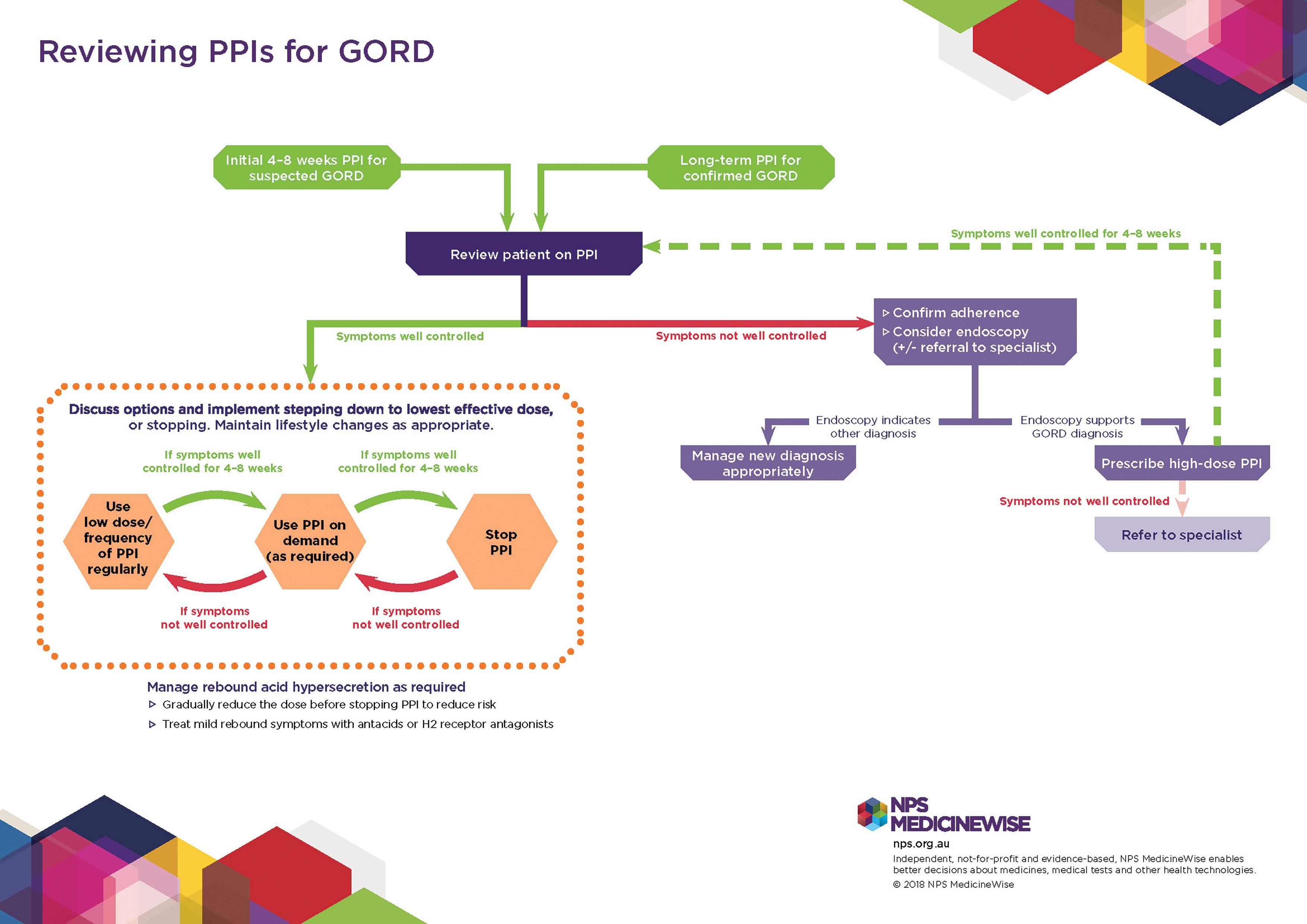
The Australian algorithm for reviewing PPI therapy for patients with GORD provides useful guidance for patients with reflux symptoms (Box).11 The approach we recommend for patients with reflux symptoms, including those diagnosed with GORD, is as follows.
Before prescribing and when deciding whether to stop PPI therapy, we explain to patients that most people should take PPIs for only 4–8 weeks, and are careful to encourage realistic expectations about the benefits of therapy. If symptoms are well controlled after 4–8 weeks, tapering the dose over a similar period and then stopping should be considered. We explain that some people experience unpleasant symptoms during the first few weeks after stopping PPI therapy; their impact on everyday activities should be discussed, as many patients will accept mild residual symptoms. These symptoms, which may be related to acid rebound and will cease within a few weeks, should be treated with antacids, alginates or H2 receptor antagonists before deciding to re-start PPI therapy.
If symptoms are not well controlled by PPI treatment, it is reasonable to perform a gastroscopy. If erosive disease is present in a patient with GORD, PPI therapy should not be discontinued, but adherence should be checked or high dose PPI therapy considered (usually twice daily, before meals).
Any recurrence of symptoms should be discussed with the patient during a review 4 weeks after stopping PPI therapy.
For patients who develop mild intermittent symptoms after ending PPI therapy, lifestyle modifications and treatment with antacids and H2 receptor antagonists, or on-demand PPI therapy (which may reduce PPI intake by 60–75%12) are usually adequate for relief. For patients with more severe intermittent symptoms, low dose PPI therapy (10–20 mg daily) is appropriate. The medication needs of patients who require long term PPI therapy (eg, because of long term non-steroidal anti-inflammatory drug use or chronic severe reflux symptoms) and any associated adverse effects should be reviewed periodically.
If patients do not benefit from initial empiric PPI therapy, it should be discontinued and the patient referred for endoscopy. Patients with symptoms that are not acid-related (such as nausea, bloating, or diffuse abdominal pain) rarely benefit from PPI therapy; any response is likely to be a placebo effect.
Reinstitution of PPI therapy is particularly common for patients with reflux symptoms. This is not surprising, given the chronic nature of the underlying disease (GORD) and the good symptomatic response to PPIs when reflux symptoms recur. Our focus as prescribers should primarily be on avoiding unnecessary long term prescribing, especially for patients who commenced PPI therapy for inappropriate reasons.
Competing interests
No relevant disclosures.
References
- Pottegård A, Broe A, Hallas J, et al. Use of proton-pump inhibitors among adults: a Danish nationwide drug utilization study. Therap Adv Gastroenterol 2016; 9: 671-678.
- Batuwitage BT, Kingham JG, Morgan NE, Bartlett RL. Inappropriate prescribing of proton pump inhibitors in primary care. Postgrad Med J 2007; 83: 66-68.
- Vaezi, MF, Yang YX, Howden CW. Complications of proton pump inhibitor therapy. Gastroenterology 2017; 153: 35-48.
- Reimer C. Safety of long-term PPI therapy. Best Pract Res Clin Gastroenterol 2013; 27: 443-454.
- Lødrup AB, Reimer C, Bytzer P. Systematic review: symptoms of rebound acid hypersecretion following proton pump inhibitor treatment. Scand J Gastroenterol 2013; 48: 515-522.
- Haastrup P, Paulsen MS, Begtrup LM, et al. Strategies for discontinuation of proton pump inhibitors: a systematic review. Fam Pract 2014; 31: 625-630.
- Reimer C, Bytzer P. Discontinuation of long-term proton pump inhibitor therapy in primary care patients: a randomized placebo-controlled trial in patients with symptom relapse. Eur J Gastroenterol Hepatol 2010; 22: 1182-1188.
- Murie J, Allen J, Simmonds R, de Wet C. Glad you brought it up: a patient-centred programme to reduce proton-pump inhibitor prescribing in general medical practice. Qual Prim Care 2012; 20: 141-148.
- Björnsson E, Abrahamsson H, Simrén M, et al. Discontinuation of proton pump inhibitors in patients on long-term therapy: a double-blind, placebo-controlled trial. Aliment Pharmacol Ther 2006; 24: 945-954.
- Inadomi, JM, Jamal R, Murata GH, et al. Step-down management of gastroesophageal reflux disease. Gastroenterology 2001; 121: 1095-1100.
- National Prescribing Service. Reviewing PPIs for GORD. June 2018. https://cdn0.scrvt.com/08ab3606b0b7a8ea53fd0b40b1c44f86/c052d66150fd152a/df9dd3c72fab/Reviewing-PPIs-for-GORD-algorithm-June-2018.pdf (viewed July 2018).
- Bytzer P. Goals of therapy and guidelines for treatment success in symptomatic gastroesophageal reflux disease patients. Am J Gastroenterol 2003; 98(3 Suppl): S31-S39.
Linked content
-
MJA Podcast: Professor Peter Bytzer
-
MJA InSight: Proton pump inhibitors: safe, effective … overused
Provenance: Commissioned; externally peer reviewed.
Intranasal Adrenaline Use for the Management of Insect Venom-Induced Anaphylaxis
Thomas J. Young, Wilhelmina R. F. Johnson, Braydon L. Pennington, Troy Wanandy, Wun Y. Lau, Thanh-Thao A. Le
Gabapentinoid Poisoning Presentations to Victorian Emergency Departments: A 15-Year Trend Analysis
Bishaal Tej Gurung, Amy McNeilage, Angus Skeen, Tina Lam, Joanna F. Dipnall, Jane Hayman, Suzanne Nielsen, Ting Xia
Still Treating Yesterday's Risk? Reconsidering Antiviral Use for Mild-to-Moderate COVID-19 Cases in a Broadly Immune Population
Hadar Mudrik-Zohar, Tim Cutfield, Susan Morpeth, Thomas Hills, Eamon Duffy, Laura J. Edwards, Allen C. Cheng, Steven Y. C. Tong
Birth prevalence, clinical sequelae, and management of congenital cytomegalovirus infections in Australia, 1999–2023: a national prospective study
Ece Egilmezer, Suzy M Teutsch, Carlos Nunez, Stuart T Hamilton, Adam W Bartlett, Pamela Palasanthiran, Elizabeth J Elliott, William D Rawlinson
Concurrent use of hormonal long‐acting reversible contraception by women of reproductive age dispensed teratogenic medications, Australia, 2013–2021
Aaron E Boyce, Tony Caccetta, Jo‐Ann See, Rosemary L Nixon AM
Concurrent use of hormonal long‐acting reversible contraception by women of reproductive age dispensed teratogenic medications, Australia, 2013–2021
Michelle KY Chen, Adrian Lim, Deshan F Sebaratnam