




Volume 208 - Issue 1
Nicotine replacement therapy for smoking cessation during pregnancy
Authors: Yael Bar-Zeev, Ling Li Lim, Billie Bonevski, Maree Gruppetta and Gillian S Gould
Med J Aust 2018; 208 (1): 46-51. || doi: 10.5694/mja17.00446
Published online: 4 December 2017
Published online: 4 December 2017
All pregnant women who smoke should be offered NRT
Summary
- Nicotine replacement therapy (NRT) is recommended in current Australian clinical guidelines for pregnant women who are unable to quit smoking unassisted.
- Clinicians report low levels of prescribing NRT during pregnancy, due to safety concerns and low levels of confidence in their ability to prescribe NRT.
- Animal models show that nicotine is harmful to the fetus, especially for brain and lung development, but human studies have not found any harmful effects on fetal and pregnancy outcomes.
- Studies of efficacy and effectiveness in the real world suggest that NRT use during pregnancy increases smoking cessation rates. These rates may be hampered by the fact that studies so far have used an NRT dose that does not adequately account for the higher nicotine metabolism during pregnancy and, therefore, does not adequately treat withdrawal symptoms.
- Further research is needed to assess the safety and efficacy of higher dosages of NRT in pregnancy, specifically of combination treatment using dual forms of NRT.
- As NRT is safer than smoking, clinicians need to offer this option to all pregnant women who smoke. A practical guide for initiating and tailoring the dose of NRT in pregnancy is suggested.
Smoking during pregnancy is the most important preventable risk factor for poor maternal and infant health outcomes. In 2014, 11% of women who gave birth in Australia smoked at some point of their pregnancy, and smoking rates during pregnancy were higher for specific vulnerable populations, such as Aboriginal and Torres Strait Islander women (45%).1
Behavioural counselling combined with medication is the most effective smoking cessation strategy.2 In pregnant women who smoke, studies have shown counselling alone to be effective.3 Medications such as varenicline and bupropion are not recommended during pregnancy,4 and the use of nicotine replacement therapy (NRT), while well supported and safe for the general population,5 remains controversial for use during pregnancy because nicotine crosses the placenta and may accumulate in the amniotic fluid.6 Thus, it is important to gather evidence regarding the benefits and potential harms of NRT for pregnant women.
In a recent survey of Australian general practitioners and obstetricians, 25% of participants stated that they never prescribe NRT during pregnancy.7 These findings mirror surveys from the United Kingdom,8 New Zealand9 and the United States.10 The most frequently cited barriers are low confidence in the ability to prescribe NRT and safety concerns.8,10
The aim of this narrative review is to provide an overview of current guidelines regarding NRT use in pregnancy, considering the existing evidence base on safety, efficacy and effectiveness. In addition, we outline pragmatic suggestions for clinical practice and implications for policy and future research.
Method
For current guidelines, we performed online searches using Google and the keywords “smoking cessation”, “guidelines” and “name of country”. We included national guidelines from high income countries (eg, Australia, UK, US, Canada and New Zealand) published in English from the year 2010 onward.
We conducted MEDLINE searches on NRT safety, efficacy and effectiveness, using the Medical Subject Headings and keywords “nicotine”, “nicotine replacement therapy”, “fetal” and “pregnancy” — limited to the English language with no limit on the years. Previous reviews were manually searched to identify further studies. We included both observational and interventional studies that aimed to specifically assess either the safety or efficacy of NRT during pregnancy. Studies that included NRT as part of a multicomponent intervention were excluded, as their design does not permit determining the effect of NRT alone.
To provide a full overview, we also include a short summary of findings previously published from animal models studying the effects of nicotine on fetal development.
Current guidelines for the use of nicotine replacement therapy during pregnancy
Although all clinical guidelines on the use of NRT during pregnancy acknowledge that there is insufficient evidence to firmly conclude whether NRT in pregnancy is safe or effective, national guidelines from Australia,4 the UK,11 New Zealand12 and Canada13 recommend the use of NRT by pregnant women who have been unable to quit smoking without medication (Box 1). However, many of the guidelines impose caveats such as “only if women are motivated”, “only give out 2 weeks’ supply” or “under close supervision”.
In Australia, the Royal Australian College of General Practitioners has published the only comprehensive national guidelines on the use of NRT during pregnancy,4 which recommend initiating NRT in pregnant women who are motivated to quit smoking and have been unsuccessful without medication. NRT should be offered after discussing the relative risks and benefits, and prescribed under supervision of the treating clinician. These guidelines recommend initiating treatment using oral forms of NRT, which are considered to deliver a lower total dose of nicotine compared with a patch.4,5 In the event that the pregnant woman is still unsuccessful at quitting smoking, clinicians should consider adding a nicotine patch (ie, combination treatment).4 The Royal Australian and New Zealand College of Obstetricians and Gynaecologists has also issued recommendations regarding smoking cessation during pregnancy, and even though their statement takes a more conservative approach, it acknowledges that NRT may reduce the risk to the fetus in pregnant women who continue to smoke heavily.14
Animal models: effects of nicotine on fetal development
The most established evidence from animal models shows derangement in central nervous system and pulmonary development.18 Nicotine binds to the nicotinic acetylcholine receptors located in the central nervous system.19 Rat models indicate that prenatal nicotine exposure damages the developing brain by triggering apoptosis, reducing the number of neuronal cells and disturbing the genesis of axons and synapses. Chronic nicotine exposure in utero leads to changes in neuronal architecture, nicotinic acetylcholine receptor expression and the function of other neurotransmitter systems, including dopamine, noradrenaline and serotonin.20,21
Nicotine also causes developmental anomalies in the lungs in animal models; for example, non-human primates exposed to nicotine in utero have decreased lung size and volume.22 Histopathological analysis has shown a reduced alveolar surface area, enlarged respiratory airspaces23 and thickened alveolar walls.24 These changes lead to impaired ability to adequately oxygenate blood.25 Moreover, prenatal nicotine exposure also decreases pulmonary compliance and forced expiratory flow26 and increases airway resistance.27 It should be noted that most of these animal studies used a continuous form of nicotine delivery,26,27 and it is not clear how directly transferable the findings from animal studies are to humans.28
Safety and efficacy of nicotine replacement therapy in human studies
The safety and efficacy of NRT during pregnancy has been studied in both observational and intervention studies (Appendix).
Observational studies
A UK population-based cohort study of 192 498 live births29 examined the association between early pregnancy NRT exposure and major congenital anomalies; the study found no statistically signi?cant increased risk for either the NRT group (n = 2677) v non-smokers (n = 17 9841) (odds ratio [OR], 1.12; 99% confidence interval [CI], 0.84–1.48) or the NRT group v smokers not receiving NRT (n = 9980) (OR, 1.07; 99% CI, 0.78–1.47). Examining system-specific anomalies, there were no significant increased risks except for respiratory anomalies, but the authors caution that this is based on small numbers of exposed cases.29 A smaller Danish study30 found similar results when restricting their analysis, comparing NRT users (n = 250) with non-smokers (n = 55 915), to major anomalies (OR, 1.13; 95% CI, 0.62–2.07); however, when including minor anomalies, NRT use was significantly associated with a higher rate of anomalies (OR, 1.61; 95% CI, 1.01–2.58). A similar study from this cohort31 did not find an association between using NRT and the rate of stillbirth (hazard ratio, 0.57; 95% CI, 0.28–1.16).
Another Danish population-based cohort study32 found that the use of NRT during the first 27 weeks of pregnancy was not significantly associated with changes in mean birth weight (mean change, 0.25 g per week of NRT use; 95% CI, -2.31 to 2.81). The use of more than one product in the same week was associated with a decrease in mean birth weight, but this was not statistically significant (mean change, -10.73 g per week of NRT use; 95% CI, -26.51 to 5.05).32
A UK cohort study,33 including 3880 pregnant women who attended smoking cessation services, found that combination NRT (patch plus an oral form) was associated with significantly higher cessation rates (OR, 1.93; 95% CI, 1.13–3.29), but that the use of only one NRT form was not associated with an increased cessation rate (OR, 1.06; 95% CI, 0.60–1.86).
Randomised controlled studies
To date, there have been five double-blind placebo-controlled studies34-38 and three non-placebo-controlled studies39-41 on the safety and efficacy of NRT in pregnancy (Appendix). The most recent 2015 Cochrane meta-analysis,42 which included all these eight studies (n = 2199 pregnant women), found that NRT use significantly increased the smoking cessation rate by 40% (relative risk [RR], 1.41; 95% CI, 1.03–1.93). Restricting the meta-analysis to only placebo-controlled studies (five studies, n = 1926) resulted in a lower, not significant cessation rate of 28% (RR, 1.28; 95% CI, 0.99–1.66).
No significant differences in health and safety outcomes were found in the Cochrane meta-analysis.42 Data from four studies34-36,40 were pooled together — with over 1700 women — showing no significant differences in the risk of miscarriage or spontaneous abortion (RR, 1.47; 95% CI, 0.45–4.77), stillbirth (RR, 1.24; 95% CI, 0.54–2.84), neonatal intensive care unit admissions (RR, 0.90; 95% CI, 0.64–1.27) and neonatal death (RR, 0.66; 95% CI, 0.17–2.62). Two studies34,35 — with 1401 women — provided data for the pooled estimate of congenital anomalies and caesarean delivery, showing no significant difference (RR, 0.73; 95% CI, 0.36–1.48; and RR, 1.18; 95% CI, 0.83–1.69, respectively); and six studies34-36,38-40 provided data for the pooled estimate of preterm birth (RR, 0.87; 95% CI, 0.67–1.14) with no significant difference.
The largest randomised placebo-controlled trial34 included 1050 pregnant women, of whom 521 were randomised to receive a 15 mg per 16 hours patch. This study found favourable results after one month of treatment (21.3% biochemically validated abstinence rate in the NRT group and 11.7% in the placebo group; adjusted OR, 2.1; 95% CI, 1.49–2.97), but these results were not sustained at delivery (9.4% NRT and 7.6% placebo; adjusted OR, 1.27; 95% CI, 0.82–1.98). Adherence was problematic, with few participants using NRT for more than 4 weeks, and there were no statistically significant differences in any pregnancy or birth safety outcomes.34 This was the only study to follow infants for 2 years after delivery.43 Infants born to mothers who received NRT had a significantly higher rate of unimpaired development, regardless of the mothers’ smoking status (73% NRT group and 65% placebo group; OR, 1.4; 95% CI, 1.05–1.86). The results suggest a dose–response relation with no difference in impairment rates between women using one to ten patches during pregnancy and those not using patches, but they suggest a significant difference between women using 11–56 patches (OR, 1.72; 95% CI, 1.22–2.57).43
Almost all of the trials34,37,38,41 (Appendix) used a fixed dosage regardless of the woman’s smoking and tobacco dependence level. Taking into account the higher metabolism of nicotine in pregnancy,44 this may have led to insufficient dosage to adequately treat withdrawal symptoms.42,44 The most recent randomised placebo-controlled study35 adjusted the dosage of the patch according to the woman’s baseline cotinine level (a metabolite of nicotine). Women in the NRT group in this study received on average a slightly higher mean daily dose (18 mg) compared with the 15 mg patch used in other studies — with 25% receiving 25–30 mg daily — for a longer duration (median prescription length, 105 days), and there was a high compliance rate (85%). Despite this, the validated abstinence rate at delivery was low and similar between the NRT (5.5%) and placebo groups (5.1%) (OR, 1.08; 95% CI, 0.45–2.6).35 However, the conversion ratio used to determine the nicotine dose was not modified for pregnancy, and was based on studies with non-pregnant participants,45 suggesting that participants did not receive an adequate dosage.45
Only one randomised placebo-controlled study (n = 194) used 2 mg nicotine gum (and not a patch) in the intervention group (n = 100), allowing up to 20 doses of gum per day.36 Treatment was continued even if the women had not quit smoking, with the gum being used to reduce the overall number of cigarettes smoked. This study did not find any significant treatment effect, with point prevalence abstinence rates similar between the two groups at 6 weeks after treatment (13% NRT group and 9.6% placebo group; P = 0.45) and at 32–34 weeks gestation (18% v 14.9%; P = 0.56).36 However, birth weight (NRT group, 3287 g; standard deviation [SD], 566 g; placebo group, 2950 g; SD, 653 g; P < 0.001) and gestational age (NRT group, 38.9 weeks; SD, 1.7 weeks; placebo group, 38 weeks; SD, 3.3 weeks; P = 0.014) were significantly greater in the NRT group.36 Moreover, rates of preterm birth (NRT group, 7.2%; placebo group, 18%; P = 0.027) and low birth weight (< 2500 g) (NRT group, 2%; placebo group, 18%; P < 0.001) were both significantly higher in the placebo group.36
The limitations of many of the trials include low adherence to NRT, resulting in most women not receiving the intended dose, and NRT dosage not adjusted to the increased nicotine metabolism during pregnancy (Appendix). None of the studies assessed smoking withdrawal symptoms in order to adjust the dosage accordingly. The hypothesis that the dosage was not sufficient to treat withdrawal symptoms is supported by the findings from several trials that compared cotinine levels at baseline and during treatment with NRT patches.37,41,46 These studies showed that cotinine levels were lower during treatment than at baseline (when women were still smoking).
Discussion
In summary, this narrative review found that in animal models, nicotine has been found to be harmful for the fetus, especially for brain and lung development. Human studies, however, did not find any harmful effects on fetal and pregnancy outcomes compared with placebo, but the evidence is limited due to the small numbers of participants in the meta-analysis.42 In addition, efficacy studies suggest that NRT increased smoking cessation rates overall, but this effect is not statistically significant for the more rigorous placebo-controlled trials. Nevertheless, one observational study using real world data shows promising results, specifically for NRT combination treatment, but studies so far have used an NRT dose that does not adequately account for the higher nicotine metabolism during pregnancy.
Pragmatic suggestions for clinical practice
Confidence in prescribing NRT and actual practices may be low due to the conflicting messages and different restrictions mentioned in the guidelines, particularly since they do not offer a detailed practical clinical protocol that includes clear instructions for NRT use in pregnant women.
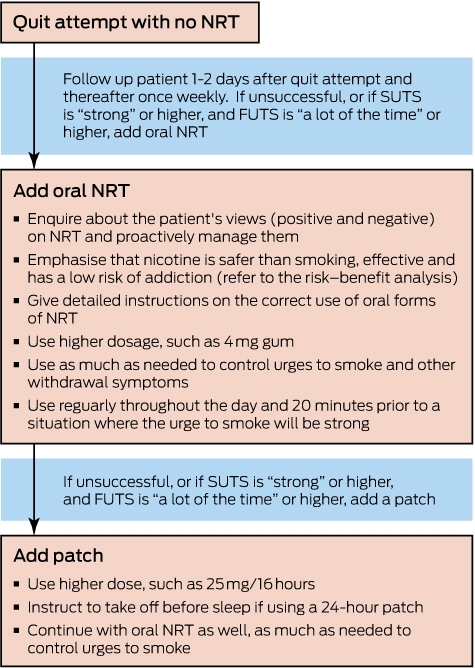
Box 2 offers a practical detailed approach to initiating and managing NRT during pregnancy. As many pregnant women reduce on their own the number of cigarettes they smoke,48 using measures that rely on number of cigarettes per day may be less effective. We suggest using the strength of urges to smoke (SUTS)49 and the frequency of urges to smoke (FUTS) scales50 as practical guides to the decision to initiate or increase the NRT dose:
-
SUTS — “in general, how strong have the urges to smoke been in the past 24 hours?” “Slight”, “moderate”, “strong”, “very strong” or “extremely strong”; and
-
FUTS — “how much of the time have you felt an urge to smoke in the past 24 hours?” “Not at all”, “a little of the time”, “some of the time”, “a lot of the time”, “almost all of the time” and “all of the time”.
If the women report experiencing strong or frequent (“a lot of the time”) urges to smoke, this suggests the need for additional support.
The most important guidance for NRT in pregnancy is to use the lowest possible dose that is effective. However, to be effective, women should be instructed to use as much as needed to deal with cravings. Physicians should encourage using oral NRT regularly throughout the day to substitute for cigarettes; for example, a woman smoking ten cigarettes a day should be instructed to use one piece of gum every 1.5 hours regularly, even if she is not experiencing a strong craving at this time. In addition, physicians should encourage the use of oral NRT in anticipation of cravings; if a woman knows she is going to be in a situation where the urge to smoke will be strong (eg, going out with friends who smoke), doctors should encourage the use of oral NRT 20 minutes beforehand. Physicians should proactively review the SUTS and FUTS on a weekly basis and adjust dosage as needed. Further, women should be encouraged to use NRT for at least 12 weeks, or longer if required, in order not to relapse. This practical approach is currently being tested as part of a multicomponent intervention in a pilot study.51
Risk versus benefit
Nicotine may not be completely safe for the pregnant mother and fetus, but it is always safer than smoking. A risk and benefit analysis needs to be done to help pregnant women (and their partners) judge whether to use a clean source of nicotine such as NRT, which might help cessation, and whether this is preferable to continuing exposure to the nicotine and other chemicals present in combustible cigarettes. The context of using NRT in pregnancy is always within a smoking cessation attempt, which means that it is used by women who are already exposed to higher levels of nicotine and other products of combustion from smoking. Box 3 offers suggestions to aid the risk versus benefit analysis discussion.47
Implications for policy and future research
Reports from specialised smoking cessation services with trained counsellors in England52 and Scotland53 show that NRT is routinely prescribed during pregnancy — in England, 87% of smoking cessation services offer combination NRT in pregnancy.52 Pregnant women are routinely referred to these services, highlighting not only the importance of additional training for health providers to increase their confidence and skills but also the question of whether the health system should be offering pregnant women access to specialised cessation support. The findings of Bar-Zeev and colleagues7 provide further support for the importance of these services showing that referral is practised more frequently by Australian GPs and obstetricians than prescribing NRT. Even though all Australian states and territories offer the Quitline service, it is still underutilised.54 More research is needed on how to increase the acceptability and usability of the Quitline and whether other options such as specialised smoking cessation clinics should be available.
Moreover, further research is needed to assess the safety and efficacy of higher dosages of NRT in pregnancy, specifically combination treatment, and also to evaluate the safety and efficacy of using NRT as a harm reduction strategy for women who are unmotivated to quit smoking, in order to reduce or eliminate exposure to cigarette smoke during pregnancy.
Conclusions
Ambiguous messages may be contributing to the low NRT prescribing rates and, therefore, it is important to provide a clear practical message to health practitioners and women. It is our duty as clinicians to interpret the evidence, deal with uncertainty and be able to provide pregnant women with information that will allow them to make an informed decision. Clinicians need to offer pregnant women the option of receiving NRT in a timely fashion if they cannot quit smoking on their own. In this review, we offered a practical guide on how the risks versus benefits of NRT use during pregnancy could be articulated, and how and when to decide whether to use or increase NRT during pregnancy. More education and training is required to improve clinicians’ confidence and skills, and better referral pathways, including specialised smoking cessation services, need to be in place to help pregnant women to quit smoking.
Box 1 – Summary of current international guidelines for the use of nicotine replacement therapy (NRT) during pregnancy
|
Organisation, year updated |
Key points |
||||||||||||||
|
|
|||||||||||||||
|
RACGP, 20144 |
|
||||||||||||||
|
RANZCOG, 201414 |
|
||||||||||||||
|
NICE, 2010 (update to be released March 2018)11 |
|
||||||||||||||
|
New Zealand Ministry of Health, 201412 |
|
||||||||||||||
|
CAN-ADAPTT, 201113 |
|
||||||||||||||
|
USPSTF, 201515 |
|
||||||||||||||
|
ACOG, 201516 |
|
||||||||||||||
|
WHO, 201317 |
|
||||||||||||||
|
|
|||||||||||||||
|
ACOG = American College of Obstetricians and Gynecologists. CAN-ADAPTT = Canadian Action Network for the Advancement, Dissemination and Adoption of Practice-informed Tobacco Treatment. NICE = National Institute for Health and Care Excellence. RACGP = Royal Australian College of General Practitioners. RANZCOG = Royal Australian and New Zealand College of Obstetricians and Gynaecologists. USPSTF = United States Preventive Services Task Force. WHO = World Health Organization. |
|||||||||||||||
Box 2 – Suggested approach to initiating and managing nicotine replacement therapy (NRT) during pregnancy47
FUTS = frequency of urges to smoke. SUTS = strength of urges to smoke.
Box 3 – Suggested approach to a risk v benefit discussion with a pregnant woman who smokes47
|
Risks |
|||||||||||||||
|
|
|||||||||||||||
|
Nicotine has been linked to harmful effects on the fetus in animal studies:19
|
|||||||||||||||
|
We do not know for sure how the data from animal studies can be transferred to humans28 |
|||||||||||||||
|
Studies with nicotine from NRT use in pregnant women (> 2000 women) have not shown NRT to cause any harm to the women or the baby42 |
|||||||||||||||
|
Benefits |
|||||||||||||||
|
|
|||||||||||||||
|
NRT has only nicotine in it, and none of the other 7000 chemicals also found in a cigarette (300 known to be toxic and harmful, 52 known to cause cancer)5,42 |
|||||||||||||||
|
|
|||||||||||||||
|
Nicotine from NRT is absorbed at a slower and lower rate compared with nicotine from a cigarette. This means that if you use NRT, you are actually receiving less nicotine than when you smoke5 |
|||||||||||||||
|
NRT will increase your chances of quitting and remaining smoke free by 40%42 |
|||||||||||||||
|
|
|||||||||||||||
|
Using NRT may help your baby’s health, even if you do not quit smoking.43 This is probably because of less overall exposure to chemicals |
|||||||||||||||
|
|
|||||||||||||||
|
NRT = nicotine replacement therapy. |
|||||||||||||||
Competing interests
Yael Bar-Zeev has received fees for lectures in the past (2012–2015) from Novartis NCH, which distributes NRT in Israel.
Acknowledgements
Yael Bar-Zeev thanks the Hunter Cancer Research Alliance Implementation Flagship program for funding her PhD scholarship.
References
- Australian Institute of Health and Welfare. Australia’s mothers and babies 2014 — in brief (AIHW Cat No. PER 87; Perinatal Statistics Series No. 32). Canberra: AIHW; 2016.
- Fiore MC, Jaén CR, Baker TB, et al. Treating tobacco use and dependence: 2008 update. Clinical practice guideline. Rockville, MD: US Department of Health and Human Services. Public Health Service; 2008. https://bphc.hrsa.gov/buckets/treatingtobacco.pdf (accessed May 2017).
- Chamberlain C, O’Mara-Eves A, Porter J. Psychosocial interventions for supporting women to stop smoking in pregnancy. Cochrane Database Syst Rev 2017; (2): CD001055.
- Zwar N, Richmond R, Borland R, et al. Supporting smoking cessation: a guide for health professionals [website]. Melbourne: RACGP; 2011 (updated July 2014). http://www.racgp.org.au/your-practice/guidelines/smoking-cessation (accessed May 2017).
- Stead LF, Perera R, Bullen C, et al. Nicotine replacement therapy for smoking cessation. Cochrane Database Syst Rev 2012; (11): CD000146.
- Luck W, Nau H, Hansen R, Steldinger R. Extent of nicotine and cotinine transfer to the human fetus, placenta and amniotic fluid of smoking mothers. Dev Pharmacol Ther 1985; 8: 384-395.
- Bar-Zeev Y, Bonevski B, Twyman L, et al. Opportunities missed: a cross-sectional survey of the provision of smoking cessation care to pregnant women by Australian general practitioners and obstetricians. Nicotine Tob Res 2017; 19: 636-641.
- Herbert R, Coleman T, Britton J. UK general practitioners’ beliefs, attitudes, and reported prescribing of nicotine replacement therapy in pregnancy. Nicotine Tob Res 2005; 7: 541-546.
- Glover M, Paynter J, Bullen C, Kristensen K. Supporting pregnant women to quit smoking: postal survey of New Zealand general practitioners and midwives’ smoking cessation knowledge and practices. N Z Med J 2008; 121: 53-65.
- Price JH, Jordan TR, Dake JA. Perceptions and use of smoking cessation in nurse-midwives’ practice. J Midwifery Womens Health 2006; 51: 208-215.
- National Institute for Health and Care Excellence. Smoking: stopping in pregnancy and after childbirth. London: NICE; 2010. https://www.nice.org.uk/guidance/ph26/resources/smoking-stopping-in-pregnancy-and-after-childbirth-pdf-1996240366789 (accessed May 2017).
- Ministry of Health. Background and recommendations of the New Zealand guidelines for helping people to stop smoking. Wellington, New Zealand: Ministry of Health; 2014. https://www.health.govt.nz/system/files/documents/publications/background-recommendations-new-zealand-guidelines-for-helping-stop-smoking-mar15-v2.pdf (accessed May 2017).
- Canadian Action Network for the Advancement, Dissemination and adoption of practice-informed tobacco treatment. Canadian smoking cessation clinical practice guideline. Toronto, Canada: CAN-ADAPTT; 2011. https://www.peelregion.ca/health/professionals/events/pdf/2013/canadaptt-summary-statements.pdf (accessed May 2017).
- Royal Australian and New Zealand College of Obstetricians and Gynaecologists. Women and smoking. Sydney: RANZCOG; 2014. www.ranzcog.edu.au/RANZCOG_SITE/media/RANZCOG-MEDIA/Women%27s%20Health/Statement%20and%20guidelines/Clinical-Obstetrics/Women-and-Smoking-(C-Obs-53)-Review-November-2014.pdf?ext=.pdf (accessed May 2017).
- Siu AL, US Preventive Services Task Force. Behavioral and pharmacotherapy interventions for tobacco smoking cessation in adults, including pregnant women: US Preventive Services Task Force recommendation statement. Ann Intern Med 2015; 163: 622-634.
- American College of Obstetricians and Gynecologists. Committee opinion no. 471: smoking cessation during pregnancy. Obstet Gynecol 2010; 116: 1241-1244.
- World Health Organization. WHO recommendations for the prevention and management of tobacco use and second-hand smoke exposure in pregnancy. WHO; 2013. http://www.who.int/tobacco/publications/pregnancy/guidelinestobaccosmokeexposure/en (accessed May 2017).
- England LJ, Aagaard K, Bloch M, et al. Developmental toxicity of nicotine: a transdisciplinary synthesis and implications for emerging tobacco products. Neurosci Biobehav Rev 2017; 72: 176-189.
- US Department of Health and Human Services, Office of the Surgeon General. The health consequences of smoking — 50 years of progress: a report of the Surgeon General. Rockville, MD: US Department of Health and Human Services. Public Health Service; 2014. https://www.surgeongeneral.gov/library/reports/50-years-of-progress/full-report.pdf (accessed May 2017).
- Smith AM, Dwoskin LP, Pauly JR. Early exposure to nicotine during critical periods of brain development: mechanisms and consequences. J Pediatr Biochem 2010; 1: 125-141.
- Slotkin TA. If nicotine is a developmental neurotoxicant in animal studies, dare we recommend nicotine replacement therapy in pregnant women and adolescents? Neurotoxicol Teratol 2008; 30: 1-19.
- England LJ, Bunnell RE, Pechacek TF, et al. Nicotine and the developing human: a neglected element in the electronic cigarette debate. Am J Prev Med 2015; 49: 286-293.
- Sekhon HS, Keller JA, Benowitz NL, Spindel ER. Prenatal nicotine exposure alters pulmonary function in newborn rhesus monkeys. Am J Respir Crit Care Med 2001; 164: 989-994.
- Sekhon HS, Keller JA, Proskocil BJ, et al. Maternal nicotine exposure upregulates collagen gene expression in fetal monkey lung. Association with alpha7 nicotinic acetylcholine receptors. Am J Respir Cell Mol Biol 2002; 26: 31-41.
- Holbrook BD. The effects of nicotine on human fetal development. Birth Defects Res C Embryo Today 2016; 108: 181-192.
- Spindel ER, McEvoy CT. The role of nicotine in the effects of maternal smoking during pregnancy on lung development and childhood respiratory disease. implications for dangers of e-cigarettes. Am J Respir Crit Care Med 2016; 193: 486-494.
- Wongtrakool C, Wang N, Hyde DM, et al. Prenatal nicotine exposure alters lung function and airway geometry through α7 nicotinic receptors. Am J Respir Cell Mol Biol 2012; 46: 695-702.
- Shanks N, Greek R, Greek J. Are animal models predictive for humans? Philos Ethics Humanit Med 2009; 4: 2.
- Dhalwani NN, Szatkowski L, Coleman T, et al. Nicotine replacement therapy in pregnancy and major congenital anomalies in offspring. Pediatrics 2015; 135: 859-867.
- Morales-Suárez-Varela MM, Bille C, Christensen K, et al. Smoking habits, nicotine use, and congenital malformations. Obstet Gynecol 2006; 107: 51-57.
- Strandberg-Larsen K, Tinggaard M, Nybo Andersen AM, et al. Use of nicotine replacement therapy during pregnancy and stillbirth: a cohort study. BJOG 2008; 115: 1405-1410.
- Lassen TH, Madsen M, Skovgaard LT, et al. Maternal use of nicotine replacement therapy during pregnancy and offspring birthweight: a study within the Danish National Birth Cohort. Paediatr Perinat Epidemiol 2010; 24: 272-281.
- Brose LS, McEwen A, West R. Association between nicotine replacement therapy use in pregnancy and smoking cessation. Drug Alcohol Depend 2013; 132: 660-664.
- Coleman T, Cooper S, Thornton JG, et al. A randomized trial of nicotine-replacement therapy patches in pregnancy. N Engl J Med 2012; 366: 808-818.
- Berlin I, Grangé G, Jacob N, Tanguy ML. Nicotine patches in pregnant smokers: randomised, placebo controlled, multicentre trial of efficacy. BMJ 2014; 348: g1622.
- Oncken C, Dornelas E, Greene J, et al. Nicotine gum for pregnant smokers: a randomized controlled trial. Obstet Gynecol 2008; 112: 859-867.
- Kapur B, Hackman R, Selby P, et al. Randomized, double-blind, placebo-controlled trial of nicotine replacement therapy in pregnancy. Curr Ther Res 2001; 62: 274-278.
- Wisborg K, Henriksen TB, Jespersen LB, Secher NJ. Nicotine patches for pregnant smokers: a randomized controlled study. Obstet Gynecol 2000; 96: 967-971.
- El-Mohandes AA, Windsor R, Tan S, et al. A randomized clinical trial of trans-dermal nicotine replacement in pregnant African-American smokers. Matern Child Health J 2013; 17: 897-906.
- Pollak KI, Oncken CA, Lipkus IM, et al. Nicotine replacement and behavioral therapy for smoking cessation in pregnancy. Am J Prev Med 2007; 33: 297-305.
- Hotham ED, Gilbert AL, Atkinson ER. A randomised-controlled pilot study using nicotine patches with pregnant women. Addict Behav 2006; 31: 641-648.
- Coleman T, Chamberlain C, Davey MA, et al. Pharmacological interventions for promoting smoking cessation during pregnancy. Cochrane Database Syst Rev 2015; (12): CD010078.
- Cooper S, Taggar J, Lewis S, et al. Effect of nicotine patches in pregnancy on infant and maternal outcomes at 2 years: follow-up from the randomised, double-blind, placebo-controlled SNAP trial (Erratum in Lancet Respir Med 2014; 2: e22). Lancet Respir Med 2014; 2: 728-737.
- Dempsey D, Jacob P, Benowitz NL. Accelerated metabolism of nicotine and cotinine in pregnant smokers. J Pharmacol Exp Ther 2002; 301: 594-598.
- Mendelsohn C, Gould GS. Nicotine patches in pregnant smokers: randomised, placebo controlled, multicentre trial of efficacy (rapid response letter). BMJ 2014; 348: g1622.
- Bowker KA, Lewis S, Coleman T, et al. Comparison of cotinine levels in pregnant women while smoking and when using nicotine replacement therapy. Nicotine Tob Res 2014; 16: 895-898.
- Bar-Zeev Y, Michelle B, Gould GS. Indigenous Counselling And Nicotine (ICAN) Quit in Pregnancy educational resource package. Callaghan: University of Newcastle University; 2016.
- World Health Organization. Pregnancy and postpartum smoking cessation. In: Gender, women, and the tobacco epidemic. WHO, 2010; pp 175-188. http://www.who.int/tobacco/publications/gender/women_tob_epidemic/en (accessed May 2017).
- Fidler JA, Shahab L, West R. Strength of urges to smoke as a measure of severity of cigarette dependence: comparison with the Fagerstrom Test for Nicotine Dependence and its components. Addiction 2011; 106: 631-638.
- Riaz M, Lewis S, Coleman T, et al. Which measures of cigarette dependence are predictors of smoking cessation during pregnancy? Analysis of data from a randomised controlled trial. Addiction 2016; 111: 1656-1665.
- Bar-Zeev Y, Bonevski B, Bovill M, et al, ICAN QUIT in Pregnancy Pilot Group. The Indigenous Counselling and Nicotine (ICAN) QUIT in Pregnancy Pilot Study protocol: a feasibility step-wedge cluster randomised trial to improve health providers’ management of smoking during pregnancy. BMJ Open 2017; 7: e016095.
- Fahy SJ, Cooper S, Coleman T, et al. Provision of smoking cessation support for pregnant women in England: results from an online survey of NHS stop smoking services for pregnant women. BMC Health Serv Res 2014; 14: 107.
- McGowan A, Hamilton S, Barnett D, et al. “Breathe”: the stop smoking service for pregnant women in Glasgow. Midwifery 2010; 26: e1-e13.
- Grunseit AC, Ding D, Anderson C, et al. A profile of callers to the New South Wales Quitline, Australia, 2008–2011. Nicotine Tob Res 2015; 17: 617-621.
Linked content
-
MJA InSight: Nicotine replacement in pregnancy: be confident
-
MJA Podcast: Dr Yael Bar-Zeev
Provenance: Commissioned; externally peer reviewed.
Forty Years in the Making: Reporting on the Co-Creation of a National Roadmap for Birthing on Country Services for the Best Start to Life
Res McCalman, Anneka J. Bowman, Roianne West, Kristie Watego, Jyai Allen, Claire Clack, Sue Kildea, Sue Kruske, Melanie Briggs, Cleone Wellington, Rebecca Coddington, Yu Gao, Isabella Garti, Sascha Kowalenko, Sarah Ireland, Catherine Austin, John D. Boffa, Marah Prior, Kelsie Kahl, Bettina Chaseling, Sarah Khaw, Emily Armstrong, Donna Hartz, Yvette Roe
Temporal Trends in Preterm Birth Associated With Hypertensive Disorders of Pregnancy in Victoria, Australia: A Population-Based Interrupted Time-Series Study
Melvin Marzan, Heng Jiang, Daniel Lorber Rolnik, Joanne M. Said, Lisa Hui
Linguistic Manoeuvres: Obstetric Violence Camouflages Harm and Loss of Consent From Birth
Liz Sutton, Harsha Ananthram, Rebecca Matthews
Linguistic Manoeuvres: Obstetric Violence Camouflages Harm and Loss of Consent From Birth
Bashi Kumar-Hazard, Andrew M. Bisits, Sharon L. Settecasse, Jenny Gamble, Hazel Keedle, Hannah G. Dahlen
Linguistic Manoeuvres: Obstetric Violence Camouflages Harm and Loss of Consent From Birth
Wendy Pollock, Alissa Fleming, Ensieh Fooladi, Joy Kloester, Anne Tremayne, Yasmin Zisin, Bethany Carr, Kym Davey, Suzanne Willey, Jenny Gamble
Getting on the Same Page: Why Australia Needs a National Maternity Early Warning System (MEWS) Chart
Briony A. Cutts, Lucy Bowyer, Nisha Khot, Sandra Lowe, Stefan C. Kane