




Volume 207 - Issue 1
Perspectives on the complexity of Indigenous child health
Author: James P Fitzpatrick
Med J Aust 2017; 207 (1): 18. || doi: 10.5694/mja16.01403
Published online: 3 July 2017
Published online: 3 July 2017
Aboriginal children, history and health: beyond social determinants
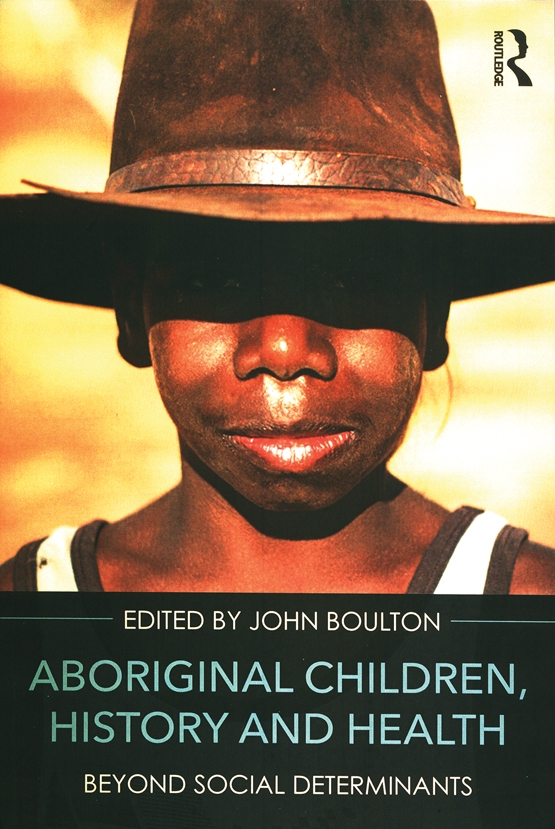
Aboriginal children, history and health: beyond social determinants. John Boulton, editor. Routledge, 2016 (238 pp, £76.00). ISBN 9781138955257
In 2008 at his 65th birthday dinner, John Boulton drew attention to his own foibles. Eccentricities such as ruthlessly interrogating the sociological and cultural, as well as biomedical, circumstance of the sick Indigenous children that came into his care. Peculiarities such as transcribing into endless field notebooks and the family connections of Indigenous people who saw him as an uncle and a trusted physician.
In Boulton’s foibles lies his brilliance. His work on growth and nutrition as foundation professor of medicine at the University of Newcastle, his formal studies in anthropology at the University of Sydney, a decade of front-line paediatric service across the Kimberley region of Western Australia, and his insatiable consumption of scientific literature and written and oral stories of Indigenous people make him Australia’s leading authority in this field.
There are many lenses to view the plight of Australia’s sickest children, those in remote Indigenous communities. Cosmological, historical, political, anthropological and biomedical understanding, each in isolation, present a paper cut-out of the Indigenous child, on which scant formulation of causality or useful action can be hung. Boulton and his collaborators in this book apply a multitude of comprehensive, accurate and objective perspectives, such that a full and complex matrix of Indigenous child health is seen in the context of ancient and modern historical events, and the resultant changes, in social systems and parenting effort. Infant growth is woven through the work as a biomarker of entrenched social and biomedical malaise. Boulton avoids what he terms a “lack of rigour, and displays of emotion designed to designate empathy” in this work. The result is a unique and important, deep and broad insight into why Indigenous child ill health and parenting problems seem intractable.
Boulton’s greatest foible may be that, through his hyperacute insights, he can overcomplicate what are but complex systems and remove the locus of control and responsibility from parents themselves. The value of this book will be in what the reader does to translate a deeper understanding of causality into useful policy, practice and effective human service and parenting efforts, so that Indigenous children know what it is like to be healthy.
Costs of Delivering the Hep B PAST Model of Care in Remote Australia: A Retrospective Pre–Post Study
Hoa Nguyen, Anh Le Tuan Nguyen, Paula Binks, Melita McKinnon, Emily Vintour-Cesar, Karen Wills, Nicola Stephens, Benjamin Cowie, Joshua S. Davis, Yuejen Zhao, Peter Nihill, Julie A. Campbell, Andrew J. Palmer, Jane Davies, Barbara de Graaff
Epidemiology and Quality of Care for Aboriginal and Torres Strait Islander Peoples Treated by Emergency Medical Services for Stroke in Victoria, Australia: Retrospective Analysis of Linked Data
Candice Menezes, Ziad Nehme, Luke J. Burchill, Tegwyn McManamny, Angela Dos Santos, Michelle Crilly, Luke P. Dawson, Benjamin Clissold, David Anderson, Emily Nehme
Hepatitis C Among First Nations Australians: A Rethink Is Required to Meet the 2030 Elimination Target
James Ward, Emily Pegler, Kellie Stacy, Stephen Harfield
Sovereignty and Survival: Understanding Lung Cancer Outcomes for Aboriginal and Torres Strait Islander People in Australia, a Case–Control Study
Alice R. T. Bergin, Luc te Marvelde, Roger L. Milne, Benjamin J. Solomon, Kris Ivanova, Peter Savas, Stephen J. Luen, Jay Hamann, Andrea Casey, Nicole Watt, Sue M. Evans, Gail Garvey, Sherene Loi
Rethinking Rheumatic Fever Diagnosis: Progress, Pitfalls and the Path Towards a Definitive Test
Anna P. Ralph, Rachel Webb, Tom Parks, Nicole J. Moreland, Asha C. Bowen, Benjamin Jones, Emma Ndagire, Andrea Z. Beaton
Not Gone but Often Forgotten: Action Needed to Address Tuberculosis in Aboriginal and Torres Strait Islander Communities
Nikkita Joshua, Emma L. Smith, Eunice (Cheeky) Love, Christopher P. Lowbridge, Nicole Tukana, Amy Bowden, Megan A. Campbell, Dawn Casey, James Ward