




Medical education
Clinical skills
Volume 206 - Issue 9
The scratch test for determining the inferior hepatic margin
Authors: Thomas Millington Goodsall, Patrick Flynn and John R Attia
Med J Aust 2017; 206 (9): 386-387. || doi: 10.5694/mja16.01068
Published online: 15 May 2017
Published online: 15 May 2017
Still a valuable component of the physical exam
Still a valuable component of the physical exam
Evaluation of liver size by palpation is a basic component of the physical examination. Suspicion of an enlarged liver should prompt the clinician to examine for possible causes (Box 1) and investigate further with appropriate imaging such as ultrasonography. Palpation to detect the inferior liver margin may not be accurate or possible in certain clinical conditions (eg, obesity, abdominal distension, tenderness, or guarding). In such cases the scratch test may be useful. We describe the technique of the test and review the evidence base for its use.
The scratch test is a type of auscultatory percussion which was described as far back as 1840, and used to ascertain the size and form of various organs, including the heart and liver.2 The principle behind the scratch test is that the sound from a scratch on the skin overlying the relatively solid liver will be transmitted to a stethoscope located at another point over the liver better than a scratch not over the liver (ie, separated from the stethoscope by bowel or air).
Method for performing the scratch test3
-
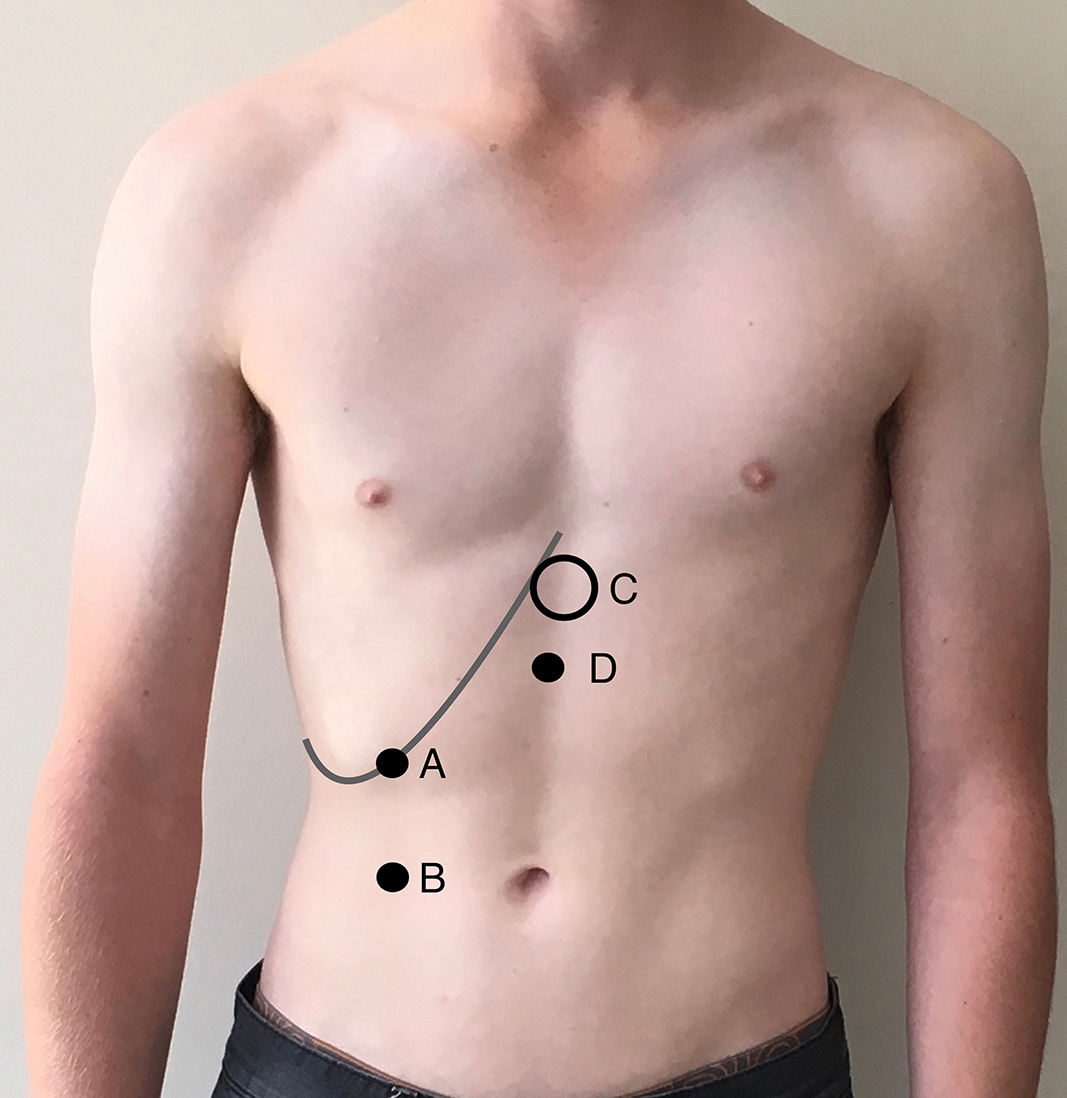
The diaphragm of the stethoscope is placed on the xiphisternum (point C in Box 2).
-
The examiner repeatedly and lightly strokes the skin with a single finger, parallel to the suspected liver edge, starting from the right lower quadrant and moving towards the costal margin along the midclavicular line (point A in Box 2).
-
The examiner will hear very little transmission of sound to the stethoscope until the scratches reach the liver edge (point B in Box 2), at which point there will be a sudden increase in volume and quality of the sound transmission.
-
A control manoeuvre is recommended to exclude a false positive finding, which can occur in up to 10% of cases.3
-
To ensure that the sound transmission is not purely through the skin, we suggest using the same stroking technique to scratch up the midline to the xiphisternum until the point of sound transmission is reached (point D in Box 2).
-
If the distance from the detected liver edge to the xiphisternum (BC) is more than the control distance (CD), then it can be assumed that the transmission of sound heard at point B was through liver.
-
If the distance from the detected liver edge to the xiphisternum (BC) is less than or equal to CD, then it can be assumed that the sound conduction was likely due to skin conduction and that the liver edge did not extend beyond the right costal margin.
A video demonstrating the use of the scratch test is available here.
Is the scratch test still useful in practice?
Very few studies have formally evaluated the scratch test and yet, based on limited evidence, calls have been made to abandon this test.4,5 We believe this call is premature for a number of reasons, as follows.
-
Small numbers of participants in previous studies, leading to low precision.
-
Conflating the reference standard of the inferior hepatic margin with the overall hepatic span — the lower hepatic margin does not correlate with the overall liver span given the variation in the superior border of the liver.
-
Interobserver variation in choosing landmarks (eg, midclavicular line).4
-
Elementary statistical analyses restricted to correlation coefficients — the question with a physical examination manoeuvre is not absolute accuracy, but whether it is useful enough to yield some information. In our evaluation of the scratch test,3 we noted only a moderate correlation (Spearman correlation coefficient, 0.37) but that 37% of ratings fell within 2 cm and 53% within 3 cm of the ultrasound-located edge. This level of accuracy is still potentially clinically useful.
-
Lack of definition as to whether the start of the sound transmission was taken as the liver edge or the point of maximal sound transmission. In our study,3 we noted, anecdotally, a difference of about 2.5 cm between these two points, which could be an added source of error. We also noted that by using the point of initial sound transmission, the accuracy rate could increase to 43% of ratings falling within 2 cm and 76% falling within 3 cm of the ultrasound-located value.
-
Lack of any control site for auscultation to guard against skin transmission of sound.
-
The scratch test was sometimes performed by the same examiner who performed other manoeuvres, such as palpation, and so was not interpreted independently.
-
Lack of any training or standardisation of examiners.
Further, a Bland–Altman plot indicates that raters tend to overestimate small spans and underestimate large spans,3 so physicians should be aware of this bias. With some practice and an awareness of this bias, we believe the scratch test can still be a valuable part of the physical exam.
Box 1 – Causes of an enlarged liver1
- Hepatocellular carcinoma
- Liver metastases
- Fatty infiltration (alcoholic and non-alcoholic)
- Haematological disease
- Myeloproliferative neoplasms
- Lymphoma
- Leukaemia
- Infiltration
- Amyloidosis
- Haemochromatosis
- Acute hepatitis
- Biliary obstruction
- Right heart failure or pulmonary hypertension (usually pulsatile)
Competing interests
No relevant disclosures.
Acknowledgements
We thank Benjamin Oakley, Evelyn Tan and Ken Goon for their help as model and for audiovisual support.
References
- Talley NJ, O’Connor S. Clinical examination. A systematic guide to physical diagnosis. 6th ed. Sydney: Churchill Livingstone, 2006.
- Orient J. Sapira’s art and science of bedside diagnosis. 4th ed. Philadelphia: Wolters Kluwer, 2011.
- Gupta K, Dhawan A, Abel C, et al. A re-evaluation of the scratch test for locating the liver edge: a reliable physical sign. BMC Gastroenterol 2013; 13: 35.
- Simel DL, Rennie D. The rational clinical examination: evidence-based clinical diagnosis. New York: McGraw-Hill, 2009.
- McGee S. Evidence-based physical diagnosis. 3rd ed. Philadelphia: Elsevier, 2012.
Provenance: Commissioned; externally peer reviewed.
Early-Onset Colorectal Cancer With Liver-Only Metastases: A Retrospective Cohort Study Integrating Prospectively Collected Real-World Clinical and Molecular Data From an Australian National Database (2009–2024) to Guide Treatment Planning
Savio G. Barreto, Christos S. Karapetis, Shahid Ullah, Matthew Burge, Susan Caird, Angus Campbell, Azim Jalali, Ross Jennens, Muhammad A. Khattak, Belinda Lee, Stephanie H. Lim, Shehara Mendis, Louise Nott, Timothy J. Price, Jeremy D. Shapiro, Jeanne Tie, Javier Torres, Colin Williams, Rachel Wong, Vanessa Wong, Peter Gibbs
Australian Pathways for Specialist Pain Management and Early Palliative Care for People With Pancreatic Cancer: Developed Using a Community Consensus Approach
Jennifer Philip, Melanie R. Lovell, Kylee Bellingham, Gail Garvey, Gregory B. Crawford, Nicole M. Rankin, Kara Burns, Isabel Young, Vivienne Milch, Dorothy Keefe, Katrina Anderson, James Lawson, Meinir Krishnasamy
Cause‐specific mortality among Queensland people with cirrhosis, by cirrhosis aetiology and decompensation status, 2007–22: a retrospective cohort study
Vikas Bhasker, Jessica R Fong, Paul J Clark, Gunter F Hartel, Richard Skoien, James O’Beirne, Elizabeth E Powell, Patricia C Valery
Clinical practice guidelines for hepatocellular carcinoma surveillance for people at high risk in Australia: summary of recommendations
Jacob George, Nicole L Allard, Stuart K Roberts, Leon A Adams, Jane Davies, Behzad Hajarizadeh, Jennifer H MacLachlan, Suzanne E Mahady, Rosalie Altus, Catherine Brown, David C Fry, Belinda Greenwood‐Smith, Natali Smud, Patricia C Valery, Nafisa Yussf, Kate Broun, Denise Campbell, Karen Canfell, Chelsea Carle Harrison, Victoria Freeman, Paul Grogan, Catherine Holliday, Suzanne Hughes, Anna Kelly, Cathelijne Kemenade, Claire Latumahina, Amanda McAtamney, Megan Varlow, Joachim Worthington, Susan Yuill, Eleonora Feletto
Assessment of metabolic dysfunction‐associated fatty liver disease in primary care: a consensus statement summary
Leon A Adams, William W Kemp, Kate R Muller, Elizabeth E Powell, Stuart K Roberts, Luis Calzadilla Bertot, Stephanie Best, Gary Deed, Jon D Emery, Samantha L Hocking, Graham R Jones, John S Lubel, Sinead Sheils, Stephen M Twigg, Gerald F Watts, Jacob George
Treatment outcomes for people with hepatitis C referred to tertiary care in Victoria, 2021–22: a retrospective observational study
Elly Layton, Nicole Matthews, Brendan Quinn, Nasra Higgins, Gabrielle Lindeman, Mielle Abbott, Jennifer MacLachlan, Elizabeth Birbilis, Margaret E Hellard, Joseph Doyle, Benjamin C Cowie, Mark Stoové