




Volume 206 - Issue 6
HPV vaccine coverage is increasing in Australia
Authors: Julia ML Brotherton, Karen L Winch, Lisette Bicknell, Genevieve Chappell and Marion Saville
Med J Aust 2017; 206 (6): 262. || doi: 10.5694/mja16.00958
Published online: 3 April 2017
Published online: 3 April 2017
Identifying and removing barriers to completing the vaccination course in schools is proving successful
In 2016, the tenth year of quadrivalent human papillomavirus (HPV) vaccine delivery in Australia by the national immunisation program, it is encouraging to report recent increases in HPV vaccine coverage recorded by the National HPV Vaccination Program Register (NHVPR). The program commenced in April 2007, with a catch-up program for all females aged 12–26 years until the end of 2009, and routine school vaccination at age 12–13 thereafter. In 2013, routine immunisation of boys (12–13 years) against HPV commenced, with a 2-year catch-up program for boys up to 15 years old. Quadrivalent HPV vaccine is routinely given at school to both girls and boys aged 12–13 years, with a three-dose schedule. The NHVPR maintains records of HPV vaccinations, and there is almost complete notification of school doses. Coverage is routinely reported at age 15, as recommended by the World Health Organization and to facilitate consistency in national reporting (the age of vaccination and course completion varies slightly between states and territories). The NHVPR uses Australian Bureau of Statistics estimated resident population data as the denominator for calculating coverage. Notification of doses delivered in general practice is not compulsory, resulting in some undernotification.1
As shown in the Box, HPV vaccine coverage in girls by age 15 had in 2015 reached 86%, 83% and 78% for doses 1, 2 and 3 respectively. Coverage in 14-year-old girls in 2015 was 87%, 85% and 79%, indicating that coverage at age 15 will increase further. This improvement has occurred in the context of systematic assessment and action to identify barriers to completing the HPV vaccine course in school-based vaccination programs, in the light of relatively stable coverage since the program commenced; research has found that logistical barriers in program delivery are the major problem.2-4 It is notable that coverage for the third HPV vaccine dose increased by 10 percentage points in New South Wales by moving the catch-up of missed doses into the school program of the next school year, rather than relying on delivery by a general practitioner.4 Coverage of boys by age 15 in 2015 for the three doses was 78%, 75% and 67% respectively; at 14 years it was 82%, 79% and 74%.
It is likely that coverage will continue to improve, especially if a two-dose HPV vaccine schedule, now recommended by the WHO as clinically equivalent for those under 15 at the first dose, is implemented in Australia.5 Further, the expansion of Australia’s immunisation registers into a whole-of-life system, with complete electronic capture of all vaccine doses, promises to streamline reporting of GP-delivered doses of HPV vaccine, reducing the current problem of under-reporting. As first-dose coverage has been relatively stable over time, barriers to consent need to be further investigated and overcome. The availability of up-to-date information explaining the rationale for HPV vaccination and providing data that support its safety and effectiveness are also important. Our sex-neutral HPV vaccination program will hopefully become a routine rite of passage for all pre-adolescents as a safe and effective cancer prevention strategy.
Box – National human papillomavirus (HPV) vaccination coverage for girls at age 15, by dose number and year, Australia, 2007–2015*
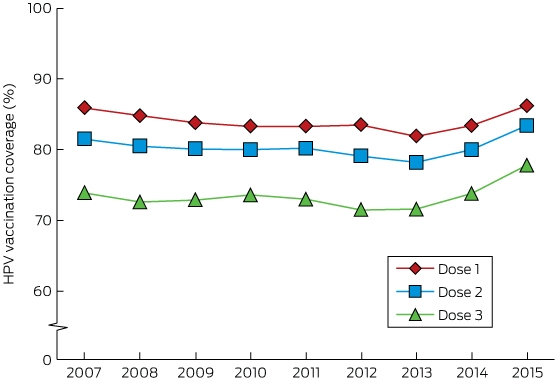
* Data as held on the National HPV Vaccination Program Register on 19 January 2017 (available in online Appendix). Age is at date of Australian Bureau of Statistics (ABS) estimated resident population (30 June) for the specified year. Coverage estimates have been revised from earlier reports because of revised vaccination data and finalised ABS population estimates (except 2015), resulting in an increase in coverage estimates for most years.
Competing interests
Julia Brotherton and Marion Saville have been investigators on investigator-initiated unrestricted research projects partly funded by Seqirus and Merck.
References
- Gertig DM, Brotherton JML, Saville M. Methods for measuring HPV vaccination coverage and the role of the National HPV Vaccination Program Register, Australia. Sex Health 2011; 8: 171-178.
- Watson M, D’Onise K, Lynch J, Brotherton JML. What are the barriers to better three-dose coverage with HPV vaccination in school based programs? Aust N Z J Public Health 2014; 38: 91-92.
- Mak DB, Bulsara MK, Wrate MJ, et al. Factors determining vaccine uptake in Western Australian adolescents. J Paediatr Child Health 2012; 49: 895-900.
- Staples C, Butler M, Nguyen J, et al. Opportunities to increase rates of human papillomavirus vaccination in the New South Wales school program through enhanced catch-up. Sex Health 2016; 13: 536-539.
- World Health Organization. Human papillomavirus vaccines: WHO position paper, October 2014. Wkly Epidemiol Rec 2014; 89: 465-491.
Awareness, Usage and Perceptions of Doxycycline Post-Exposure Prophylaxis (doxyPEP) for Prevention of Sexually Transmitted Infections in Australia: Insights From a National Cross-Sectional Survey
Catriona S. Bradshaw, Dash Heath-Paynter, Benjamin Riley, Daniel Grace, Fabian Y. S. Kong, Eric P. F. Chow
How Can We Ensure Access to Sexual and Reproductive Health Information for Adolescents in Light of Australia's Social Media Restrictions?
Olena Ivanova, Anisa R. Assifi, Danielle Mazza
Differentiated and simplified oral HIV pre‐exposure prophylaxis (PrEP) models hold the key to virtually eliminating HIV transmission in Australia by 2030
Tyson Arapali, Sarah Warzywoda, Anthony K J Smith, Curtis Chan, Timothy R Broady, Erin Sullivan, Catherine MacPhail, Mohamed A Hammoud, Alexander Dowell‐Day, Benjamin R Bavinton
An autoethnographic critique of a past report of inpatient psychiatric treatment for gender diverse children
Jayne McFadyen, Timothy W Jones, Rowena Koek, Fintan Harte, Brendan Jansen, Megan Galbally, Warren Kealy‐Bateman, Catherine Wall, Quinnehtukqut McLamore, Anja Ravine
Cass Review does not guide care for trans young people
Julia K Moore, Cate Rayner, S Rachel Skinner, Katie Wynne, Blake S Cavve, Brodie Fraser, Uma Ganti, Claire McAllister, Gideon Meyerowitz‐Katz, Tram Nguyen, Anja Ravine, Brian Ross, Darren B Russell, Liz A Saunders, Aris Siafarikas, Ken C Pang
Motivations, barriers and enablers for medical and forensic examiners in New South Wales sexual assault services: a qualitative interview study
Natalie Edmiston, Sam Sperring, Rosalie Power, Samantha Ryan, Kathryn Evans, Jane Ussher, Ellie Freedman