




Snapshot
Volume 204 - Issue 3
Massive subdural haematoma and dementia: a “yin and yang” paradigm
Authors: Pietro Maggi, Jean Christophe Bier and Sandra De Breucker
Med J Aust 2016; 204 (3): 126. || doi: 10.5694/mja15.01043
Published online: 15 February 2016
Published online: 15 February 2016
Two interdependent entities giving rise to each other
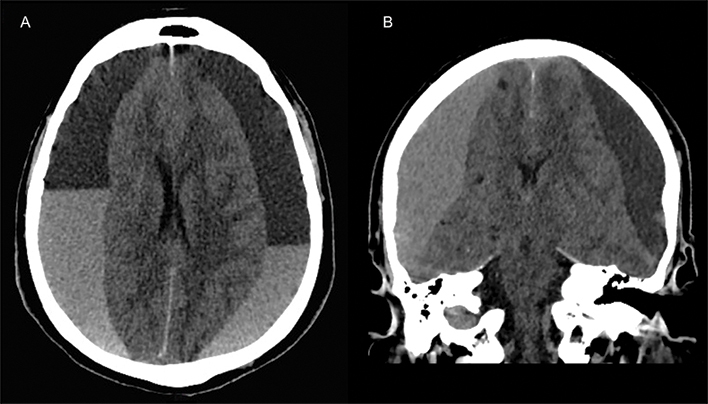
An 85-year-old man with a 2-year history of cognitive decline and falls, and signs of brain atrophy on previous computed tomography imaging, presented with severe drowsiness. Axial and coronal non-contrasted cerebral computed tomography images (Figure, A and B respectively) showed massive bi-hemispheric acute (hyperdense) and chronic (hypodense) subdural haematoma, with extensive parenchymal compression. Dementia is strongly associated with brain atrophy and frequent falling, both of which are risk factors for subdural bleeding1 caused by stretching and tearing of subdural veins2. The formation of a subdural haematoma can have further adverse effects in terms of cognitive decline. Surgical decompression of the subdural haematoma led to progressive improvement of the patient’s neurological status in the following weeks. The axial image resembles the black and white “yin and yang” symbol, which is conceptually relevant to the patient’s clinical history of subdural haematoma and dementia — two interdependent entities giving rise to each other.
References
- Hamden K, Agresti D, Jeanmonod R, et al. Characteristics of elderly fall patients with baseline mental status: high-risk features for intracranial injury. Am J Emerg Med 2014; 32: 890-894.
- Xia P, Hu XY, Wang J, et al. Risk factors for subdural haematoma in patients with spontaneous intracranial hypotension. PLoS One 2015; 10: e0123616.
Respiratory Syncytial Virus Disease Burden and Evidence Gaps in Australia Before Immunisation Introduction: A Retrospective Population-Based Study Using 2016–2019 Hospitalisation and 2023 Laboratory Surveillance Data
Chisato Imai-Boulter, Jean Li-Kim-Moy, Clayton Chiu, Sanjay Jayasinghe, Kristine Macartney
Multimorbidity Clusters Among People Aged 65 Years and Over in Australia: A Nationwide Cross-Sectional Data Linkage Study
Weisi Chen, Christine Y. Lu, Sarah N. Hilmer, Alice A. Gibson, Edwin C. K. Tan
Predictors of Ambulance Transport to Hospital for Older People Living in Tasmanian Aged Care Facilities: A Retrospective Cohort Study
Sharon Andrews, Pieter F. Fouche, Belinda Flanagan, Michael McDermott, Melanie Greenwood
Deprescribing in Older People: A Clinical Practice Guideline Summary
Stephen Tucker, John D. G. Watson, Donna Wellins, Tim Whitmore, Christopher Etherton-Beer, Amy T. Page
Emergency Department Presentations and Hospitalisations for Elder Abuse in People Accessing Aged Care Services in Australia: A Retrospective Cross-Sectional Study
Stephanie L. Harrison, Sahar Barmomanesh, Bryan Morden, Maria C. Inacio, Gillian E. Caughey, on behalf of the ROSA Consumer and Community Advisory Committee
A future for the hospital‐in‐the‐home (HITH) deteriorating patient: shifting the paradigm
Davide R Tomassoni, Iftah Amith