




Volume 204 - Issue 2
A multidisciplinary renal genetics clinic improves patient diagnosis
Authors: Andrew Mallett, Lindsay F Fowles, Julie McGaughran, Helen Healy and Chirag Patel
Med J Aust 2016; 204 (2): 58-59. || doi: 10.5694/mja15.01157
Published online: 1 February 2016
Published online: 1 February 2016
Genetics and genomics in everyday clinical practice
Developments in genomic science are disproportionately in advance of their translational clinical application. Multidisciplinary clinics are proposed to overcome this1 in many medical fields.2 This is especially so in nephrology, which is typified by significant community disease burden3 and heritability.4 Several renal genetics clinics (RGCs) operate overseas, although their models and outcomes are largely unreported. The first multidisciplinary RGC in Australasia commenced at the Royal Brisbane and Women’s Hospital in August 2013, involving a clinical geneticist, nephrologist, genetic counsellor, and ancillary clinical and diagnostic services. The departments of clinical genetics and nephrology jointly operate the RGC. The clinical geneticist and nephrologist see families in the same appointment, maximising use of time. In this article, we report this clinical service’s initial outcomes and model for mainstreaming genetic medicine.
We undertook a retrospective cohort study of patients who attended the Royal Brisbane and Women’s Hospital Renal Genetics Clinic during its first 2 years of operation (1 August 2013 to 31 August 2015; ethics approval reference, HREC/14/QRBW/187). During this period, 108 patients from 100 families were seen; the median age was 41 years (range, 13–86 years). Most patients were referred by a public or private sector nephrologist (47% [51/108] and 28% [30/108], respectively), and 81% (87/108) had an existing genetic renal diagnosis, 45% (49/108) had extra-renal clinical features and 65% (70/108) had a family history of renal disease. Existing renal diagnoses were diverse, and the most common were autosomal dominant polycystic kidney disease (34% [37/108]), Alport syndrome (17% [18/108]) and focal segmental glomerulosclerosis (7% [8/108]).
The overlapping reasons for referral were for a diagnosis (67% [72/108]), a discussion about a diagnosis (27% [29/108]) and genetic counselling (81% [87/108]). Clinical and family histories and results of clinical investigations were reviewed. Differential diagnoses were discussed for 68% of patients (73/108), disease information was provided to 89% (96/108), and genetic counselling provided to 67% (72/108).
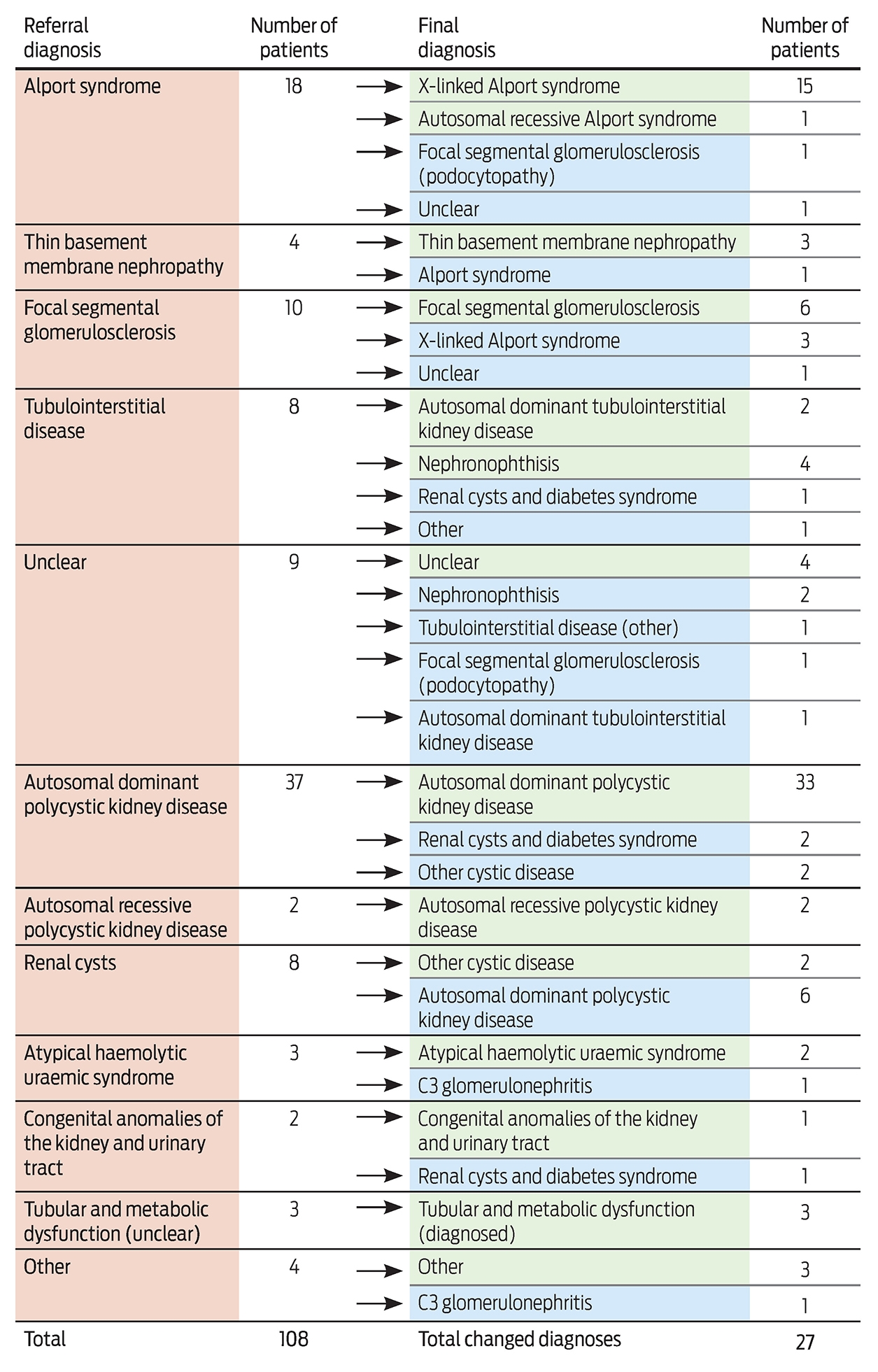
Genetic testing was ordered for 69% of patients (75/108). Of a total of 83 tests, results were positive for 39% (32/83), negative for 30% (25/83), “variant of uncertain significance” for 7% (6/83) and pending for 24% (20/83). Negative genetic test results have enabled 12 of the families to enrol in a research study.5 To date, the clinical diagnosis has changed for 27 of the 108 patients (25%) (Box), enabling correct diagnosis, accurate genetic counselling, identification of at-risk individuals, access to assisted reproductive technologies and altered medical management.
This RGC model is novel in Australasia and its results are among the first to be reported internationally. In its first 2 years of operation, patients underwent clinical appraisal and a tailored combination of differential diagnosis discussion, disease information provision and genetic counselling. Genetic testing was often, but not always, used, with results confirming or clarifying a diagnosis for about half of the patients. Overall, the diagnosis was changed in a quarter of patients. This clinic model is inclusive, flexible and multidisciplinary while demonstrably improving patient diagnosis and care. We believe that it is a viable, translational and patient-focused clinical template for effective introduction of genetics and genomics into everyday clinical practice.
Competing interests
No relevant disclosures.
Acknowledgements
We thank the referrers and patients who have been and continue to be involved in this clinic.
References
- Battista RN, Blancquaert I, Laberge AM, et al. Genetics in health care: an overview of current and emerging models. Public Health Genomics 2012; 15: 34-45.
- Zentner D, Thompson TN, James PA, et al. The Cardiac Genetics Clinic: a model for multidisciplinary genomic medicine. Med J Aust 2015; 203: 261.
- Australian Institute of Health and Welfare. End-stage kidney disease in Australia: total incidence 2003–2007. Canberra: AIHW, 2011. (AIHW Cat. No. PHE 143.) http://www.aihw.gov.au/WorkArea/DownloadAsset.aspx?id=10737419266&libID=10737419265 (accessed Nov 2015).
- Mallett A, Patel C, Salisbury A, et al. The prevalence and epidemiology of genetic renal disease amongst adults with chronic kidney disease in Australia. Orphanet J Rare Dis 2014; 9: 98.
- Mallett A, Patel C, Maier B, et al. A protocol for the identification and validation of novel genetic causes of kidney disease. BMC Nephrol 2015; 16: 152.
The first Australian evidence‐based guidelines on male infertility
Darren J Katz, Liza O’Donnell, Robert I McLachlan, Tim J Moss, Clare V Boothroyd, Veena Jayadev, Sarah R Catford
The epidemiology of haemodialysis catheter infections in Australia, 2016–20: a prospective cohort study
Benjamin Lazarus, Kevan R Polkinghorne, Martin P Gallagher, Jayson Catiwa, Nicholas A Gray, Sarah Coggan, Kathryn R Higgins, Girish Talaulikar, Stephen P McDonald AM, Sradha Kotwal
Am I on the list? Clinician‐reported factors for kidney transplantation non‐waitlisting among Aboriginal and Torres Strait Islander people with kidney failure: a cross‐sectional study
Stephen P McDonald AM, Katie Cundale, Christopher E Davies, Kelli Karrikarringka Owen (Kaurna, Nharangga, and Ngarrindjeri), Kerry Dole, Feruza Kholmurodova, Matilda D’Antoine (Paakantyi), Jaquelyne T Hughes (Wagadagam)
Hyperkalaemic cardiac arrest due to cream of tartar ingestion
Daniel Yee Lee Ng, Laksmi Govindasamy, Andrew Hughes, Hwee Min Lee
Dialysis care in Australia: a call for reform and innovation
Dharshana Sabanayagam, Angela Makris, Frederika Sciberras, Nicole J Scholes‐Robertson, Germaine Wong
Closing the gap in kidney disease: validating the reporting of Aboriginal and/or Torres Strait Islander identification in a clinical quality registry using linked data
Heather J Baldwin, Nicole De La Mata, Grant Sara, Faye McMillan, Brett Biles, Jianyun Wu, Paul Lawton, Stephen McDonald, Angela C Webster