




Volume 201 - Issue 11
The Australian medical response to Typhoon Haiyan
Author: Nicholas R Coatsworth
Med J Aust 2014; 201 (11): 632-634. || doi: 10.5694/mja14.00306
Published online: 15 December 2014
Published online: 15 December 2014
Meeting standards in disaster response
Our well equipped civilian professionals made a rapid and valuable contribution to internationally coordinated aid
On the morning of 8 November 2013, category 5 Typhoon Haiyan (known locally as Typhoon Yolanda) made first landfall over Eastern Samar province in the Philippines. Sustained, damaging winds of 235 km/h gusting to 275 km/h were accompanied by a tidal storm surge and subsequent inundation. The official number of fatalities stands at 6190, with 28 626 injuries attributed to the event, and over 16 million people affected.1
On 9 November, as reports indicated the scale of the disaster, the government of the Philippines officially requested international humanitarian assistance. Eastern Samar and Leyte provinces, including the major population centre of Tacloban (population 220 000) sustained catastrophic damage.
As part of a $40 million assistance package, the Australian Government deployed a field hospital and a fully self-sustaining civilian medical team with a mandate to assist the Philippines Department of Health in immediate postdisaster medical care. The first Australian medical assistance team (AUSMAT) of 37 medical, nursing, paramedical and logistics professionals deployed on 13 November with over 28 tonnes of equipment. They were relieved on 27 November by a second team of 37.
At the direction of the Philippines Department of Health, a field hospital with 35 inpatient beds, two operating tables, an outpatient clinic and a resuscitation room was deployed to Tacloban, the most critically affected population centre. Clinical activity commenced 7 days after Typhoon Haiyan made landfall — one of the fastest deployments of a foreign field hospital to a sudden-onset disaster.2 The field hospital was registered as a Type 2 facility under the new World Health Organization guidelines for foreign medical teams in sudden-onset disasters.3 This was the first occasion on which a host government was able to use the WHO guidelines to assess the contribution of foreign medical teams.
The AUSMAT field hospital rapidly became a critical adjunct to the overall medical response in Tacloban, providing surgical and trauma care while the major local referral centre gradually restored its own surgical services. The surgical casemix, reflecting the nature of the disaster, comprised a high proportion of traumatic injuries from high-velocity debris. As the deployment continued, individuals with minor to moderate injuries, but who had not yet sought medical care, presented with wound infections that were frequently exacerbated by intercurrent type 2 diabetes. Many of these patients had either been searching for lost family or attempting to rebuild their homes and livelihoods, but not attending to their own need for health care.
During a 23-day operational period, 238 surgical procedures were performed, of which 90 were considered major. A total of 2734 patients were seen. Based on average numbers of outpatients, this meant that, for the time it was operational, the AUSMAT field hospital was as busy as the Royal Darwin Hospital emergency department. In addition to surgical patients, our clinicians treated patients with a variety of acute and chronic medical conditions, ranging from respiratory tract infections and diarrhoeal illness through to uncontrolled hypertension.
Operation Philippines Assist marked two critical points in the evolution of Australia's capacity to provide professional, emergent medical relief after sudden-onset disasters. It was the first occasion on which a clinical team comprising members from each state and territory was deployed (it also included an orthopaedic surgeon and logistician from the New Zealand Medical Assistance Team). This was also the AUSMAT field hospital's first deployment overseas as part of an Australian response.
Historical perspective on AUSMAT
Previous responses funded by the Australian Government to regional natural disasters such as those in Aceh, Yogyakarta, Samoa and Christchurch were managed through the state-based disaster medical assistance teams model, with involvement of some multijurisdictional teams. Since 2010, the AUSMAT concept, derived from the global movement towards professional, trained medical disaster-relief teams, has become the national model for medical disaster response. AUSMAT training and deployment is primarily coordinated via the Darwin-based National Critical Care and Trauma Response Centre under the auspices of the Australian Government Department of Health. Each state and territory has a coordination focal point linking local health departments to the national team.
Since 2010, over 400 health professionals and medical logisticians have undergone specific and tailored training to deliver care in typical austere, resource-poor environments. The team member training course focuses on safety and security, cultural awareness, team dynamics in the field and familiarisation with equipment. Its centrepiece is a high-fidelity 36-hour simulated deployment to a fictitious nation where each key competency is tested in field conditions. Specific courses for surgeons and anaesthetists, team leaders and medical logisticians have also been developed.
AUSMAT also has a nationally agreed set of standards governing all aspects of deployment including vaccination and predeparture health checks, in-country codes of conduct and postdeployment psychological debriefing. These standards, documented in the national AUSMAT manual,4 have been endorsed by the Australian Health Protection Principal Committee and ensure that the Australian Government maintains a consistent and predictable medical response to regional disasters.
The need for standards in disaster response
Sudden-onset disasters attract a wide variety of responders, from clinicians trained specifically in humanitarian and disaster response to well meaning but untrained individuals or teams. As seen over a number of natural disasters in the 20th and 21st centuries, significant harm to a disaster-affected population can be caused by foreign medical teams who are either untrained in disaster medicine or poorly resourced and not self-sufficient.5
Analysis of responses to the 2010 Haiti earthquake provided clear evidence of the effects of underprepared and underresourced teams. A review of the surgical response in Haiti found that amputation rates varied considerably between foreign surgical teams, from 1% of surgical procedures to over 45%. The lowest rates occurred among specialised orthoplastic teams experienced in limb salvage.6
One account of a trauma team's experience in Haiti documents the rapid overwhelming of the team by the scale of the disaster, forcing them to self-evacuate. The authors suggest that individual and institutional medical responders partner with experienced disaster-relief organisations to “facilitate the personnel from the more developed countries to learn how to live and work under unfamiliar austere circumstances”.7
Typhoon Haiyan was a typical natural disaster in that it attracted responders with varied training and differing levels of self-sufficiency, ranging from skilled government teams from Australia, Japan, Korea and Belgium, and well known non-government organisations (NGOs) such as the International Committee of the Red Cross and Médecins Sans Frontières, through to individuals who were essentially “disaster tourists”. In between were many small NGOs and philanthropic organisations. Frequently, the AUSMAT team was asked to supply medications or other supplies to teams that had arrived in the country inadequately equipped to provide effective care. Typically, these teams were not participants in the WHO and Philippines Department of Health global health cluster coordination process.
An extensive body of literature points to the key competencies required by medical disaster responders. Clinical medicine, public health and disaster incident management are the core disciplines practised by disaster health professionals.8
Similarly, the AUSMAT concept is firmly rooted in the philosophy that disaster health professionals must have key clinical and humanitarian competencies. First, they must be registered to practise in their stated profession. Too often, clinicians, under the pretext of saving lives at all costs, extend themselves far beyond their scope of practice without following the fundamental principle of medical practice — first do no harm.
Second, health professionals must be able to perform their clinical specialty in a disaster context. It is outdated practice to pluck individuals from their clinical practice in developed-world tertiary hospitals and deposit them in a disaster zone, expecting them to be able to function in austere circumstances with limited resources. Not only does poor patient care result, but it may cause psychological and professional distress for the clinician. Fortunately, in Australia, the clinical experience of many doctors and nurses in rural and remote settings means they are ideally suited to the demands of practice in an austere environment.
Finally, to appreciate the context in which they work, health professionals must have a set of core humanitarian competencies. These range from an understanding of international humanitarian norms through to self-management skills in the field and an ability to operate safely and securely in difficult circumstances.
AUSMAT's efficient and timely deployment to Tacloban demonstrated the importance of preparedness and consistency. A repository of well trained and prepared clinicians and support staff with a suite of appropriate skills meant an effective response could be mounted. While training is obviously required for preparedness, the importance of an agreed consistency in disaster training is less obvious. The AUSMAT response to Typhoon Haiyan showed well the advantages of both.
The need for qualified and capable medical professionals to be deployed to assist disaster-affected populations will continue into the future. It is the responsibility of organisations rendering assistance to ensure that personnel are trained in the nuances of humanitarian and disaster medicine and to adhere to the new international standards for deployment of foreign medical teams.
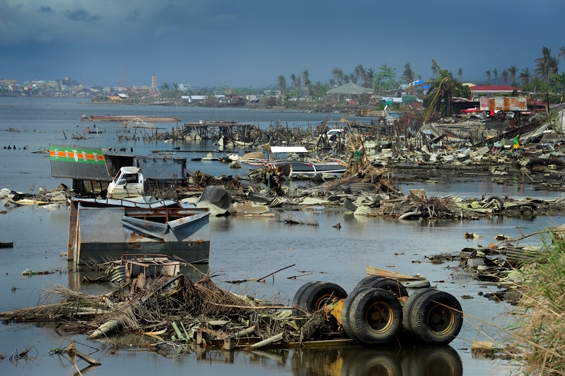
The devastation of Tacloban in the wake of Typhoon Haiyan was mirrored across the Philippine provinces of Leyte and Eastern Samar
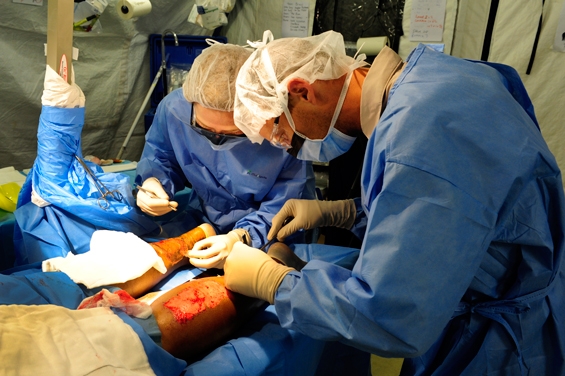
Surgeons Vaughan Poutawera (New Zealand) and Cea-Cea Moller (South Australia) complete a skin graft for a diabetic patient with typhoon-related injuries
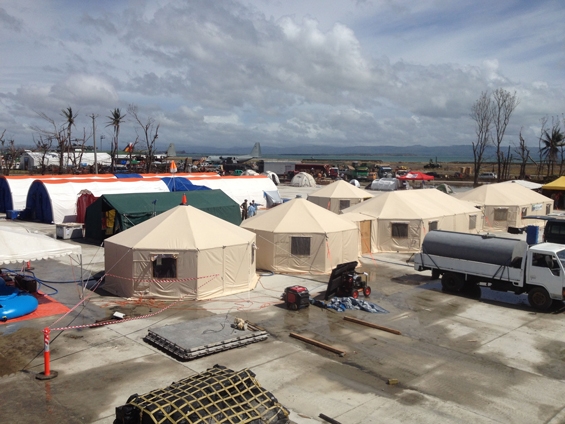
The Australian field hospital in Tacloban, with outpatient tents in the foreground and wards and operating theatre behind (blue-and-white tents)
Competing interests
No relevant disclosures.
Acknowledgements
On behalf of the AUSMAT deployees, I acknowledge the government of the Philippines and the Philippines Department of Health for their collaboration, and the people of Tacloban and Leyte province for allowing us to provide medical care. I acknowledge the support of Australia's Chief Medical Officer Professor Chris Baggoley AO, members of the Australian Health Protection Principal Committee, and the staff of the Department of Foreign Affairs and Trade, Department of Health, Emergency Management Australia, Royal Australian Air Force and the National Critical Care and Trauma Response Centre, all of whom contributed to the deployment.
References
- Republic of the Philippines National Disaster Risk Reduction and Management Council. Effects of typhoon “Yolanda” (Haiyan). SitRep No. 90. Quezon City: Government of the Philippines, 2014. http://reliefweb.int/sites/reliefweb.int/files/resources/UPD%20re%20SitRep%2090%20Effects%20of%20Ty%20YOLANDA%20%2812JAN2014%29.pdf (accessed Feb 2014).
- von Schreeb J, Riddez L, Samnegård H, Rosling H. Foreign field hospitals in the recent sudden-onset disasters in Iran, Haiti, Indonesia and Pakistan. Prehosp Disaster Med 2008; 23: 144-151. 2
- Norton I, von Schreeb J, Aitken P, et al. Classification and minimum standards for foreign medical teams in sudden onset disasters. Geneva: World Health Organization, 2013. http://www.who.int/entity/hac/global_health_cluster/fmt_guidelines_september2013.pdf?ua=1 (accessed Jul 2014).
- Australian Health Protection Principal Committee. National AUSMAT manual. Canberra: Commonwealth Department of Health and Ageing, 2012. 4
- Johnson K, Idzerda L, Baras R, et al. Competency-based standardized training for humanitarian providers: making humanitarian assistance a professional discipline. Disaster Med Public Health Prep 2013; 7: 369-372. 5
- Redmond AD, Mardel S, Taithe B, et al. A qualitative and quantitative study of the surgical and rehabilitation response to the earthquake in Haiti, January 2010. Prehosp Disaster Med 2011; 26: 449-456. 6
- Crippen D, Krin C, Lorich D, Mattox K. Disaster medicine: the caring contradiction. Crit Care 2010; 14: 133-134. 7
- Bradt DA, Drummond CM. Professionalization of disaster medicine – an appraisal of criterion-referenced qualifications. Prehosp Disaster Med 2007; 22: 360-368. lefthere
Provenance: Not commissioned; externally peer reviewed.
‘Once Bitten’: A Case of Tetanus Following Snakebite in Australia
Adrian A. S. Doherty, Naomi N. E. Clarke, Sarah Fletcher, Sarah Huffam, Camille V. Awburn, Eugene Athan
Epidemiology and Quality of Care for Aboriginal and Torres Strait Islander Peoples Treated by Emergency Medical Services for Stroke in Victoria, Australia: Retrospective Analysis of Linked Data
Candice Menezes, Ziad Nehme, Luke J. Burchill, Tegwyn McManamny, Angela Dos Santos, Michelle Crilly, Luke P. Dawson, Benjamin Clissold, David Anderson, Emily Nehme
Intranasal Adrenaline Use for the Management of Insect Venom-Induced Anaphylaxis
Thomas J. Young, Wilhelmina R. F. Johnson, Braydon L. Pennington, Troy Wanandy, Wun Y. Lau, Thanh-Thao A. Le
Gabapentinoid Poisoning Presentations to Victorian Emergency Departments: A 15-Year Trend Analysis
Bishaal Tej Gurung, Amy McNeilage, Angus Skeen, Tina Lam, Joanna F. Dipnall, Jane Hayman, Suzanne Nielsen, Ting Xia
They Brought the Hospital to Me
Hugh N. Burrill
Predictors of Ambulance Transport to Hospital for Older People Living in Tasmanian Aged Care Facilities: A Retrospective Cohort Study
Sharon Andrews, Pieter F. Fouche, Belinda Flanagan, Michael McDermott, Melanie Greenwood