




Volume 200 - Issue 6
Staphylococcus aureus bacteraemia associated with peripherally inserted central catheters: the role of chlorhexidine gluconate-impregnated sponge dressings
Authors: Michael J Loftus, Cosmin J Florescu and Rhonda L Stuart
Med J Aust 2014; 200 (6): 317-318. || doi: 10.5694/mja13.00092
Published online: 7 April 2014
Published online: 7 April 2014
Supportive evidence for routine use of this simple infection prevention measure
To the Editor: Staphylococcus aureus bacteraemia (SAB) is an important health care-associated infection that is often related to indwelling vascular catheters.1 Peripherally inserted central catheters (PICCs) are increasing in popularity for providing long-term central access, enabling earlier hospital discharge and reducing inpatient costs.2 Despite increased use of PICCs, little has been published on the risks of PICC-associated SAB (PA-SAB). We sought to characterise the frequency of PA-SABs at our institution and analyse the effect of using a chlorhexi-dine gluconate-impregnated sponge (CHGIS) dressing on the PA-SAB rate.
All SAB episodes at Monash Health are investigated by the Department of Infection Prevention and Epidemiology. A PA-SAB was defined as a health care-associated SAB in a patient with a PICC in situ (or removed within 7 days before the positive blood culture) with no other source of SAB identified and written documentation or clinical findings suggesting a PICC source.3 The data for this study included all PA-SAB episodes during 2007–2012.
All PICCs at our institution are inserted by a radiologist from the diagnostic imaging service under sterile conditions. In January 2011, routine use of a CHGIS (Biopatch, Ethicon) as a dressing around the insertion site was introduced for all PICCs. Aside from the use of an additional sterile drape during PICC insertion from mid 2008, there were no other changes to protocols for inserting, dressing or accessing PICC lines during the study period.
We calculated the PA-SAB rate using as the denominator the total number of PICCs inserted by the diagnostic imaging service for the 4 years before and 2 years after CHGIS use began. The χ2 test was used to calculate statistical significance.
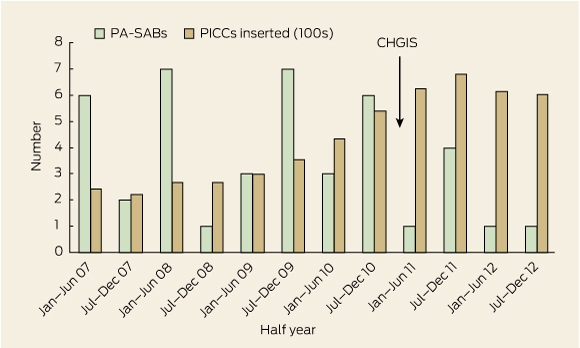
Across the 6-year study period, 42 PA-SAB episodes were identified. Of these, 35 occurred during the first 4 years of the study, in which a total of 2625 PICCs were inserted, giving a rate of 1.3 PA-SAB episodes per 100 PICCs. After routine use of CHGISs began, there was a significant reduction in the infection rate to 0.3 PA-SAB episodes per 100 PICCs (7 PA-SAB episodes/2522 PICCs inserted; P < 0.001) (Box).
The median time from PICC insertion to SAB was 16.5 days (range, 1–150 days). Eight patients experienced serious infective complications from PA-SAB, including septic shock and infective endocarditis.
A limitation of our study was its observational and retrospective nature. We are unable to completely exclude other causative factors aside from CHGIS dressing use that could have contributed to a reduction in the PA-SAB rate during the final 2 years of the study period.
Our study provides supportive evidence that CHGIS dressing use may be effective at reducing SAB in the presence of a PICC. The introduction of routine CHGIS use in January 2011 was followed by a significant reduction in the rate of PA-SABs in the subsequent 2 years. Such a drop is consistent with the results of previous trials assessing the efficacy of CHGIS dressings for preventing central line-associated bloodstream infections in the intensive care setting.4
Competing interests
No relevant disclosures.
References
- Maki DG, Kluger DM, Crnich CJ. The risk of bloodstream infection in adults with different intravascular devices: a systematic review of 200 published prospective studies. Mayo Clin Proc 2006; 81: 1159-1171.
- Chopra V, Flanders SA, Saint S. The problem with peripherally inserted central catheters. JAMA 2012; 308: 1527-1528. i1142876
- Stuart RL, Cameron DRM, Scott C, et al. Peripheral intravenous catheter-associated Staphylococcus aureus bacteraemia: more than 5 years of prospective data from two tertiary health services. Med J Aust 2013; 198: 551-553. CBBIFBDJ
- Timsit J-F, Schwebel C, Bouadma L, et al. Chlorhexidine-impregnated sponges and less frequent dressing changes for prevention of catheter-related infections in critically ill adults: a randomized controlled trial. JAMA 2009; 301: 1231-1241. CBBBEIIF
Costs of Delivering the Hep B PAST Model of Care in Remote Australia: A Retrospective Pre–Post Study
Hoa Nguyen, Anh Le Tuan Nguyen, Paula Binks, Melita McKinnon, Emily Vintour-Cesar, Karen Wills, Nicola Stephens, Benjamin Cowie, Joshua S. Davis, Yuejen Zhao, Peter Nihill, Julie A. Campbell, Andrew J. Palmer, Jane Davies, Barbara de Graaff
Buruli Ulcer Acquired From Ringtail Possum Rescue
Daniel P. O'Brien, Naomi Clarke, Sara Bonnici, Mohammad A. Hussain
Q Fever Visceral Abscesses After Contact With Native Australian Marsupials
Samantha J. Laws, Enzo Binotto, James Stewart, Jennifer Ho, Trent Yarwood, Josh Hanson, Simon Smith
Hospital-Admitted Injection-Related Infections Among Incarcerated People Who Inject Drugs in Australia: A Retrospective Cohort Study
Andrew Palmer, Matthew Carter, Jeremy Yeo, Cecilia Shim, Jason Connor, Jeremy Hayllar, Gerald Holtmann, Naomi Moy, Elliott G. Playford, Naomi Runnegar, Paul J. Clark
The Live Attenuated Influenza Vaccine in Australia: An Additional Tool for Influenza Prevention
Cyra Patel, Alexis Pillsbury, Tran Nguyen, Xia Wang, Helen E. Quinn, Clayton K. Chiu, Allen C. Cheng, Katie L. Flanagan, Zhicheng Wang
Reflex Testing for Hepatitis D Infection: A Unique Opportunity to Reduce Hepatitis D-Related Chronic Liver Disease Deaths in Australia
Jessica Howell, Lauren Andersson, Miriam T. Levy, James O'Beirne, Leon Adams, Katharine Irvine, Avik Majumdar, Golo Ahlenstiel, Kathy Jackson, Krispin Hajkowicz, Joseph Doyle, Jane Davies, Sarah Cherian, Wayne Dimech, Alexander J. Thompson