




Volume 200 - Issue 4
Taking the inferior out of inferior vena cava filter follow-up
Authors: Nicholas I Brown, Reade Deleacy, Chloe Szikla and Ashu Jhamb
Med J Aust 2014; 200 (4): 206. || doi: 10.5694/mja13.00010
Published online: 3 March 2014
Published online: 3 March 2014
Simple strategies can be used to improve filter monitoring and removal
To the Editor: Follow-up of inferior vena cava (IVC) filters after insertion is a task that is variably successful. This was highlighted by a recent article describing poor removal rates of IVC filters at our institution between 2007 and 2009.1 Since that time, the interventional radiology (IR) department has established a filter database and clinic with the aim of improving IVC filter monitoring and removal. This radiology-driven initiative has been integrated into the standard interventional procedures and has proven extremely effective. Based on the success of this program, we advocate strongly that IVC filter follow-up should be the responsibility of those who provide the insertion service.
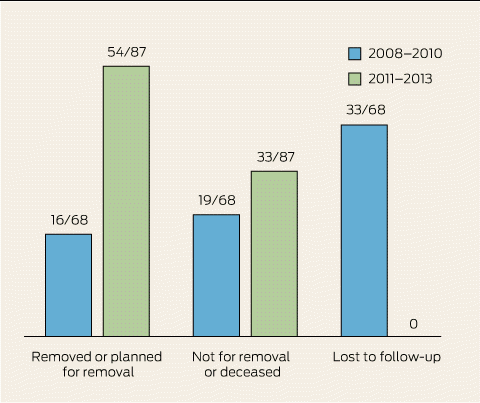
Between 2011 and 2013, all 87 IVC filters inserted by IR at St Vincent’s Hospital Melbourne have been accounted for; 44 have been removed, 33 were planned not for removal (eg, patients with a poor prognosis or contraindications), and 10 are awaiting removal or review in our IR clinic. The average indwelling time for IVC filters inserted between 2011 and 2013 was 23 weeks (range, 1–130 weeks), with 71/87 filters remaining in situ for less than 6 months. The average time in situ fell from 35 weeks in 2011 to 14 weeks in 2013. These results contrast with 2008–2010 data from our institution, where only 16/68 IVC filters were removed or planned for removal, 19/68 were planned not for removal or the patient was deceased, and 33/68 were lost to follow-up (Box).
Concerns about inadequate IVC filter removal and follow-up have been reported in the literature, particularly as the use of filters has increased.2,3 Potential complications associated with “forgotten” IVC filters include thrombogenesis, caval perforation, and filter fracture and migration. However, the important role of IR in tracking and removing lost filters is becoming widely recognised, with a number of studies outlining improvements in IVC filter follow-up that have resulted from radiology-led initiatives.4,5 Our data support the conclusion that IR departments, through easily implemented strategies, can and should take responsibility for tracking and removing all IVC filters they insert.

Competing interests
No relevant disclosures.
References
- Tan XL, Tam C, Mckellar R, et al. Out of sight, out of mind: an audit of inferior vena cava filter insertion and clinical follow up in an Australian institution and literature review. Intern Med J 2013; 43: 365-372. BABEIJEC
- Sarosiek S, Crowther M, Sloan JM. Indications, complications, and management of inferior vena cava filters: the experience in 952 patients at an academic hospital with a level I trauma center. JAMA Intern Med 2013; 173: 513-517. CBBHHHJG
- Sella DM, Oldenburg WA. Complications of inferior vena cava filters. Semin Vasc Surg 2013; 26: 23-28. CBBJCACG
- Zangan S, Funaki B, Van Ha T, et al. A focused follow up program to increase the retrieval rate of optional IVC filters. Chicago: Radiological Society of North America, 2012. https://rsna.org/uploadedFiles/RSNA/Content/Science_and_Education/Quality/Zangan2.pdf (accessed Feb 2014).
- Lee L, Taylor J, Munneke G, et al. Radiology-led follow-up system for IVC filters: effects on retrieval rates and times. Cardiovasc Intervent Radiol 2012; 35: 309-315. i1142882
Shifting focus to adolescent wellbeing and inclusive participation in the digital age
Allyson R Todd, Elena Wang, Stephanie R Partridge
The clinical presentation, investigation, and management of women diagnosed with endometriosis in Australian general practices, 2011–2021: an open cohort study
Danielle Mazza, Kailash Thapaliya, Sharinne B Crawford, Alissia Hui, Maryam Moradi, Luke E Grzeskowiak
The impact of the Breast Screen NSW transition from film to digital mammography, 2002–2016: a linked population health data analysis
Rachel Farber, Nehmat Houssami, Katy J L Bell
Non‐technical errors associated with deaths in surgical care, Australia, 2012–2019, by surgical specialty (Australian and New Zealand Audit of Surgical Mortality): a retrospective cohort study
Jesse Ey, Victoria Kollias, Octavia Lee, Kelly Hou, Matheesha Herath, John B North, Ellie Treloar, Suzanne Edwards, Martin Bruening, Adam J Wells, Guy J Maddern
The CURE Asthma roadmap
Gary P Anderson, Anthony Flynn, Phil G Bardin, John D Blakey, Shyamali C Dharmage, Paul Foster, Peter G Gibson, Adam Jaffe, Alan James, Christine R Jenkins, Sundram Sivamalai, Peter D Sly, Guy B Marks, Vanessa M McDonald, Judy Wetttenhall
Evidence from Australian cohort studies about asthma trajectories and transitions across the life course: a narrative review
Caroline Lodge, Xin Dai, Ingrid A. Laing, Michael P Menden, Anthony Flynn, Gary P Anderson, Sarath Ranganathan, Shyamali C Dharmage