




Volume 197 - Issue 11
How should we regulate smokeless tobacco products and e-cigarettes?
Authors: Coral E Gartner, Wayne D Hall and Ron Borland
Med J Aust 2012; 197 (11): 611-612. || doi: 10.5694/mja12.10940
Published online: 10 December 2012
Published online: 10 December 2012
Less harmful forms of nicotine have harm reduction potential that is worth investigatingConcern has been expressed about the possible increased use of smokeless forms of tobacco, such as low-nitrosamine smokeless tobacco (SLT) and electronic nicotine delivery systems (ENDS), also known as e-cigarettes (Box).1 Domestic sale of SLT was banned pre-emptively in 1991 in response to overseas marketing of these products to youth. Currently, Australians are permitted ...
Less harmful forms of nicotine have harm reduction potential that is worth investigating
Concern has been expressed about the possible increased use of smokeless forms of tobacco, such as low-nitrosamine smokeless tobacco (SLT) and electronic nicotine delivery systems (ENDS), also known as e-cigarettes (Box).1 Domestic sale of SLT was banned pre-emptively in 1991 in response to overseas marketing of these products to youth. Currently, Australians are permitted to import limited amounts of SLT for personal use, but the importation of nicotine cartridges and solutions for use in ENDS is prohibited because nicotine is a Schedule 7 poison. Meanwhile, the most harmful tobacco products — conventional cigarettes — are ubiquitous in Australian retail environments.
Low levels of SLT use have been reported in Australia. According to the 2010 National Drug Strategy Household Survey, 0.7% (95% CI, 0.6%–0.9%) of the population aged 14 years or older had used SLT at least once in the previous year, a marginal increase from the 0.5% (95% CI, 0.4%–0.6%) in the 2007 survey.2,3 This is much lower than the levels of use of illicit drugs, such as ecstasy (3.0%), cocaine (2.1%), methamphetamine (2.5%) and cannabis (10.3%).4 Unpublished data from the International Tobacco Control Policy Evaluation Study indicate that use of ENDS in Australia is very low.
The tobacco industry has known for many decades that conventional cigarettes cannot be modified to be substantially less harmful.5 SLT products, by contrast, vary in their harmfulness. Low-nitrosamine SLT probably does not differ much in safety from “clean” nicotine products that are legally available over the counter in pharmacies and supermarkets.6 Traditional chewing tobaccos from Asia and Africa are much more carcinogenic, although still less harmful than cigarettes.7 Allowing restricted domestic sales of SLT products, with strict limits on toxin content, would prevent the most harmful SLT products from being marketed while allowing tobacco smokers to use the much less harmful SLT products.
There are fewer risks associated with domestic sales of SLT products now than there were 20 years ago because the regulatory environment has changed substantially for the better. For example, Australia now has a complete tobacco advertising ban (which includes sports sponsorship), higher tobacco taxes, effective public education campaigns, mandatory graphic health warning labels on cigarette packets, and mandatory plain packaging of cigarettes. Furthermore, we now have better evidence that low-toxin forms of SLT are much less harmful than cigarettes.7 A ban on clean nicotine products for recreational use would appear to be primarily for moral rather than public health reasons.8,9 Indeed, the United Kingdom’s National Institute for Health and Clinical Excellence has recently released draft guidelines which include use of e-cigarettes for those who may need to use alternative forms of nicotine for extended periods to quit smoking.10
ENDS vary in terms of the nicotine delivery and the quality control processes used during their manufacture. Although the safety of regular use of ENDS is unknown, it is likely on biological and toxicological grounds to be less harmful than regular use of conventional cigarettes as the vapour does not contain the combustion by-products of tobacco that are responsible for much smoking-related harm (eg, tobacco-specific nitrosamines, polycyclic aromatic hydrocarbons, fine particulate matter and carbon monoxide).11 So it is worth investigating whether these products cause as little harm as nicotine replacement products. The development of consumer standards for ENDS would also address the greatest safety concerns: leaky nicotine cartridges, contamination of nicotine solutions with diethylene glycol, and a lack of warning labels on these products.12
The risks in allowing ENDS to be sold can be managed. These products are designed to look like cigarettes and be used like cigarettes — puffing and exhaling a vapour that resembles smoke. This is why some smokers find them attractive in countries that allow their sale. Some public health advocates oppose their use for this reason, fearing that the tobacco industry will use ENDS to undermine smoke-free policies and counter the denormalisation of smoking.9 It would be prudent to ban use of ENDS in places where smoking is banned and to mandate that ENDS be made to look less like cigarettes — for example, by not having a red glowing tip that lights up when the device is puffed.
Marketing of ENDS requires regulation. This could involve similar controls as for smoked tobacco or, preferably, limited marketing to current smokers by not-for-profit agencies.13 Such agencies would not have a commercial interest in growing the ENDS market; their aim would be to eliminate smoking and minimise long-term nicotine use. Under either regulatory option, distributors should be required to provide detailed market data to regulators, so that the size of the ENDS market can be closely monitored. Similar requirements should also be imposed on those who sell conventional cigarettes. Population surveys should also inquire about ENDS use to ensure that these products are primarily used by smokers to quit rather than by non-smokers.
The critical policy question is: would some current smokers use these products as substitutes for conventional cigarettes? If the proportion who would do so is sufficiently high, we might be able to use ENDS to justify making smoked tobacco products even less accessible and less affordable than they are now, with the longer-term aim of phasing out cigarettes.14 We would like to see a reversal of the current regulatory regime so that (i) smoked tobacco can only be imported for personal use and (ii) ENDS and/or clean forms of SLT are more readily available, although not as readily available as cigarettes are now. In the meantime, imposing a lower excise tax on SLT products and ENDS than cigarettes could encourage smokers to use these less harmful products. Overseas experience provides evidence for the feasibility of this approach: large-scale switching from cigarettes to SLT has occurred in Sweden, where SLT was taxed at a lower rate than cigarettes for many years.14
Australia currently has among the most restrictive regulation of SLT products and ENDS in the world. Further restrictions would force users of these products to choose between an unregulated black market and continuing to smoke cigarettes. In addition, such a move would be out of step with policy in countries such as New Zealand and the UK,7,10 where the harm reduction potential of these products is being explored. The Australian Government has a valuable opportunity to revise the regulation of these products to benefit public health in the short term and possibly hasten the end of tobacco smoking in the longer term.
The death and disability toll from smoking makes the status quo unconscionable. We urge those in the tobacco control community and the government to develop a regulatory strategy that will better serve the public by maximising the potential benefits of these products while monitoring and minimising any negative effects of their use.
Smokeless forms of tobacco
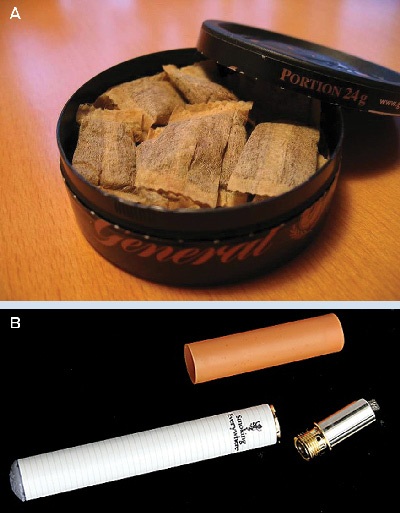
Low-nitrosamine smokeless tobacco products include compressed dissolvable powdered tobacco tablets, tobacco pellets, dissolvable tobacco strips, and oral snuff in pouches such as Swedish snus (A). Electronic nicotine delivery systems resemble conventional cigarettes but do not contain tobacco leaf. They comprise an atomiser, a battery, and a cartridge that usually contains nicotine and flavourings suspended in propylene glycol or glycerol (B). When the user draws on the mouthpiece, the battery heats the cartridge to produce a vapour that is inhaled by the user.
Competing interests
We are investigators on a National Health and Medical Research Council-funded project grant that is trialling low-nitrosamine SLT products and ENDS as quitting aids for smokers. Ron Borland is a principal investigator on the International Tobacco Control Policy Evaluation Project.
References
- Therapeutic Goods Administration. Electronic cigarettes. Canberra: Department of Health and Ageing, 2011. http://www.tga.gov.au/consumers/ecigarettes.htm (accessed Oct 2012).
- Australian Institute of Health and Welfare. National Drug Strategy Household Survey, 2007 [computer file]. Canberra: Australian Social Science Data Archive, Australian National University, 2009. 0_i1115663
- Australian Institute of Health and Welfare. National Drug Strategy Household Survey, 2010 [computer file]. Canberra: Australian Social Science Data Archive, Australian National University, 2011. 0_i1115665
- Australian Institute of Health and Welfare. 2010 National Drug Strategy Household Survey: detailed findings. Canberra: AIHW, 2011. (AIHW Cat. No. PHE 145; Drug Statistics Series No. 25.) 0_i1115667
- Proctor RN. Golden holocaust: origins of the cigarette catastrophe and the case for abolition. California: University of California Press, 2012. 0_i1115669
- Mendoza-Baumgart MI, Tulunay OE, Hecht SS, et al. Pilot study on lower nitrosamine smokeless tobacco products compared with medicinal nicotine. Nicotine Tob Res 2007; 9: 1309-1323. 0_i1115671
- Royal College of Physicians. Harm reduction in nicotine addiction: helping people who can’t quit. A report by the Tobacco Advisory Group of the Royal College of Physicians. London: RCP, 2007. 0_i1115673
- Sweanor D, Alcabes P, Drucker E. Tobacco harm reduction: how rational public policy could transform a pandemic. Int J Drug Policy 2007; 18: 70-74. 0_i1115675
- Bell K, Keane H. Nicotine control: e-cigarettes, smoking and addiction. Int J Drug Policy 2012; 23: 242-247. 0_i1115677
- National Institute for Health and Clinical Excellence. Tobacco — harm-reduction approaches to smoking. London: NICE, 2012. http://guidance.nice.org.uk/PHG/52 (accessed Oct 2012).
- Cahn Z, Siegel M. Electronic cigarettes as a harm reduction strategy for tobacco control: a step forward or a repeat of past mistakes? J Public Health Policy 2010; 32: 16-31. 0_i1115681
- Trtchounian A, Talbot P. Electronic nicotine delivery systems: is there a need for regulation? Tob Control 2011; 20: 47-52. 0_i1115683
- Borland R. A strategy for controlling the marketing of tobacco products: a regulated market model. Tob Control 2003; 12: 374-382. 0_i1115686
- Gartner CE, Jimenez-Soto EV, Borland R, et al. Are Australian smokers interested in using low nitrosamine smokeless tobacco for harm reduction? Tob Control 2010; 19: 451-456. 0_i1115688
Provenance: Not commissioned; externally peer reviewed.