




Volume 197 - Issue 11
The hazards of brussels sprouts consumption at Christmas
Authors: Stephen J Pettit, Alan G Japp and Roy S Gardner
Med J Aust 2012; 197 (11): 661-662. || doi: 10.5694/mja12.11304
Published online: 10 December 2012
Published online: 10 December 2012
A festive season dietary indiscretion precipitated hospital admission for one patient who was on anticoagulation therapy.
Excessive consumption of vitamin K1-rich foods may antagonise the action of warfarin. Eating a large amount of brussels sprouts precipitated hospital admission for a patient who was on anticoagulation therapy for a left ventricular assist device. Doctors should counsel all patients in whom maintenance of anticoagulation is crucial against overconsumption of such foods.
Clinical record
A man in Scotland with chronic heart failure and severe left ventricular systolic dysfunction caused by coronary artery disease received a HeartMate II (Thoratec) left ventricular assist device (LVAD) as a bridge to transplantation. In line with standard practice, he was anticoagulated with warfarin. The target international normalised ratio (INR) was 2.0 (reference interval, 1.8–2.2). Stable anticoagulation was achieved with a daily dose of 7 mg.
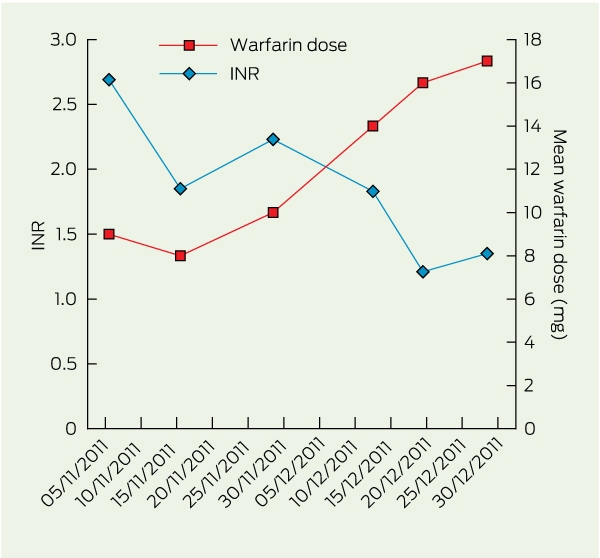
Four months later, in the weeks before Christmas, his INR was persistently subtherapeutic despite escalating doses of warfarin (Box). He was counselled about the importance of concordance with drug therapy and told to avoid green leafy vegetables, specifically brussels sprouts, which he admitted to enjoying over the festive season. The problems with anticoagulation did not resolve and he was readmitted to hospital 3 days after Christmas for parenteral anticoagulation with low molecular weight heparin and assessment of his response to directly observed warfarin therapy. His INR rose to 2.8 within 3 days of readmission, but there were no bleeding complications. He consumed a standard hospital diet during this readmission. On specific questioning, he admitted to consumption of 15–20 brussels sprouts on 3–4 occasions per week in the period before readmission. His warfarin requirement returned to baseline once this dietary indiscretion was corrected.
Discussion
Warfarin inhibits the enzyme vitamin K1 epoxide reductase, decreasing the amount of reduced vitamin K1 that is available for carboxylation of coagulation factors II, VII, IX and X. The action of warfarin may be antagonised by ingestion of foods rich in vitamin K1. Brussels sprouts (Brassica oleracea) have a vitamin K1 content of 140.3 μg per 100 g after preparation by boiling.1 The mass of a typical brussels sprout is 10–15 g. We estimated that our patient consumed 0.6 to 1.7 mg of vitamin K1 per week, depending on sprout mass, portion size and ingestion frequency. This is a relatively small amount of vitamin K1 compared with the recommended 2.5–5 mg oral dose of vitamin K1 for reversal of a high INR without spontaneous bleeding. However, brussels sprouts have additional effects on warfarin pharmacokinetics. In a trial involving 10 healthy subjects, a diet including 400 g of brussels sprouts per day for 2 weeks stimulated warfarin metabolism, with a 29% increase in mean elimination rate constant.2
A previous report showed that a patient maintained on high-dose warfarin developed bleeding complications due to a high INR during a hospital admission because her usual vitamin K1-rich diet was unavailable in hospital.3 Patients have also experienced thrombotic complications due to a low INR because of consumption of other vitamin-K1-rich foods, including broccoli, lettuce and wild turnip greens.4,5 We believe this is the first description of a festive-season hospital admission caused directly by the consumption of brussels sprouts.
Finally, a detailed dietary history from our patient was notable for an absence of cranberry sauce over the festive period. Widely recognised as a traditional Christmas “trimming”, its well described potentiating effects on warfarin via inhibition of the cytochrome P450 system might have served to offset the procoagulant action of the sprouts.6 However, this strategy has not been subjected to a rigourous clinical trial and, while cranberry juice has attained popularity as a urinary deodoriser, its ability to counteract the malodorous sequelae of excessive sprout ingestion has not, to our knowledge, been demonstrated. We were therefore compelled to advocate a policy of strict abstinence (“nowt sprout”) pending further investigation of alternative approaches.
Excessive consumption of brussels sprouts can antagonise the action of warfarin and may precipitate admission to hospital. Doctors and patients should be aware of this possibility. Doctors should consider counselling patients who must remain anticoagulated at all times, such as those with LVADs or mechanical valve replacements, against excessive consumption of this traditional Christmas fare.
Competing interests
Stephen Pettit and Roy Gardner do not like brussels sprouts.
References
- US Department of Agriculture, Agricultural Research Service. USDA national nutrient database for standard reference, release 25. 2012. http://www.ars.usda.gov/ba/bhnrc/ndl (accessed Nov 2012).
- Ovesen L, Lyduch S, Idorn ML. The effect of a diet rich in brussels sprouts on warfarin pharmacokinetics. Eur J Clin Pharmacol 1988; 34: 521-523. 0_i1115609
- Kidd LR, Hanumantharaya DH. Sprouting a warfarin interaction. BMJ 2010; 341: c2621. 0_i1115611
- Kempin SJ. Warfarin resistance caused by broccoli. N Engl J Med 1983; 308: 1229-1230. 0_i1115613
- Walker FB. Myocardial infarction after diet-induced warfarin resistance. Arch Intern Med 1984; 144: 2089-2090. 0_i1115615
- Suvarna R, Pirmohamed M, Henderson L. Possible interaction between warfarin and cranberry juice. BMJ 2003; 327: 1454. 0_i1115618
Intranasal Adrenaline Use for the Management of Insect Venom-Induced Anaphylaxis
Thomas J. Young, Wilhelmina R. F. Johnson, Braydon L. Pennington, Troy Wanandy, Wun Y. Lau, Thanh-Thao A. Le
Gabapentinoid Poisoning Presentations to Victorian Emergency Departments: A 15-Year Trend Analysis
Bishaal Tej Gurung, Amy McNeilage, Angus Skeen, Tina Lam, Joanna F. Dipnall, Jane Hayman, Suzanne Nielsen, Ting Xia
Still Treating Yesterday's Risk? Reconsidering Antiviral Use for Mild-to-Moderate COVID-19 Cases in a Broadly Immune Population
Hadar Mudrik-Zohar, Tim Cutfield, Susan Morpeth, Thomas Hills, Eamon Duffy, Laura J. Edwards, Allen C. Cheng, Steven Y. C. Tong
Birth prevalence, clinical sequelae, and management of congenital cytomegalovirus infections in Australia, 1999–2023: a national prospective study
Ece Egilmezer, Suzy M Teutsch, Carlos Nunez, Stuart T Hamilton, Adam W Bartlett, Pamela Palasanthiran, Elizabeth J Elliott, William D Rawlinson
Medication delivery and dispensing interval preferences of people who use antihypertensive medications in Australia: a survey study
Carissa Bonner, Michael A Fajardo, Rachael M Keast, Emily Atkins, Niamh Chapman, Kristie R Weir, Anthony Rodgers, Aletta E Schutte
Concurrent use of hormonal long‐acting reversible contraception by women of reproductive age dispensed teratogenic medications, Australia, 2013–2021
Michelle KY Chen, Adrian Lim, Deshan F Sebaratnam