




Volume 195 - Issue 9
Thunderstorm asthma — a timely reminder
Authors: Megan L Howden, Christine F McDonald and Michael F Sutherland
Med J Aust 2011; 195 (9): 512-513. || doi: 10.5694/mja11.11044
Published online: 7 November 2011
Published online: 7 November 2011
To the Editor: The approach of spring, together with high winter rainfall in and around Melbourne,1 heralds another severe pollen season, raising the risk of allergic rhinitis and asthma in pollen-sensitive individuals. It is therefore timely to report an epidemic of “thunderstorm asthma” that occurred in Melbourne during spring 2010.
Thunderstorm asthma is the phenomenon of a sudden increase in acute asthma exacerbations temporally related to a thunderstorm.2 Previous epidemics in 1987 and 1989 saw up to 10-fold increases in asthma presentations to emergency departments across Melbourne over 24-hour periods.3 Those commonly affected are young adults with a history of seasonal allergic rhinitis but not necessarily asthma, and people with a previous diagnosis of asthma, many of whom do not use preventer medication.4
Rye-grass pollen is believed to be the major causative allergen in Melbourne thunderstorm epidemics.2 In Melbourne, this common springtime aeroallergen is generally filtered out by the nose due to its relatively large 20-micron diameter, causing allergic rhinitis in sensitised individuals. When exposed to moisture, such as in a developing storm cloud, osmotic stress can lead rye-grass pollen to rupture into submicronic particles that are respirable to the lower airways.2 Thunderstorms have outflow winds which concentrate these particles at ground level,4 resulting in epidemics of asthma in exposed, pollen-sensitive individuals.
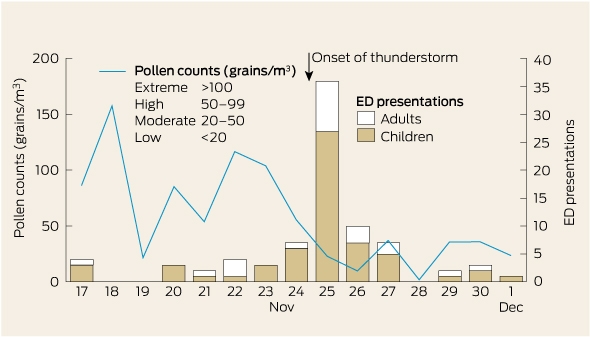
We analysed pollen counts and numbers of asthma presentations at the emergency department of Austin Health (a tertiary hospital servicing north-eastern Melbourne) in the days before and after the thunderstorm of 25 November 2010 (Box). There was a clear spike in asthma presentations immediately after the storm, similar in magnitude to previous epidemics.3 Although we report the experience of one institution only, this was a city-wide event that caused considerable media interest and implementation of the ambulance disaster response plan due to the large number of emergency calls received.5 Pollen counts were in the extreme range (> 100 grains/m3) during some of the days before the thunderstorm, but they were only moderate on the day of the storm (Box). Therefore, while pollen counts can be used as a guide for atopic individuals, they are not the only indicator of an allergenic environment. We propose that additional warnings of elevated risk of asthma exacerbations in pollen-allergic individuals should be made when springtime and summertime thunderstorms follow several days of high or extreme pollen counts.
Individuals with seasonal asthma should use preventer medication, at least during spring, and should have an asthma management plan. Patients with allergic rhinitis should be warned of the possibility of new-onset thunderstorm asthma and advised to seek assistance rapidly if asthma symptoms manifest. Allergen immunotherapy may be administered in carefully selected individuals to prevent springtime symptoms and assessment of such patients by an allergy physician is recommended.
Competing interests
Christine McDonald has received funding (for advisory board membership, research and conference attendance) from GlaxoSmithKline, AstraZeneca and Novartis. Michael Sutherland has received honoraria for lectures from AstraZeneca and Stallergenes.
References
- Australian Government Bureau of Meteorology. Annual climate summary 2010. http://www.bom.gov.au/climate/annual_sum/2010/AnClimSum10_LR1.0.pdf (accessed Jul 2011).
- Suphioglu C, Singh M, Taylor P, et al. Mechanism of grass-pollen-induced asthma. Lancet 1992; 339: 569-572. 0_i1142887
- Bellomo R, Gigliotti P, Treloar A, et al. Two consecutive thunderstorm associated epidemics of asthma in the city of Melbourne. The possible role of rye grass pollen. Med J Aust 1992; 156: 834-837. 0_i1142889
- Taylor P, Jonsson H. Thunderstorm asthma. Curr Allergy Asthma Rep 2004; 4: 409-413. 0_i1142892
- Australian Broadcasting Corporation. “Thunderstorm asthma” reaches epidemic proportions. http://www.abc.net.au/news/stories/2010/11/25/3076420.htm?site=melbourne (accessed Jul 2011).
Rhabdomyolysis After COVID-19
Navya Kataria, Abel Devadass, Lana Sundac, Laura De Souza, Nabeel Sheikh, Samantha Ng, Scott Campbell, Yishen Wang, Ross S. Francis
Technological advances in the search for a CURE for asthma
Sara Quon, Timothy M Johanson, Ridhima Wadhwa, Alen Faiz, Anthony Flynn, Gary P Anderson, Amanda J Cox, Nicholas P West, Michael P Menden, Rhys S Allan
The CURE Asthma roadmap
Gary P Anderson, Anthony Flynn, Phil G Bardin, John D Blakey, Shyamali C Dharmage, Paul Foster, Peter G Gibson, Adam Jaffe, Alan James, Christine R Jenkins, Sundram Sivamalai, Peter D Sly, Guy B Marks, Vanessa M McDonald, Judy Wetttenhall
The first live term birth following uterus transplantation in Australia
Rebecca Deans, Brigitte Gerstl, Antonia W Shand, Sarah Lyons, Aaron Budden, Helen L Barrett, Grant Luxton, Mangalee Fernando, Kenneth Yong, Karen Keung, Kaushalya Arulpragasam, Henry Pleass, King Man Wan, Eva Kehag, Jana‐Emily Pittman, Mianna Lotz, Maria Fenn, Erin Nesbitt‐Hawes, Lily Byun, Katrina Tang, Mats Brannstrom, Jason Abbott
The public health impacts of mining in Australia
Javier Cortes‐Ramirez, Ruby N Michael, Leisa‐Maree Toms, Melissa Haswell
Lingual Raynaud phenomenon
Michael Taggart, Mina John