




Volume 195 - Issue 11
Register of reported cases of leprosy
Author: Peter Christopher
Med J Aust 2011; 195 (11): 717. || doi: 10.5694/mja11.10416
Published online: 12 December 2011
Published online: 12 December 2011
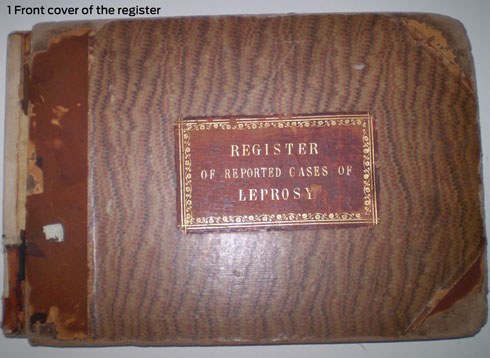
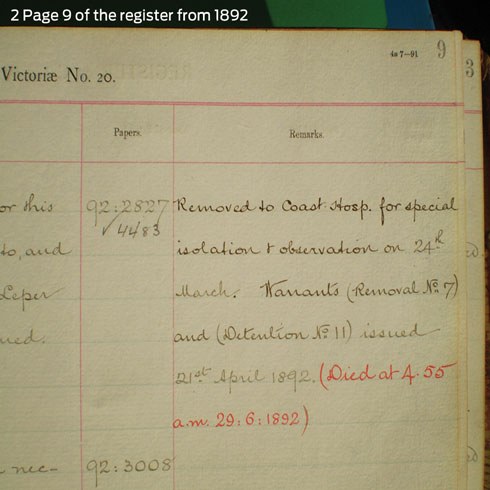
Many years ago, I rescued from destruction a unique 120-year-old leprosy register of the colony of New South Wales (Box 1). This register commenced in 1891 and continued after federation under NSW legislation.1,2 With 101 double pages, patient details were entered into 12 columns, in clearly legible copperplate handwriting (Box 2). As leprosy notification was compulsory, entries were a provisional diagnosis. Patients were subsequently examined by specialists, sometimes chaperoned by police. The diagnosis was entered into the register. If the patient had leprosy, warrants were issued for their detention at the Coast Hospital lazaret at Little Bay in Sydney.
For many, this was a sentence of life imprisonment as there was no effective treatment. Some absconded only to be returned by the constabulary. Patients were treated compassionately, being allowed to keep pets, grow vegetables, and to fish. Chinese patients were even given a liberal allowance of opium.3
“Nationality”, where recorded, showed the highest prevalences of leprosy among Australian or European patients (79 [35%]), Chinese patients (66 [30%]) and Pacific Islanders (22 [10%]). Only three (1%) were Aboriginal, corroborating the fact that leprosy was not endemic before European settlement. Other patients were from Ceylon, Egypt, India, Syria, the United States and Zanzibar.
In the fifth decade (1934), the hospital was renamed the Prince Henry Hospital of Sydney. Subsequently, with the advent of sulfones, patients could be rendered non-infectious within 12 months and be discharged on treatment (with regular reviews) rather than remain incarcerated. Many were readmitted, probably because their compliance with treatment lapsed. The last entry in the register was made in 1950, 59 years after its commencement.
There was no confidentiality coding as there is now with HIV-AIDS registers. Nowadays, leprosy is rare in Australia and immigrants are screened;4 globally, there is a decreasing trend in new cases, with the World Health Organization reporting about half a million in 2003 falling to about a quarter of a million in 2009.5
Competing interests
No relevant disclosures.
References
- Leprosy Act 1890 (54 Vic. No. 20). 0_i1142870
- Public Health Act 1902 (NSW). 0_i1142872
- Boughton CR. A coast chronicle: the history of Prince Henry Hospital 1881–1981. Centenary issue 2nd ed. Waterloo, NSW: Knudsen Printing Pty Ltd, 1981. 0_i1142874
- Christopher PJ, Millsom RH, Bailey KF. Indochinese refugees [letter]. Med J Aust 1978; 1: 507. 0_i1142876
- World Health Organization. Global leprosy situation 2010. Wkly Epidemiol Rec 2010; 85: 337-348. http://www.who.int/wer/2010/wer8535.pdf (accessed Nov 2011).
‘Once Bitten’: A Case of Tetanus Following Snakebite in Australia
Adrian A. S. Doherty, Naomi N. E. Clarke, Sarah Fletcher, Sarah Huffam, Camille V. Awburn, Eugene Athan
Epidemiology and Quality of Care for Aboriginal and Torres Strait Islander Peoples Treated by Emergency Medical Services for Stroke in Victoria, Australia: Retrospective Analysis of Linked Data
Candice Menezes, Ziad Nehme, Luke J. Burchill, Tegwyn McManamny, Angela Dos Santos, Michelle Crilly, Luke P. Dawson, Benjamin Clissold, David Anderson, Emily Nehme
Intranasal Adrenaline Use for the Management of Insect Venom-Induced Anaphylaxis
Thomas J. Young, Wilhelmina R. F. Johnson, Braydon L. Pennington, Troy Wanandy, Wun Y. Lau, Thanh-Thao A. Le
Gabapentinoid Poisoning Presentations to Victorian Emergency Departments: A 15-Year Trend Analysis
Bishaal Tej Gurung, Amy McNeilage, Angus Skeen, Tina Lam, Joanna F. Dipnall, Jane Hayman, Suzanne Nielsen, Ting Xia
They Brought the Hospital to Me
Hugh N. Burrill
Predictors of Ambulance Transport to Hospital for Older People Living in Tasmanian Aged Care Facilities: A Retrospective Cohort Study
Sharon Andrews, Pieter F. Fouche, Belinda Flanagan, Michael McDermott, Melanie Greenwood