




Volume 193 - Issue 11
Creating and marketing illness
Author: Greg Kyle
Med J Aust 2010; 193 (11): 708. || doi: 10.5694/j.1326-5377.2010.tb04112.x
Published online: 6 December 2010
Published online: 6 December 2010
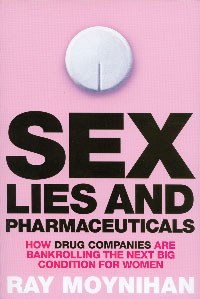
Sex, lies and pharmaceuticals. How drug companies are bankrolling the next big condition for women
. Ray Moynihan. Sydney: Allen & Unwin, 2010 (256 pp). ISBN 9781742370187.
SEX SELLS, as does the implication of a good scandal, so the title alone should generate some sales of Australian investigative journalist Ray Moynihan’s latest exposé of Big Pharma’s marketing machine. Building on the success of his earlier work, Selling sickness, Moynihan here teams up with Dr Barbara Mintzes (Assistant Professor in the Department of Anesthesiology, Pharmacology and Therapeutics at the University of British Columbia in Canada) to disassemble the story behind “female sexual dysfunction” or FSD.
The story of FSD is traced through an investigative journalist’s eyes, from the revolution in sexual medicine in the late 1980s, through the launch of the now infamous phosphodiesterase type 5 inhibitors, to today. Along the way, with the benefit of hindsight, the authors assemble the jigsaw pieces of pharmaceutical company influences on researchers and clinicians to paint a picture of a series of disorders being created by the very industry which then fortuitously provides the panacea.
Moynihan and Mintzes are no strangers to highlighting the effects of pharmaceutical company promotion and largesse. While it could be argued that this work is part of a sustained attack on the industry, Moynihan takes great care to emphasise the usefulness of pharmaceuticals for some women who have a sexual disorder. The main theme is that these women form a small minority — not 43% or similar figures quoted by proponents of such medical treatment — and that many non-drug therapies are as effective as drugs, if not more so.
Sex, lies and pharmaceuticals is very readable, and its target audience is consumers, not health professionals. Its main aim is to encourage consumers (or patients) to ask questions of their doctors to gain an understanding of the diagnosis with which they are being labelled, and for which they are subsequently treated. It is $30 well spent to see what your patients may be reading and to question “Where did those useful diagnostic tools really come from?”.
Awareness, Usage and Perceptions of Doxycycline Post-Exposure Prophylaxis (doxyPEP) for Prevention of Sexually Transmitted Infections in Australia: Insights From a National Cross-Sectional Survey
Catriona S. Bradshaw, Dash Heath-Paynter, Benjamin Riley, Daniel Grace, Fabian Y. S. Kong, Eric P. F. Chow
How Can We Ensure Access to Sexual and Reproductive Health Information for Adolescents in Light of Australia's Social Media Restrictions?
Olena Ivanova, Anisa R. Assifi, Danielle Mazza
Differentiated and simplified oral HIV pre‐exposure prophylaxis (PrEP) models hold the key to virtually eliminating HIV transmission in Australia by 2030
Tyson Arapali, Sarah Warzywoda, Anthony K J Smith, Curtis Chan, Timothy R Broady, Erin Sullivan, Catherine MacPhail, Mohamed A Hammoud, Alexander Dowell‐Day, Benjamin R Bavinton
An autoethnographic critique of a past report of inpatient psychiatric treatment for gender diverse children
Jayne McFadyen, Timothy W Jones, Rowena Koek, Fintan Harte, Brendan Jansen, Megan Galbally, Warren Kealy‐Bateman, Catherine Wall, Quinnehtukqut McLamore, Anja Ravine
Cass Review does not guide care for trans young people
Julia K Moore, Cate Rayner, S Rachel Skinner, Katie Wynne, Blake S Cavve, Brodie Fraser, Uma Ganti, Claire McAllister, Gideon Meyerowitz‐Katz, Tram Nguyen, Anja Ravine, Brian Ross, Darren B Russell, Liz A Saunders, Aris Siafarikas, Ken C Pang
Motivations, barriers and enablers for medical and forensic examiners in New South Wales sexual assault services: a qualitative interview study
Natalie Edmiston, Sam Sperring, Rosalie Power, Samantha Ryan, Kathryn Evans, Jane Ussher, Ellie Freedman