




Volume 192 - Issue 12
Cross-cultural mental health guide
Author: Perminder S Sachdev
Med J Aust 2010; 192 (12): 718. || doi: 10.5694/j.1326-5377.2010.tb03711.x
Published online: 21 June 2010
Published online: 21 June 2010
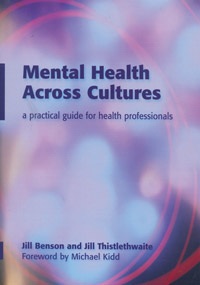
Mental health across cultures. A practical guide for health professionals.
Jill Benson, Jill Thistlethwaite. Oxford: Radcliffe Medical Press, 2008 (xiii + 208 pp). ISBN 9781846192197.
In an increasingly multicultural Australia, a medical practitioner is called upon, on a daily basis, to treat patients from diverse cultural backgrounds: migrants, refugees, students from other cultures and Indigenous people. This cultural diversity extends to differences in social status, age, religion, sexual orientation and many other sociodemographic aspects. A medical consultation across the cultural divide is fraught with the risk of miscommunication. Jill Benson and Jill Thistlethwaite, in this small information-packed volume, provide an antidote to such a predicament. Both authors are doctors who have worked in diverse settings in Australia and overseas, have treated patients from many different cultural backgrounds, are knowledgeable about diverse cultures and sensitive to differences, recognise the importance of mental health consultations in general practice, and take a keen interest in their patients’ stories.
The first call they make in the book is for physicians to become aware of cultural differences. They then present a model for working across the cultural divide, beginning with self-reflection, developing an understanding of another culture through networking and mentoring and, most importantly, listening to the patient’s story. The primary care physician is first and foremost a healer, and this book presents a succinct view of the issues that come up when psychotherapy, behaviour therapy or narrative therapy must bridge a cultural divide. Even pharmacotherapy is not immune to transcultural challenges as miscommunication can affect adherence and appropriate use of drugs, and ethnic or racial differences can influence drug kinetics and dynamics.
The strength of this book lies in the distilled wisdom of two practitioners who teach through real-life examples and present practical solutions. It can therefore be recommended to all physicians and medical students. If you are an international medical graduate practising in Australia or an Australian graduate wishing to work overseas, you will find the case studies particularly appealing. The book fills a gap in the cross-cultural health literature.
Reorienting Allied Health Into Community-Based Care for People Experiencing Trauma and Social Disadvantage
Simon Rosenbaum, Grace McKeon, Gulsah Kurt, Oscar Lederman, Kemi Wright, Sabuj Kanti Mistry, Jackie E. Curtis, Philip B. Ward, Zachary Steel, Hamish Fibbins, Rachel Morell, Melissa C. Eaton, Andrew Watkins, Ben Harris-Roxas, Brendan Goodger, Eleanor Beck, Megan Teychenne, Joseph Firth, Davy Vancampfort, David Burns, Russell Roberts, Tristan Favaloro, Danielle Weber, Rosanna Barbero, Vasili Maroulis, Melissa Holmes, Stefan Mackenzie, Chiara Mastrogiovanni, Afsana Anwar, Uzma Choudhry, Catherine Sherrington, Jane Currie, Thomas Gadsden, Scott Teasdale
Stigmatising Attitudes Towards People With Depression, Bipolar Disorder, Borderline Personality, ADHD and Early and Long-Term/Untreated Schizophrenia: Representative Survey of Australian Adults
Amy J. Morgan, Anna M. Ross, Gayle McNaught, Rachel Green, Nicola J. Reavley
Psychosocial Hazards for Healthcare Workers: Supporting the Second Victim Also Helps the Primary Victims
Sarah Michael
Supporting Population Mental Health in the Wake of Mass Tragedies
Susan J. Rees, Derrick M. Silove
In the Wake of the National Suicide Prevention Strategy 2025–2035: Suicide Prevention in Type 1 Diabetes
Rigel Paciente, Keely Bebbington, Alix Woolard, Helen Milroy