




Volume 192 - Issue 11
Pandemic (H1N1) 2009 influenza, pregnancy and extracorporeal membrane oxygenation
Authors: Susan A Welch, Leone N Snowden and Hergen Buscher
Med J Aust 2010; 192 (11): 668. || doi: 10.5694/j.1326-5377.2010.tb03675.x
Published online: 7 June 2010
Published online: 7 June 2010
To the Editor: Treatment of critically ill pregnant women is challenging, and information on medication use during pregnancy is scant. We describe the case of a pregnant woman who required extracorporeal membrane oxygenation (ECMO), prolonged sedation and paralysis to treat acute respiratory distress syndrome secondary to pandemic (H1N1) 2009 influenza.
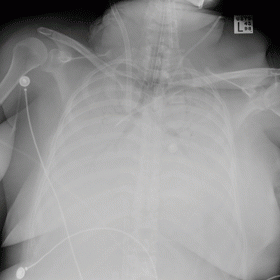
A 34-year-old pregnant woman (G2P1) at 21 weeks’ gestation presented to a metropolitan hospital with level 1 intensive care unit facilities. She had known Grade 2 placenta praevia, a 5-day history of influenza-like symptoms, and no history of asthma, chronic disease or recent travel. On examination, she was severely hypoxic (PaO2, 27 mmHg on 15 L/min O2), conscious, tachypnoeic and speaking in single words. A chest x-ray showed extensive bilateral infiltrates (Box). She needed urgent endotracheal intubation but remained hypoxic despite maximal intensive mechanical ventilation.
The patient was transferred to St Vincent’s Hospital, Sydney, where venovenous ECMO was commenced on arrival. Her oxygenation status improved and remained satisfactory. Mechanical ventilation was reduced (tidal volume, < 6 mL/kg; peak pressure, < 30 cm H2O) to avoid ventilator-induced lung injury. The patient required very high doses of morphine, fentanyl, midazolam, propofol, dexmedetomidine, cisatracurium and heparin during ventilation and ECMO. In addition, empirical treatment with oseltamivir (150 mg twice a day, Days 1–8), azithromycin and ceftriaxone was started on admission, before a bronchoalveolar lavage specimen tested positive for influenza A and pandemic influenza. Furthermore, a multiresistant Escherichia coli caused ventilator-associated pneumonia, which was treated with meropenem (1 g three times a day, Days 17–30).
ECMO was discontinued on Day 19, when lung function had improved. No other organ failure developed. On Day 21, a tracheostomy was performed for severe weakness and weaning failure. The patient was weaned from the ventilator on Day 35 and was discharged home 2 weeks later, after making a full recovery. She gave birth by caesarean section at 35 weeks’ gestation. The baby was in good health and the patient recovered well — both left hospital 3 days after the birth.
Information on the use of medication in pregnant women who require intensive care is limited, especially the use of neuraminidase inhibitors.1 We found little evidence on the safety of long-term use of neuromuscular blockers and sedation in pregnancy, with or without ECMO.2 Most literature on this topic describes short-term use of neuromuscular blockers and sedation. Dexmedetomidine has a short postmarketing history, and has therefore had limited use.
Data from Australia and New Zealand indicate that 9% of patients admitted to an intensive care unit with pandemic influenza are pregnant. An estimated inhospital mortality rate of more than 16% in this population indicates the severity of the infection.3,4 Single-organ lung failure is a common feature of complicated pandemic influenza, and venovenous ECMO should be considered in these circumstances.2,4,5 Our case demonstrates that ECMO and the drugs necessary for its use can be used during pregnancy in a patient with influenza-associated acute respiratory distress syndrome, and that survival of the patient and fetus is possible.
References
- Mangtani P, Mak T, Pfeifer D. Pandemic H1N1 infection in pregnant women in the USA. Lancet 2009; 374: 429-430. 0_BABIJDJG
- King PT, Rosalion A, McMillan J, et al. ECMO in pregnancy. Lancet 2000; 356: 45-46. 0_BABFGBAC
- Webb SA, Pettilä V, Seppelt I, et al. Critical care services and 2009 H1N1 influenza in Australia and New Zealand. N Engl J Med 2009; 361: 1925-1934. 0_BABBJEAE
- Davies A, Jones D, Bailey M, et al. Extracorporeal membrane oxygenation for 2009 influenza A (H1N1) acute respiratory distress syndrome. JAMA 2009; 302: 1888-1895. 0_BABCAHDC
- Peek G, Mugford M, Tiruvoipat R, et al. Efficacy and economic assessment of conventional ventilatory support versus extracorporeal membrane oxygenation for severe adult respiratory failure (CESAR): a multicentre randomised controlled trial. Lancet 2009; 374: 1351-1363. 0_i1091882
Forty Years in the Making: Reporting on the Co-Creation of a National Roadmap for Birthing on Country Services for the Best Start to Life
Res McCalman, Anneka J. Bowman, Roianne West, Kristie Watego, Jyai Allen, Claire Clack, Sue Kildea, Sue Kruske, Melanie Briggs, Cleone Wellington, Rebecca Coddington, Yu Gao, Isabella Garti, Sascha Kowalenko, Sarah Ireland, Catherine Austin, John D. Boffa, Marah Prior, Kelsie Kahl, Bettina Chaseling, Sarah Khaw, Emily Armstrong, Donna Hartz, Yvette Roe
Temporal Trends in Preterm Birth Associated With Hypertensive Disorders of Pregnancy in Victoria, Australia: A Population-Based Interrupted Time-Series Study
Melvin Marzan, Heng Jiang, Daniel Lorber Rolnik, Joanne M. Said, Lisa Hui
Linguistic Manoeuvres: Obstetric Violence Camouflages Harm and Loss of Consent From Birth
Liz Sutton, Harsha Ananthram, Rebecca Matthews
Linguistic Manoeuvres: Obstetric Violence Camouflages Harm and Loss of Consent From Birth
Bashi Kumar-Hazard, Andrew M. Bisits, Sharon L. Settecasse, Jenny Gamble, Hazel Keedle, Hannah G. Dahlen
Linguistic Manoeuvres: Obstetric Violence Camouflages Harm and Loss of Consent From Birth
Wendy Pollock, Alissa Fleming, Ensieh Fooladi, Joy Kloester, Anne Tremayne, Yasmin Zisin, Bethany Carr, Kym Davey, Suzanne Willey, Jenny Gamble
Getting on the Same Page: Why Australia Needs a National Maternity Early Warning System (MEWS) Chart
Briony A. Cutts, Lucy Bowyer, Nisha Khot, Sandra Lowe, Stefan C. Kane