




Volume 189 - Issue 11
de Ketham revisited: a modern-day urine wheel
Author: Charles J Diskin
Med J Aust 2008; 189 (11): 658-659. || doi: 10.5694/j.1326-5377.2008.tb02232.x
Published online: 1 December 2008
Published online: 1 December 2008
During the Middle Ages, uroscopy was an important tool for evaluating health, and medical practitioners often carried Johannes de Ketham’s urine wheel as a diagnostic aid. In honour of de Ketham, a modern urine wheel is presented, which may be a useful diagnostic tool for present-day physicians.
Hippocrates, Aristotle and the ancient Egyptians inferred diagnoses from urine evaluation, but it was not until the Middle Ages that uroscopy reached diagnostic dominance. A major reason for its rise to prominence was the publication of Johannes de Ketham’s Fasciculus medicinae in 1491.1 This was the first illustrated medical book printed and is also among the most beautiful of such texts. The importance it places on urine evaluation is evident on page 1b, which depicts a urine wheel: a large circle surrounded by 21 thin-necked, urine-filled flasks (matulae) (Box 1). This wheel shows how the colour and consistency of urine could be matched to a diagnosis. Disease was thought to result from the imbalance of humours, reflected by urine colour. In the corners of the urine wheel, four small circles contain descriptions of the four temperaments: sanguineous, choleric, phlegmatic and melancholic.
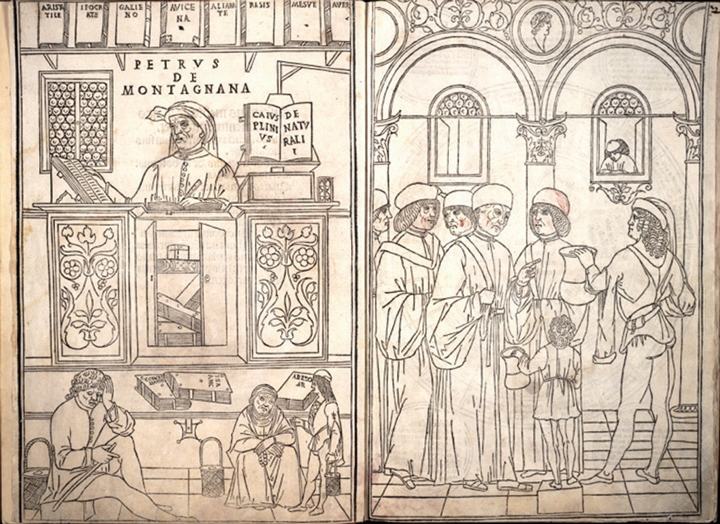
In an era nearly four centuries earlier than Laënnec’s stethoscope, three centuries before the first investigations into blood pressure and two centuries earlier than Hooke’s microscope, uroscopy became the most important tool in evaluating internal health of the human body — more highly valued than the pulse. Its use is depicted by a woodcut from the first Italian edition of de Ketham’s Fasciculus medicinae, showing a professor teaching diagnosis by uroscopy as different matulae are presented to him (Box 2). Although modern technology allows greater insight into the hidden clues of bodily functions, visual observation of urine is still useful. A contemporary urine wheel with diagnoses that might be associated with visually abnormal urine is presented in Box 3.
1 Urine wheel from the first edition of Fasciculus medicinae*
 |
|
* An English translation of de Ketham’s urine wheel is available at www.mhm.ku.dk/upload/urinposter.pdf.2 |

Competing interests
None identified.
Acknowledgements
Emeritus Professor Roy Maffly of Stanford University, whose passion for the evaluation of urine spanned over 40 years and held successive generations of students spellbound.
References
- de Ketham J. Fasciculus Medicinae. Venice: Johannem et Gregorium fratres de Forlivio, 1491. 0_CHDIJAFE
- Jungersen K. The relation between text and colours in medieval urine wheels. http://www.mhm.ku.dk/upload/urinposter.pdf (accessed Oct 2008).
Shifting focus to adolescent wellbeing and inclusive participation in the digital age
Allyson R Todd, Elena Wang, Stephanie R Partridge
The clinical presentation, investigation, and management of women diagnosed with endometriosis in Australian general practices, 2011–2021: an open cohort study
Danielle Mazza, Kailash Thapaliya, Sharinne B Crawford, Alissia Hui, Maryam Moradi, Luke E Grzeskowiak
The impact of the Breast Screen NSW transition from film to digital mammography, 2002–2016: a linked population health data analysis
Rachel Farber, Nehmat Houssami, Katy J L Bell
Non‐technical errors associated with deaths in surgical care, Australia, 2012–2019, by surgical specialty (Australian and New Zealand Audit of Surgical Mortality): a retrospective cohort study
Jesse Ey, Victoria Kollias, Octavia Lee, Kelly Hou, Matheesha Herath, John B North, Ellie Treloar, Suzanne Edwards, Martin Bruening, Adam J Wells, Guy J Maddern
The CURE Asthma roadmap
Gary P Anderson, Anthony Flynn, Phil G Bardin, John D Blakey, Shyamali C Dharmage, Paul Foster, Peter G Gibson, Adam Jaffe, Alan James, Christine R Jenkins, Sundram Sivamalai, Peter D Sly, Guy B Marks, Vanessa M McDonald, Judy Wetttenhall
Evidence from Australian cohort studies about asthma trajectories and transitions across the life course: a narrative review
Caroline Lodge, Xin Dai, Ingrid A. Laing, Michael P Menden, Anthony Flynn, Gary P Anderson, Sarath Ranganathan, Shyamali C Dharmage