




Volume 186 - Issue 12
The difficulty with data: greater accuracy required for policy making
Authors: Susan Downes and Sally M Roach
Med J Aust 2007; 186 (12): 663-664. || doi: 10.5694/j.1326-5377.2007.tb01099.x
Published online: 18 June 2007
Published online: 18 June 2007
To the Editor: Women of the remote Indian Ocean Territories (Christmas Island and the Cocos Islands [see map]) regularly question why their comprehensive obstetric service, allowing deliveries on the Islands, ceased in 1998. A study in 20051 aimed to provide answers for these women.
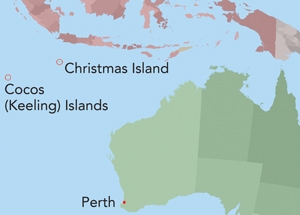
There is one general practitioner on the Cocos Islands and two on Christmas Island. Previously, procedural GPs attended to most deliveries. Now, pregnant women must leave the Islands 4 weeks before their expected delivery. The financial, physical, emotional, and cultural costs of this are substantial.
Reports published in 20022 and 20043 identified community concerns, but resisted recommendations to resume on-Island birthing, because of perceived low birth numbers and difficulty sustaining the skills of clinicians. Both studies relied on external birthing data, as the Indian Ocean Territories Health Service (IOTHS; administered by the Department of Transport and Regional Services) had not documented numbers of deliveries.
The Alberton Report,3 extrapolating from Australian Bureau of Statistics (ABS) data, assumed that the population of children aged less than 1 year in a census year equalled the number of deliveries the year before. The ABS has a system to protect the confidentiality of small isolated populations and purposely does not report these numbers.
The Bath Report2 relied on data from the Western Australian Midwife Notification System (MNS). The MNS reported 136 births to Island women from 1995 to 2004, while our study (Western Australian Centre for Remote and Rural Medicine)1 recorded 326 births. Thus, the MNS attributed only 41% of known births to Island women during 1995–2004, and only 23% during the period considered by the Bath Report.
We believe that the MNS data shortfall occurred for two reasons. Firstly, women frequently provide their temporary mainland address on the MNS form for practical reasons. Secondly, one in seven women leaving the Islands to deliver their babies choose to give birth in a state other than Western Australia to be closer to family, and these births are not attributed to women from the Islands.
The methods used by the Alberton Report, the MNS and the Bath Report result in underestimations of the number of confinements for Island women by up to 77%.
It is regrettable that this situation has not been previously recognised or acknowledged, and that recommendations for the resumption of obstetric services by the IOTHS have repeatedly been based on incomplete data. If records of the numbers of births for Island women had been collected and considered by the IOTHS, Island families might again enjoy a comprehensive on-Island delivery service for low-risk pregnancies.
Competing interests
Susan Downes was paid a modest honorarium by the Department of Transport and Regional Services to assist her in undertaking a research study, of which this was one aspect.
References
- Downes S, Roach S. Obstetric services in the Indian Ocean Territories. Perth: Western Australian Centre for Remote and Rural Medicine, 2006.
- Bath R. Indian Ocean Territories Health Services Development Project — report to the Commonwealth Department of Transport and Regional Services. Perth: Department of Health Western Australia, 2002. 0_i1091824
- Indian Ocean Territories Health and Community Services needs assessment — a combined consultative and evidence based approach. Perth: Alberton Consulting, 2004. 0_CBBEFGCC
Costs of Delivering the Hep B PAST Model of Care in Remote Australia: A Retrospective Pre–Post Study
Hoa Nguyen, Anh Le Tuan Nguyen, Paula Binks, Melita McKinnon, Emily Vintour-Cesar, Karen Wills, Nicola Stephens, Benjamin Cowie, Joshua S. Davis, Yuejen Zhao, Peter Nihill, Julie A. Campbell, Andrew J. Palmer, Jane Davies, Barbara de Graaff
Epidemiology and Quality of Care for Aboriginal and Torres Strait Islander Peoples Treated by Emergency Medical Services for Stroke in Victoria, Australia: Retrospective Analysis of Linked Data
Candice Menezes, Ziad Nehme, Luke J. Burchill, Tegwyn McManamny, Angela Dos Santos, Michelle Crilly, Luke P. Dawson, Benjamin Clissold, David Anderson, Emily Nehme
Hepatitis C Among First Nations Australians: A Rethink Is Required to Meet the 2030 Elimination Target
James Ward, Emily Pegler, Kellie Stacy, Stephen Harfield
Sovereignty and Survival: Understanding Lung Cancer Outcomes for Aboriginal and Torres Strait Islander People in Australia, a Case–Control Study
Alice R. T. Bergin, Luc te Marvelde, Roger L. Milne, Benjamin J. Solomon, Kris Ivanova, Peter Savas, Stephen J. Luen, Jay Hamann, Andrea Casey, Nicole Watt, Sue M. Evans, Gail Garvey, Sherene Loi
Rethinking Rheumatic Fever Diagnosis: Progress, Pitfalls and the Path Towards a Definitive Test
Anna P. Ralph, Rachel Webb, Tom Parks, Nicole J. Moreland, Asha C. Bowen, Benjamin Jones, Emma Ndagire, Andrea Z. Beaton
Not Gone but Often Forgotten: Action Needed to Address Tuberculosis in Aboriginal and Torres Strait Islander Communities
Nikkita Joshua, Emma L. Smith, Eunice (Cheeky) Love, Christopher P. Lowbridge, Nicole Tukana, Amy Bowden, Megan A. Campbell, Dawn Casey, James Ward