




Volume 185 - Issue 5
“Meth mouth”
Author: Kishore Shetty
Med J Aust 2006; 185 (5): 292. || doi: 10.5694/j.1326-5377.2006.tb00566.x
Published online: 4 September 2006
Published online: 4 September 2006
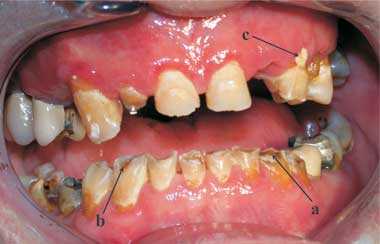
Intraoral examination revealed rampant dental caries (a), enamel erosion (b) and generalised calculus deposits (c).
A 22-year-old man presented with badly decayed teeth and generalised dental pain. Intraoral examination revealed rampant dental caries, enamel erosion and generalised calculus deposits (Box). The patient had a 2-year history of daily use of crystal methamphetamine, administered intravenously or via snorting. He complained of a dry mouth, which led him to consume 2–3 litres of carbonated beverages a day, and reported periods of jaw clenching and temporomandibular joint discomfort on waking.
This clinical syndrome in methamphetamine users, which has been referred to as “meth mouth”,1 can be attributed to several factors: the acidic nature of the drug, its xerostomic effect and propensity to cause cravings for sweetened carbonated beverages; drug-related tooth grinding and clenching; and extended periods of poor oral hygiene. Treating dentists should avoid the use of nitrous oxide, narcotics and vasoconstrictors. Early interventions, such as dietary counselling, application of fluoride varnish and dental plaque control, can prevent significant damage to the teeth.
References
- Assael LA. Methamphetamine: an epidemic of oral health neglect, loss of access to care, abuse, and violence. J Oral Maxillofac Surg 2005; 63: 1253-1254. 0_BEIDDFHE
Gabapentinoid Poisoning Presentations to Victorian Emergency Departments: A 15-Year Trend Analysis
Bishaal Tej Gurung, Amy McNeilage, Angus Skeen, Tina Lam, Joanna F. Dipnall, Jane Hayman, Suzanne Nielsen, Ting Xia
Hospital-Admitted Injection-Related Infections Among Incarcerated People Who Inject Drugs in Australia: A Retrospective Cohort Study
Andrew Palmer, Matthew Carter, Jeremy Yeo, Cecilia Shim, Jason Connor, Jeremy Hayllar, Gerald Holtmann, Naomi Moy, Elliott G. Playford, Naomi Runnegar, Paul J. Clark
The Management of Withdrawal From Alcohol and Other Drugs in Australian Custodial Settings: A Consensus Statement
Grace FitzGerald, Jocelyn Chan, Jon Cook, Mark Stoove, Michael Curtis, Suzanne Nielsen, Rebecca J. Winter, Thileepan Naren
Impact of Prescription Drug Monitoring Program Implementation on Rates and Characteristics of People Seeing Multiple Prescribers in Primary Care: A Controlled Interrupted Time-Series Analysis
Louisa Picco, Monica Jung, Grant Russell, Samanta Lalic, Mahbod A. Fini, Dan I. Lubman, Rachelle Buchbinder, Ting Xia, Suzanne Nielsen
Early Cessation of Acetylcysteine Treatment After Paracetamol Overdose (NACSTOP 2): A Non-Inferiority Randomised Controlled Trial
Anselm Wong, Richard McNulty, Sarah E. Hodgson, Naren Gunja, Andis Graudins
The risk of death after hospitalisation following intentional self‐poisoning: a retrospective observational study (PAVLOVA‐2)
Firouzeh Noghrehchi, Nicholas A Buckley, Rose Cairns