




Volume 183 - Issue 9
Tubulointerstitial nephritis and uveitis syndrome: sore eyes and sick kidneys
Authors: Andy K H Lim, Vicki Levidiotis, Matthew A Roberts and Troy Lim Joon
Med J Aust 2005; 183 (9): 477-478. || doi: 10.5694/j.1326-5377.2005.tb07128.x
Published online: 7 November 2005
Published online: 7 November 2005
Clinical records
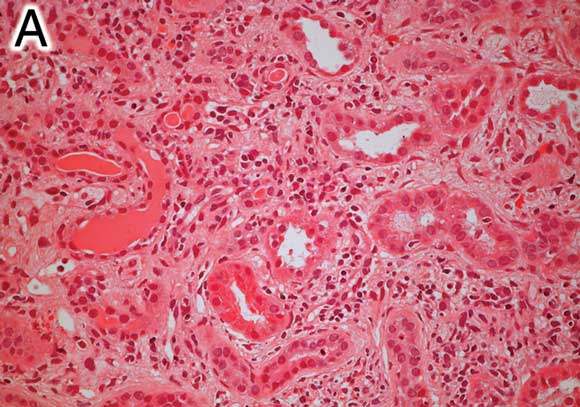
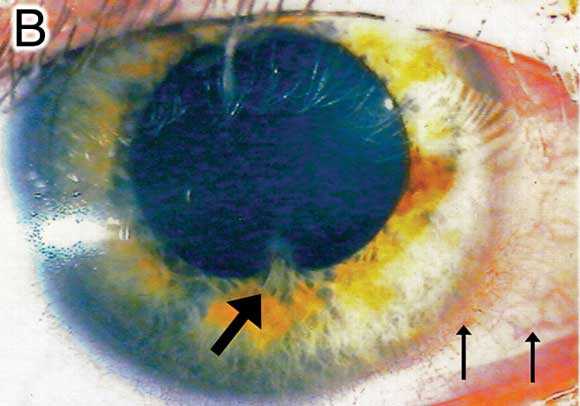
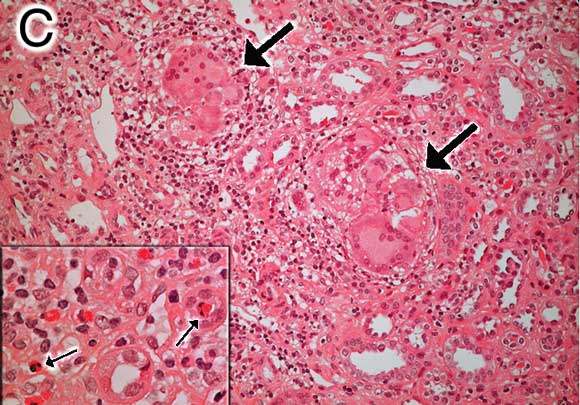
Tubulointerstitial nephritis and uveitis syndrome (TINU) was first reported in 1975.1 Diagnosis of TINU requires identification of acute interstitial nephritis and uveitis, in the absence of systemic diseases associated with either condition. TINU occurs more frequently in females (3 : 1), with the median age of onset being 15 years, and has no racial association.2 At least 50% of cases are probably idiopathic based on the absence of risk factors for acute interstitial nephritis.2 Associations that have been reported include: drugs (antibiotics, non-steroidal anti-inflammatory drugs), infections (herpes zoster, Epstein–Barr virus, toxoplasmosis), and systemic diseases (hyperthyroidism, hypoparathyroidism, rheumatoid arthritis).2 The main differential diagnosis is sarcoidosis. Although uveitis associated with sarcoidosis is typically granulomatous, uveitis associated with TINU is mostly non-granulomatous. Sarcoidosis rarely causes acute interstitial nephritis and frequently affects the lungs, whereas lung involvement has not been reported with TINU. Sjögren’s syndrome is not a differential diagnosis because patients with Sjögren’s syndrome do not develop uveitis despite having sore eyes (sicca). Neither patient was taking medications known to cause acute interstitial nephritis.
There is often a time interval between the diagnosis of uveitis and that of acute interstitial nephritis, making the diagnosis of TINU difficult. In 35% of patients with TINU, ocular findings precede or develop concurrently with acute interstitial nephritis. In 65% of patients, ocular symptoms follow acute interstitial nephritis by a median time of 1 month, but can occur up to 14 months later.2 The most common systemic features are fever, weight loss, fatigue and malaise (50%); and eye pain and redness are the most usual ocular symptoms (77%).2 Acute anterior uveitis is the typical finding (80%) and is usually bilateral. About 20% of patients develop ocular complications, such as posterior synechiae (most common), cataracts and glaucoma.
Patient 1 developed recurrence of uveitis despite quiescent renal disease, showing that the course of ocular disease can be independent of renal disease.2,3 Uveitis recurs or becomes chronic in about 50% of patients. It is commonly treated with topical or systemic steroids, and cycloplegic agents. Methotrexate, cyclosporin or azathioprine may prevent relapses in steroid-resistant, recurrent or persistent uveitis, but randomised trials are lacking.2,4
Both patients demonstrated features of proximal tubular dysfunction consistent with Fanconi’s syndrome. This syndrome causes aminoaciduria, glucosuria, metabolic acidosis (bicarbonate wasting), hypophosphataemia, natriuresis, kaliuresis, polyuria and proteinuria. It has been reported in idiopathic interstitial nephritis,3 drug-related interstitial nephritis,5 and TINU.6,7 Incomplete Fanconi’s syndrome and distal tubular defects with hyperkalaemia have also been reported.8 Urinary electrolyte losses can be significant and symptomatic, as in Patient 1.
Lessons from practice
Beware of red eyes — check for interstitial nephritis and renal failure.
In patients with uveitis, acute interstitial nephritis may not develop concurrently and may be asymptomatic.
In tubulointerstitial nephritis and uveitis syndrome, complications of proximal tubular dysfunction (leading to metabolic acidosis and serious electrolyte disorders) and chronic renal damage can occur.
Potassium, bicarbonate and phosphate supplementation may be needed. Steroid treatment may prevent chronic renal damage.
Another complication that has been found is chronic renal damage. Some authors consider renal disease in TINU to be benign,9 but the renal biopsy from Patient 1 suggests that TINU produces chronic damage. Renal failure may resolve spontan-eously and almost always responds to steroids.2 Persistent renal dysfunction occurs in about 10% of patients, with few needing dialysis. Renal biopsy findings are typical of acute interstitial nephritis, with eosinophils seen in 34% and non-caseating granulomas in 13%.2 Granulomas have been described in lymph nodes and bone marrow.1
Despite its propensity to affect the young, TINU is not limited to paediatric patients, as these cases demonstrate. TINU may be underreported, given the frequent temporal dissociation between uveitis and acute interstitial nephritis. Chronic renal damage and electrolyte abnormalities do occur; hence, patients with uveitis should be evaluated for renal involvement. If any abnormalities are detected, a renal biopsy may be indicated. Early detection and steroid treatment may prevent renal complications.
Competing interests
None identified.
Acknowledgements
We thank Dr Sarah Parsons from the Department of Anatomical Pathology, Austin Health, for providing the renal histology for both patients.
References
- Dobrin RS, Vernier RL, Fish AJ. Acute eosinophilic interstitial nephritis and renal failure with bone marrow–lymph node granulomas and anterior uveitis. A new syndrome. Am J Med 1975; 59: 325-333.
- Mandeville JTH, Levinson RD, Holland GN. The tubulointerstitial nephritis and uveitis syndrome. Surv Ophthalmol 2001; 46: 195-208. 0_i1091652
- Wakaki H, Sakamoto H, Awazu M. Tubulointerstitial nephritis and uveitis syndrome with autoantibody directed to renal tubular cells. Pediatrics 2001; 107: 1443-1446. 0_i1091654
- Takemura T, Okada M, Hino S, et al. Course and outcome of tubulointerstitial nephritis and uveitis syndrome. Am J Kidney Dis 1999; 34: 1016-1021. 0_i1091656
- Spital A, Panner BJ, Sterns RH. Acute idiopathic tubulointerstitial nephritis: report of two cases and review of the literature. Am J Kidney Dis 1987; 9: 71-78. 0_i1091658
- Neelakantappa K, Gallo GR, Lowenstein J. Ranitidine-associated interstitial nephritis and Fanconi syndrome. Am J Kidney Dis 1993; 22: 333-336. 0_i1091660
- Igarashi T, Kawato H, Kamoshita S, et al. Acute tubulointerstitial nephritis with uveitis syndrome presenting as multiple tubular dysfunction including Fanconi’s syndrome. Pediatr Nephrol 1992; 6: 547-549. 0_i1091662
- Braden GL, Germain MJ, Fitzgibbons JP. Impaired potassium and magnesium homeostasis in acute tubulo-interstitial nephritis. Nephron 1985; 41: 273-278. 0_i1091664
- Gion N, Stavrou P, Foster CS. Immunomodulatory therapy for chronic tubulointerstitial nephritis-associated uveitis. Am J Ophthalmol 2000; 129: 764-768. 0_i1091667
A Diagnostic Headache
Thomas Glynn, Michelle T. Leech, Stacy K. Goergen, Emily Lin, Nadeem Toodayan, Ralph Junckerstorff
Neisseria meningitidis: an uncommon cause of conjunctivitis
Chloe Story, Tina Marinelli, Simeon Crawford, Amrita Ronnachit
Dismantling barriers to research and clinical care for individuals with a vision impairment
Eden G Robertson, Kate Hetherington, Meredith Prain, Julia Hall, Leighton Boyd AM, Rosemary Boyd OAM, Emily Shepard, Hollie Feller, Sally Karandrews, Fleur O'Hare, Kanae Yamamoto, Matthew P Simunovic, Robyn V Jamieson, Alan Ma, Lauren Ayton AM, Anai Gonzalez‐Cordero
The New South Wales Pharmacy Trial for herpes zoster: on the nose?
Christian P Pappas, Timothy R Holmes, Minas T Coroneo
Skin fragility disorder misdiagnosed as child abuse: a cautionary tale
Heather G Mack, Fred K Chen, John R Grigg
Health economic aspects of inherited retinal diseases: looking for cost‐effective treatments
Benjamin Kamien, Rachael Heath Jeffery, Fred K Chen