




Volume 183 - Issue 3
Keeping track to keep Australia's overseas aid on track
Authors: Anthony B Zwi, Natalie J Grove and Maria-Theresa Ho
Med J Aust 2005; 183 (3): 119-120. || doi: 10.5694/j.1326-5377.2005.tb06952.x
Published online: 1 August 2005
Published online: 1 August 2005
In the competition for official development assistance, health is losing out to governance and security
Governance, law and justice were “big ticket” items in the 2005–06 Australian federal budget, reflecting the increasing focus on national security in Australia and elsewhere. Our current aid budget reflects this trend.
Australian official development assistance (ODA) seeks “to advance Australia’s national interest by assisting developing countries to reduce poverty and achieve sustainable development”.1 According to AusAID, the agency responsible for the ODA program, poverty reduction remains central, reflecting Australia’s humanitarian values and its economic and security interests. The Australian Government has committed to a number of interrelated policy, program and partnership initiatives. In 2005–06, these initiatives seek to promote a closer partnership with Indonesia and engagement with fragile states, to stimulate broad-based economic growth, to strengthen efforts to promote better governance, to tackle transnational threats (notably HIV/AIDS), and to contribute to greater stability and security.
A fair contribution?
Australian contributions to ODA, now $2.49 billion a year, have been increasing over the past 5 years — a step in the right direction. Budget allocation has risen from 0.25% of gross national income (GNI) in 2001–02 to 0.28% in 2005–06. However, this gradual rise must be seen against the much larger decline over the past 30 years: in 1975–76, 0.45% of GNI was allocated to ODA, falling to 0.43% in 1985–86, 0.32% in 1995–96; and 0.28% in 2005–06.2 Current levels are well below the 0.42% committed, on average, in 2004 by nations belonging to the OECD (Organisation for Economic Co-operation and Development).3 This prompts questions about how Australia will achieve the ODA targets required to meet the United Nations’ Millenium Development Goals, to which we committed in 2000. If it is to do so, a timetable for achievement should be reiterated, with Australian ODA reaching 0.5% of GNI by 2009, nearly double the current level, and 0.7% by 2015.4,5 Without allocating considerably more resources, Australia will be substantially under target.
Who benefits?
Australia’s ODA is increasingly directed to near neighbours; around 42% is allocated to just three countries — Indonesia, Papua New Guinea and the Solomon Islands. The allocation to the whole continent of Africa, where poverty and conflict cut deepest,6 and where the impediments to achieving the Millenium Development Goals are greatest, stands at only 3% of Australia’s ODA. Support for other resource-constrained countries in South and East Asia is not much greater. Assistance to those in greatest need remains crucial if the benefits of greater equity, stability7 and control of infectious diseases,8 for example, are to be achieved.
Attainment of the Millenium Development Goals needs better governance, but also increased and more effective aid for basic services in the poorest countries. One of the agreed indicators of effective aid targeting is the proportion going to countries classified as “Least Developed” by the UN’s Economic and Social Council. As little as 0.05% of Australia’s GNI goes to Least Developed Countries, one of the lowest rates of all OECD donors.9
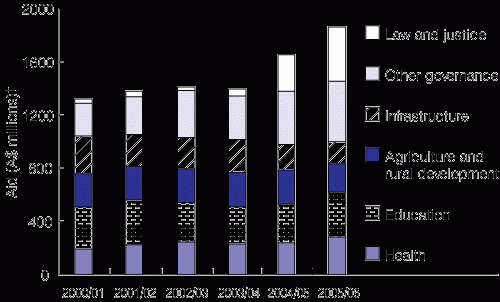
A notable trend in Australia’s latest aid budget is the increased focus on governance, which now attracts 36% of ODA, squeezing out other commitments (Box). Almost half of this governance expenditure goes towards law and justice, with large tranches allocated to the Department of Defence and the Australian Federal Police for their activities overseas. This commitment to a “whole of government” approach has seen greater involvement of Australian experts with limited experience of developing countries, and inadvertently undermines the concentration of development expertise within AusAID itself.
A healthy contribution?
In 2005–06, Australia is devoting only 12% of ODA to health, substantially less than countries such as the United Kingdom (22%),10 and much the same proportion as in the past few years. Within this health allocation, an increasing share is devoted to multisectoral HIV/AIDS programs; their funding has increased from around $25 million in 2001–02 to around $70 million in 2005–06. While increased HIV/AIDS funding is necessary and welcome, commitment to non-HIV health-related expenditure has declined, in some cases markedly. Countries such as Laos, Cambodia and Vietnam no longer receive AusAID funds for health and, in the case of Laos, had primary health care funds cut precipitously.
Health is significantly linked to poverty, but there are no short-cuts or easy solutions to re-establishing, reforming, and reshaping functional, efficient, and more equitable health systems. Basic health care requires sustained investment in human resources, infrastructure, community-level health promotion, and essential services for primary care, as well as attention to the social determinants of ill health. While supporting basic services is not the most glamorous issue, with neither the profile of HIV/AIDS nor the visibility of uniformed police and defence force personnel, these services remain the cornerstone to promoting health and to ensuring that communities can participate in, shape and control their own development. The Australian Council for International Development (ACFID), an independent association of Australian non-government overseas aid and development agencies, estimates that a fair Australian contribution to the global aid requirements for health would be around A$580 million, substantially above our current commitment of A$299 million.2
Keeping track of where ODA goes
Keeping track of ODA is important. Otherwise, we cannot assess the range of activities underway and their outcomes. In recent years, the monitoring of ODA has been made more difficult because of the greater proportion devoted to governance and security, the control of funds by government departments other than AusAID, the failure to separate HIV/AIDS from general health sector reporting, and a reduction in detailed statistical presentation (eg, AusAID has not published a detailed listing of all funded projects since 2001). The level of funding allocated to Australian government departments exposes us to the criticism of “boomerang aid”. The ability to track and account for where funds have actually gone, the proportion tied to purchase of Australian products,11 and the share that goes into basic infrastructure and service delivery in the social sectors, or other forms of direct poverty reduction, should be enhanced.
Aid effectiveness remains a key challenge.12-14 While there are no simple answers, numerous international organisations have made a commitment to promoting evidence-informed policy and allocating resources to learning lessons and reflecting on current practice, in partnership with academic and country-based experts.15 Australian commitment to this trend is to be encouraged.
Will government follow the lead of a generous public?
The response of the Australian community to the 2004 earthquake and tsunami in the Indian Ocean demonstrated popular concern for the needs of others. In fact, even before the tsunami, private contributions by Australians to aid and development were increasing by around 10% per year in real terms (from around $380 million in 2000 to $443 million in 2004, both figures in 2004–05 dollars [G Luke, Policy Adviser to Australian Council for International Development, personal communication, June 2005]), indicating strong interest and support for development cooperation. We need to tap into this public solidarity and ensure that ODA, despite its limitations, obtains more resources and attention.
Increasing commitment to health and education will reinforce governance and security, but this is not why they should be supported. Health and education should attract funds because we care about other people,16 because we have a commitment to promoting human security in the region, and because we find it unacceptable that women die in childbirth because of lack of health services, that preventable diseases kill so many children before the age of 5, and that infectious and non-communicable diseases are decimating economies. Basic services require support, which cannot be provided within the existing aid envelope. The Australian Government White Paper on aid, currently being drafted and due in early 2006, is an opportunity to reinforce commitments to dramatically increase ODA and should place health firmly back on the agenda. The Australian public has demonstrated a willingness to contribute directly. Can we mobilise a matching political commitment?
Australian official development assistance by sector*
* From analyses of AusAID budgetary data (G Luke, Australian Council for International Development, personal communication). Funds not earmarked for a particular sector (either because they go to multisectoral initiatives, such as gender and environment, or to development banks and United Nations agencies) are excluded. †Expressed in 2004–05 Australian dollars.
Competing interests
A Z has received research funding from AusAID.
Acknowledgements
Acknowledgement: The authors are grateful for data and comments from the Australian Council for International Development.
References
- Australian Government AusAID. Australian aid: an integrated approach. Thirteenth annual statement to Parliament on Australia's Aid Program. Canberra: Commonwealth of Australia, 2005. Available at: http://www.ausaid.gov.au/publications/pdf/thirteenth_annual_statement.pdf (accessed May 2005).
- Australian Council for International Development. Analysis of federal aid budget 2005–06. Available at: http://www.acfid.asn.au/campaigns/aid/aid_budget_05-06.htm (accessed May 2005).
- Organisation for Economic Co-operation and Development. Official development assistance increases further – but 2006 targets still a challenge. Table: Net official development assistance in 2004. Available at: http://www.oecd.org/dataoecd/59/51/34700392.pdf (accessed Jul 2005).
- United Nations Millennium Project. Investing in development. A practical plan to achieve the Millennium development goals. New York: UN, 2005. Available at: http://www.unmillenniumproject.org/reports/index_overview.htm (accessed May 2005).
- United Nations Secretary General. In larger freedom. Towards security, development and human rights for all. Report of the Secretary General of the United Nations for decision by Heads of State and Government in September 2005. Available at: http://www.un.org/largerfreedom/index.html (accessed May 2005).
- Dare L, Buch E. The future of health care in Africa [editorial]. BMJ 2005; 331: 1-2. i1085904
- Kaul I, Grunberg I, Stern MA, editors. Global public goods. International cooperation in the 21st century. New York: Oxford University Press, 1999. i1085906
- Smith R, Beaglehole R, Woodward D, Drager N, editors. Global public goods for health. Health economic and public health perspectives. Oxford: Oxford University Press, 2003. i1085908
- United Nations Statistics Division. Millennium indicators database. Available at: http://millenniumindicators.un.org/unsd/mi/mi_goals.asp (accessed May 2005).
- Organisation for Economic Co-operation and Development. International development statistics 2005 [CD-ROM]. Paris: OECD, 2005. i1085913
- Singer P, Gregg T. How ethical is Australia? An examination of Australia’s record as a global citizen. Melbourne: The Australian Collaboration, 2004. i1085915
- Cracknell B. Evaluating development aid. Issues, problems and solutions. London: Sage, 2000. i1085917
- Tarp F, editor. Foreign aid and development. Lessons learnt and directions for the future. London: Routledge, 2000.
- Thomas P (ed). Special issue. International perspectives on aid effectiveness. Issues of policy and practice. Dev Bull 2004: 65 (Aug): 1-122. i1085920
- Court J, Hovland I, Young J, editors. Bridging research and policy in development: evidence and the change process. Rugby, UK: ITDG Publishing, 2005. i1085922
- Chatterjee DK, editor. The ethics of assistance. Morality and the distant needy. Cambridge: Cambridge University Press, 2004. i1085924
Capturing the Benefits of Clinical Quality Registries
Taryn Bessen, Stephen McDonald
Medical Colleges Have an Obligation to Ensure Full Participation in Clinical Quality Registries
Thomas J. Hugh
Getting on the Same Page: Why Australia Needs a National Maternity Early Warning System (MEWS) Chart
Briony A. Cutts, Lucy Bowyer, Nisha Khot, Sandra Lowe, Stefan C. Kane
Data for Equity: Can Linked Administrative Data Inform Pathways to More Equitable Child Health?
Sarah Gray, Shuaijun Guo, Meredith O'Connor, Elodie O'Connor, Katrina Williams, Hannah Badland, Susan Woolfenden, Josie Dickerson, Gerry Redmond, Marnie Downes, Sharon R. Goldfeld
Specialty College Selection: Why Change is Critical to Support a Future Rural Workforce
Matthew R. McGrail, Jenny May AM, Katherine Logan
Differentiated and simplified oral HIV pre‐exposure prophylaxis (PrEP) models hold the key to virtually eliminating HIV transmission in Australia by 2030
Tyson Arapali, Sarah Warzywoda, Anthony K J Smith, Curtis Chan, Timothy R Broady, Erin Sullivan, Catherine MacPhail, Mohamed A Hammoud, Alexander Dowell‐Day, Benjamin R Bavinton