




Volume 183 - Issue 11
“Lesionnaire’s syndrome”
Authors: Dennis Velakoulis, Christos Pantelis and Mark Walterfang
Med J Aust 2005; 183 (11): 679. || doi: 10.5694/j.1326-5377.2005.tb00080.x
Published online: 5 December 2005
Published online: 5 December 2005
The explosion in psychiatric neuroimaging research has led to the establishment of stressful and dark neuroimaging laboratories in which young researchers sweat in front of computer monitors performing laborious and tedious imaging analysis. These conditions have contributed to the development of a new psychiatric syndrome, described below.
Diagnostic criteria
“Lesionnaire’s syndrome” predominantly affects younger researchers examining magnetic resonance imaging (MRI) scans of the brain. These researchers:
(a) Work in large institutions;
(b) Have a fixed belief that volume change in a brain structure causes schizophrenia;
(c) Feverishly spend hours tracing brain structures to prove this belief;
(d) Alter their beliefs if their attempts are unsuccessful and begin work on a different brain structure or new method;
(e) Attribute negative findings to “methodological limitations”;
(f) Begin to see non-brain images in brain scans on which they are working.
The diagnosis may only be made if the patient satisfies criterion (f) and any three of criteria (a)–(e). The diagnosis cannot be made if the MRI scan has revealed an organic disorder.
Case report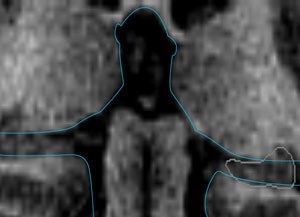
A 38-year-old psychiatrist had spent hundreds of hours tracing hippocampal volumes on MRI scans. He would lock himself in a darkened room, staring at a computer monitor, often listening to ’80s music in an attempt to relieve the mind-numbing tedium of the repetitive tracing behaviour. After tracing scans for 4–5 years, he revealed to his colleagues that he had discovered religious images — in particular, a vision of the Crucifixion (Box).
He was successfully treated with complete tracing abstinence, but has had episodic relapses of his delusional visions, during which he has been heard to cry out “Maybe if I trace a few more it will reach statistical significance”.
In order to ensure that the syndrome was related to the tracing behaviour rather than the music, a further trial was undertaken. Fortunately, re-exposure to ’80s music outside the imaging laboratory did not lead to a relapse in his symptoms.
Motor Neuron Disease Mortality Trends in Australia From 1986 to 2023: A Population-Based Study
Carol M. Y. Lee, Rupendra N. Shrestha, Julian Gold, Mark Stevenson, Kelly L. Williams, Lyndal Henden, Sandrine K. K. Chan Moi Fat, Zoe Zussa, Amanda Wright, Martin Jude, Mark A. S. Laidlaw, Willem J. R. Fokkink, Dominic B. Rowe
Mild traumatic brain injury and concussion and persisting post‐concussion symptoms: new guidelines to support evidence‐based assessment and management in Australia and Aotearoa New Zealand
Karen M Barlow, Jennie L Ponsford, Alice Theodom, Gill Cowen, Gavin A Davis, Vicki Anderson, Franz E Babl, David Cole, Jennifer Cullen, Stuart R Dalziel, Melinda Fitzgerald, Howard Flavell, Caroline Yates, Rebecca Kimble, John H Olver, Rhonda Orr, Mark Ralfe, Michael Rose, Nick Rushworth, Julia Treleaven, Gary Browne, Nathan Delang, Sarah Harris, Gary Mitchell, Sean Tweedy
The prevalence of and variation in indicators of the quality and safety of long term aged care in Australia, 2019: a cross‐sectional population‐based study
Tesfahun C Eshetie, Gillian E Caughey, Catherine Lang, Olivia Ryan, Renuka Visvanathan, Craig Whitehead, Keith Evans, Janet K Sluggett, Jyoti Khadka, Carolyn Dawkins, Helena Williams, Miranda Starke, Sara Blunt, Anne Liddell, Megan Corlis, Anna Sheppeard, Penelope Lello, Marilyn Thien, Steven L Wesselingh, Maria C Inacio
Health and economic benefits of improving pre‐hospital identification of stroke in Australian women: a modelling study
Thomas Gadsden, Lei Si, Emily R Atkins, Cheryl Carcel, Xia Wang, Stephen Jan, Mark Woodward, Laura E Downey
Symptom burden, quality of life, and diagnostic journey of people with postural orthostatic tachycardia syndrome, Australia, 2021–24: a descriptive patient registry data study
Marie‐Claire Seeley, Gemma Wilson, Eric Ong, Amy Langdon, Jonathan Chieng, Danielle Bailey, Kristina Comacchio, Amanda Page, Dennis H Lau, Celine Gallagher
The intersection of rurality and dementia prevalence in Australia for Aboriginal and Torres Strait Islander and non‐Indigenous peoples
Antonia J Clarke, Marwan Ahmed, Judith M Katzenellenbogen, John Towney (Wiradjuri), Anna H Balabanski, Adrienne Withall (Dharawal Yuin), Kylie Radford, Amy Brodtmann