




Volume 182 - Issue 7
Tsunami lung: a necrotising pneumonia in survivors of the Asian tsunami
Author: Anthony M Allworth
Med J Aust 2005; 182 (7): 364. || doi: 10.5694/j.1326-5377.2005.tb06738.x
Published online: 4 April 2005
Published online: 4 April 2005
To the Editor: The disastrous events of Boxing Day, 2004 left hundreds of thousands dead, injured or homeless across large parts of Asia. Many aid teams dispatched to affected areas are grappling with the aftermath of this catastrophe. Here, I present one of many clinical observations of what we encountered in the field. It is a clinical anecdote, but one worth sharing, as it may guide future teams in similar situations.
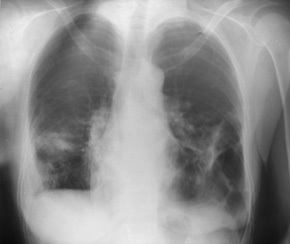
A 62-year-old woman was admitted to hospital with a history of vague ill-health for 12 months, and a subacute illness over the 4 weeks since immersion in the tsunami, with persistant cough, dyspnoea and weakness to the point of being largely bed-bound. She was cachectic, had a fever of 37.5°C and scattered crackles in both lower lung fields. Radiology facilities were not available and she was not producing sputum. She was treated empirically with antituberculous chemotherapy, as well as broad-spectrum antibiotics in the form of amoxycillin and ciprofloxacin orally, but her condition did not improve. X-ray facilities became available soon thereafter, and a chest x-ray showed changes more in keeping with a necrotising pneumonia than tuberculosis ( [a]). Her treatment was changed to intravenous meropenem (1 g every 8 hours) and her condition was slowly improving when we left.
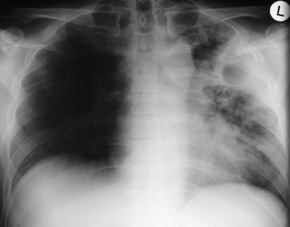
During our 2-week posting in Banda Aceh, we saw about 6–10 patients at three hospitals presenting about a month after their immersion, with fluctuating fever; chronic, non-productive cough; and radiological evidence of bilateral, asymmetric, necrotising pneumonia with cavitation. Some patients developed empyemas and pneumothoraces ( [b]). They failed to respond to broad-spectrum antibiotics including ampicillin/gentamicin/metronidazole and ticarcillin–clavulanate/cotrimoxazole. Burkholderia pseudomallei was cultured from the pleural fluid of two of these patients, and Nocardia sp. from the sputum of another. A notable feature of these patients was their subacute presentation weeks after immersion in the tsunami, the persistence of symptoms despite other broad spectrum antibiotic therapy, and the development of radiological and clinical manifestations of necrosis with pleural involvement.
Many of our patients described the wave as being “black”. In view of the immersion in muddy water in a tropical environment, B. pseudomallei is likely to have been one of the causative organisms in many of these cases. However, it has not been possible to culture B. pseudomallei from all patients, and it is likely that their infections were polymicrobial given the circumstances of their injuries. A variety of bacterial organisms, as well as fungi, have been recognised in other such situations.1-3
When we were there, Fakinah hospital provided one of the few laboratory services in Banda Aceh, and the availability of these facilities were limited as they were focused on public health surveillance. Thus, collection of specimens for culture was not routine. Furthermore, when we arrived there were no nurses, no medical records and no medication or observation charts. While the situation improved rapidly during our stay, these limitations meant that recognition of emerging clinical patterns was important. Many of the antibiotics initially used for patients with immersion injuries were ineffective in this setting, and the use of carbapenems became our first-line, or early second-line, antibiotic in post-immersion respiratory infections in Banda Aceh.
References
- Ender PT, Dolan MJ. Pneumonia associated with near-drowning. Clin Infect Dis 1997; 25: 896-907. CHDHAABG
- van Dam AP, Pruijm MT, Harinck BI, et al. Pneumonia involving Aspergillus and Rhizopus spp. after a near-drowning incident with subsequent Nocardia cyriacigeorgici and N. farcinica coinfection as a late complication. Eur J Clin Microbiol Infect Dis 2005; 24: 61-64.
- Chaney S, Gopalan R, Berggren RE. Pulmonary Pseudallescheria boydii infection with cutaneous zygomycosis after near drowning. South Med J 2004; 97: 683-687. i1085682
Costs of Delivering the Hep B PAST Model of Care in Remote Australia: A Retrospective Pre–Post Study
Hoa Nguyen, Anh Le Tuan Nguyen, Paula Binks, Melita McKinnon, Emily Vintour-Cesar, Karen Wills, Nicola Stephens, Benjamin Cowie, Joshua S. Davis, Yuejen Zhao, Peter Nihill, Julie A. Campbell, Andrew J. Palmer, Jane Davies, Barbara de Graaff
Buruli Ulcer Acquired From Ringtail Possum Rescue
Daniel P. O'Brien, Naomi Clarke, Sara Bonnici, Mohammad A. Hussain
Q Fever Visceral Abscesses After Contact With Native Australian Marsupials
Samantha J. Laws, Enzo Binotto, James Stewart, Jennifer Ho, Trent Yarwood, Josh Hanson, Simon Smith
Hospital-Admitted Injection-Related Infections Among Incarcerated People Who Inject Drugs in Australia: A Retrospective Cohort Study
Andrew Palmer, Matthew Carter, Jeremy Yeo, Cecilia Shim, Jason Connor, Jeremy Hayllar, Gerald Holtmann, Naomi Moy, Elliott G. Playford, Naomi Runnegar, Paul J. Clark
The Live Attenuated Influenza Vaccine in Australia: An Additional Tool for Influenza Prevention
Cyra Patel, Alexis Pillsbury, Tran Nguyen, Xia Wang, Helen E. Quinn, Clayton K. Chiu, Allen C. Cheng, Katie L. Flanagan, Zhicheng Wang
Reflex Testing for Hepatitis D Infection: A Unique Opportunity to Reduce Hepatitis D-Related Chronic Liver Disease Deaths in Australia
Jessica Howell, Lauren Andersson, Miriam T. Levy, James O'Beirne, Leon Adams, Katharine Irvine, Avik Majumdar, Golo Ahlenstiel, Kathy Jackson, Krispin Hajkowicz, Joseph Doyle, Jane Davies, Sarah Cherian, Wayne Dimech, Alexander J. Thompson