




Volume 182 - Issue 2
Allocation concealment and blinding: when ignorance is bliss
Authors: Peta M Forder, Val J Gebski and Anthony C Keech
Med J Aust 2005; 182 (2): 87-89. || doi: 10.5694/j.1326-5377.2005.tb06584.x
Published online: 17 January 2005
Published online: 17 January 2005
Good study design involves minimising all possible sources of bias. Two important sources of bias arise through failure to mask (ie, conceal), first, the randomisation process and, second, the treatments after randomisation. Allocation concealment is the term used to describe the procedure for protecting the randomisation process so that the treatment to be allocated is not known before the patient is entered into the study. Blinding relates to the masking of the treatments after randomisation — from the patient, the investigator or the outcomes assessor. Without exception, allocation concealment is achievable in all randomised clinical trials. In contrast, it is not always possible to blind people to study treatments received. The CONSORT statement strongly encourages detailed reporting of the allocation concealment process and the measures taken to preserve blinding (Box 1).1
Allocation concealment
Failure to conceal the process of random allocation will potentially result in a non-randomised trial, while successful allocation concealment will reduce selection bias. No matter what method is chosen to randomly allocate patients (eg, by simple random numbers, permuted blocks or minimisation), if the investigator or clinician (or the patient) is able to identify the impending treatment allocation and is able to influence the enrolment (or selection) of participating patients, the value of randomisation is compromised. Selection bias may have been introduced, whereby the treatment assignment is no longer truly random and an imbalance in prognostic factors between treatment groups occurs. If this arises, assessment of the treatment comparison is compromised.
Failed concealment from the investigator or clinician
Single-centre trials in which randomisation is conducted on site and the randomisation method is known to the participating investigators are at high risk of this problem. If an investigator has influence over the number of patients enrolling in a trial, or the order in which they are randomised, he or she has the potential to introduce selection bias into the study by directing particular patients into preferred treatment groups while excluding others. However, even if the investigator knows the allocation sequence, the problem will not arise if all consecutive eligible patients are being enrolled in order of presentation, as is often the case in trials in emergency departments, intensive care units or any acute care setting. Ideally, a successful allocation concealment process is ensured when all investigators are ignorant of future treatment allocations and have no control over the order of patients randomised into the trial.
Failed concealment from the patient
Patients may change their willingness to participate in a trial if they know or suspect which treatment they will receive. If patients are aware of their allocation before randomisation, they may be influenced to withdraw before randomisation or wait until their preferred treatment is available before entering the study.
Baseline imbalances as a direct result of concealment violation may not be evident across the whole trial, although patients from particular sites or patients from particular investigators may show consistent differences between treatment groups in various baseline prognostic factors. In practice, the method of allocation concealment is often not reported or is poorly described.2-7 Any trial report should provide enough detail to describe the quality of both allocation concealment and blinding strategies. The use of sequentially numbered, opaque, sealed envelopes, pharmacy-controlled allocations, coded identical containers or kits, and central randomisation systems (telephone or web based) are considered adequate concealment methods and are often implemented to protect the randomisation.8 Allocation lists that can be prepared in advance or may be guessed because of a known pattern (eg, permuted blocks of fixed size) are more susceptible to deciphering. No strategy is entirely tamper-proof, although remote systems are generally more secure.9
Blinding (masking)
Blinding describes the status of the patient and/or the clinician-investigator after randomisation:
Single blind: Either the patient or clinician (usually the patient) remains unaware of the treatment assignment.
Double blind: Both the patient and investigator are unaware of the allocated treatment.
Open label: All parties are aware of treatment being received after randomisation.
Triple blind: The patient, the investigator and either those who adjudicate the study outcomes (the outcomes assessment committee) or those who monitor the study safety (the safety and data monitoring committee) are unaware of the allocated treatment. A blinded safety committee will see the data from the treatment groups in coded form (ie, labelled as X and Y), and so are also blinded to treatment allocation.
Unblinding: The disclosure, planned or unintended, of the allocation of one, a group, or all of the participants.
Failure or inability to blind people to the treatment assignment in a trial potentially introduces important biases. These include reporting bias (by either the patient or investigator), assessment bias (where assessment is part of an investigator’s role), and concomitant treatment bias by either the patient or investigator; all such biases contribute to differences between groups other than those resulting from the allocated study treatment. In open-label trials, all of these biases might occur.
It is recommended that the study’s blinding be explicitly detailed when trial design and results are reported.1,10 In particular, authors should report how blinding was maintained for patients, investigators or clinicians and outcomes assessment committees.
Consequences of treatment knowledge after randomisation
If patients are not blinded to their allocated treatment, then knowledge of treatment may influence their responses to the intervention and their reporting. Commonly, patients assume that the new intervention will be more beneficial than the control or standard treatment. Compared with clinical event outcomes, patient-rated outcomes (for example, quality of life, pain and discomfort) are particularly sensitive to patients’ knowledge of the intervention to which they have been allocated. Similarly, if investigators are aware of the patients’ study treatment, their knowledge may influence, first, their management of the patient and, second, their classification of responses and events.
For example, in the Aspirin Myocardial Infarction Study,11 men and women who experienced a myocardial infarction were randomised to receive 1 g aspirin a day or matching placebo. If they or their doctors had been aware that they were taking aspirin, they might have ascribed all their gastrointestinal symptoms to aspirin. Symptoms suggesting peptic ulcer, gastritis or erosion of gastric mucosa occurred in 23.7% of the aspirin group but also 14.9% of the placebo group. Because the study was well blinded, it was possible to attribute only 8.8% of the symptoms to the aspirin treatment.
Generally, drug trials involving oral, topical or intravenous administration can be set up as a double-blind study by the use of a matching placebo. Many surgical trials comparing intraoperative techniques with an identical external incision can be designed as single-blind trials, but comparisons between medical and surgical interventions are inevitably unblinded — that is, open-label trials. When a treatment has a distinctive side effect which is likely to be expressed in most patients (such as toxic effects from chemotherapy), the use of a placebo may be futile.
To blind or not to blind?
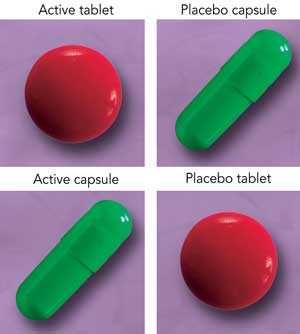
A double-blind design is desirable for any trial. When there is an active comparator in a drug evaluation trial, blinding can be ensured by the use of a so-called double-dummy design. This involves giving all patients two formulations: one group receives the active treatment plus a placebo of the alternative treatment, and the other group receives the opposite combination (see Box 2). To successfully mask the treatment, a placebo treatment should be identical in appearance (size, colour, weight, feel, odour, etc) and route of administration, and should be tested to make certain that its benign nature cannot be detected.
Patients’ or investigators’ preconceptions about the value of the treatment may affect a trial’s results. For example, in a trial of the effect of vitamin C on symptoms of colds, volunteers took vitamin C or a placebo for 9 months, with an increase in the dose at the onset of a cold.12 Because of the differences in taste between the vitamin and the placebo, some of the participants became aware of their treatment. In this group, the vitamin C had a reported benefit, but vitamin treatment did not appear to help those who remained blinded. The breakdown of the blinding led to inconclusive results, illustrating the importance of ensuring that blinding is done with care.
Masking data and intermediate outcomes during the study
When routine collection of clinical data during a trial (eg, blood tests) may potentially unblind investigators, providing investigators with summary information should be considered. For example, in a long-term cardiovascular trial assessing the effect of cholesterol-lowering treatment on the incidence of cardiovascular events, knowing individual lipid profiles during follow-up may unblind the clinician and patient. If the blood tests are performed by a central laboratory, it may be possible to provide a summary report simply stating that a patient’s values do or do not fall within a prespecified range, without compromising the patient’s safety, masking the individual data and preserving the blinded status of the investigator.
Blinded outcome assessment
Blinded assessment of outcomes is possible in most trials, regardless of whether the clinician or the patient is aware of the treatment allocation. Clinical outcomes should be assessed by people who are not aware of the patient’s treatment allocation (and preferably not involved in the patient’s clinical management) so that all patients are assessed identically. In this way, outcomes will not be influenced by beliefs about the study treatments being compared. In general, blinding becomes less important for reducing observer or information bias as the outcomes become less subjective and more objective (that is, bias is more prevalent with a subjective outcome such as degree of pain or extent of depression, but is eliminated with an outcome such as death from any cause). For outcomes such as biochemical or pathology result markers, assessment by calibrated, accurate instruments is often sufficient to ensure no bias is present. If patients are required to provide their own assessment of an outcome, it is recommended that more than one item of the same type be reported to allow reliability to be measured.
Effect of allocation concealment and blinding on the interpretation of trial results
An open-label trial with successful allocation concealment and blinded assessment may provide more reliable and more valid results than a double-blind trial with unsuccessful allocation concealment or compromised outcome assessment. Blinding does not guarantee an absence of bias, although empirical evidence does endorse a reduction of bias when adequate blinding strategies have been implemented. Allocation concealment (before randomisation) is thought to have a stronger influence on the reduction of bias than blinding (after randomisation).3,5 A checklist for successful allocation concealment and blinding is provided in Box 3.
When and how to unblind participants and investigators during the trial
Procedures should be established at the start of any randomised controlled trial for possible unblinding of the investigator and patient to an individual patient’s data during the trial. In most cases, unblinding would be carried out when the patient’s safety is at risk and this knowledge is required for emergency treatment. Often, however, if simply ceasing study treatment is a viable option for the patient’s care, it should not be necessary for unblinding to occur. Whenever possible, the chief investigator’s agreement should be sought before requests for individual unblinding are made. The process of unblinding should be such that only the data for one patient should be disclosed at any one time, and an audit trail maintained of all requests and their justifications.
1 CONSORT checklist of items to report when reporting a randomised trial1
Section and topic |
Item no. |
Descriptor |
|||||||||||||
Allocation concealment |
9 |
Method used to implement the random allocation sequence (eg, numbered containers or central telephone), clarifying whether the sequence was concealed until interventions were assigned. |
|||||||||||||
Implementation |
10 |
Who generated the allocation sequence, who enrolled participants and who assigned participants to their groups? |
|||||||||||||
Blinding (masking) |
11 |
Whether or not participants, those administering the interventions and those assessing the outcomes were blinded to group assignment. If done, how the success of blinding was evaluated. |
|||||||||||||
2 Double-blind double-dummy trial design
Randomised allocation |
Patient receives |
||||||||||||||
Active treatment 1: Tablet
Active treatment 2: Capsule |
|||||||||||||||
3 Checklist for successful allocation concealment and blinding
Allocation concealment
Investigator-clinicians are unaware of exact details of how the chosen randomisation method is being implemented (eg, ignorant of block sizes used in a permuted block randomisation scheme).
All staff responsible for providing allocations have adequate training.
An audit trail is maintained to ensure the integrity of the allocation process.13
If possible, a centralised or remote randomisation service is used (either by telephone, fax, email, the internet, a coordinating centre or site pharmacy). Remote randomisation can mean telephoning or faxing another person or clinic department to receive the next allocation.
Blinding
Appropriateness of blinding of patients and investigators (double-blind or single-blind) is ascertained.
The implementation process for blinding is planned, including deciding whether a placebo treatment is to be used, and ensuring the process maintains the relevant parties’ ignorance of the treatment after randomisation.
Evaluation of outcomes ensures objective assessment of all patients.
Unblinding
Ceasing study medication, if this is an option, is preferable to unblinding.
A method of unblinding is available quickly in a genuine emergency.
Specific methods
If envelopes are used, there is an audit trail recording each envelope opened (date and time) and envelopes are numbered, tamper-proof and opaque so that the contents remain concealed unless the envelope is destroyed or damaged.13
If kits or containers are used, they are identical (weight, size, appearance), numbered and tamper-proof.
The allocation process is reproducible.
Competing interests
None identified.
Acknowledgements
We thank Rhana Pike, Editor in the Life Sciences (ELS), for expert assistance in preparing this manuscript.
References
- Altman DG, Schulz KF, Moher D, et al. for the CONSORT Group. The revised CONSORT statement for reporting randomised trials: explanation and elaboration. Ann Intern Med 2001; 134: 663-694. i1085804
- Schulz KF, Grimes DA. Allocation concealment in randomised trials: defending against deciphering. Lancet 2002; 359: 614-618. i1085806
- Schulz KF, Grimes DA. Blinding in randomised trials: hiding who got what. Lancet 2002; 359: 696-700. i1085808
- Sackett DL. Turning a blind eye — why we don’t test for blindness at the end of our trials [letter]. BMJ 2004; 328: 1136.
- Ioannidis JPA, Polycarpou A, Ntais C, Pavlidis N. Randomised trials comparing chemotherapy regimens for advanced non-small cell lung cancer: biases and evolution over time. Eur J Cancer 2003; 39: 2278-2287. i1085811
- Schulz KF, Chalmers I, Grimes DA, Altman DG. Assessing the quality of randomisation from reports of controlled trials published in obstetrics and gynecology journals. JAMA 1994; 272: 125-128.
- Dickinson K, Bunn F, Wentz R, et al. Size and quality of randomised controlled trials in head injury: review of published studies. BMJ 2000; 320: 1308-1311. i1085814
- Schulz KF, Chalmers I, Altman DG. The landscape and lexicon of blinding in randomized trials. Ann Intern Med 2002; 136: 254-259. i1085816
- Kunz R, Oxman AD. The unpredictability paradox: review of empirical comparisons of randomised and non-randomised clinical trials. BMJ 1998; 317: 1185-1190. i1085818
- Altman DG, Schulz KF, Moher D. Turning a blind eye — testing the success of blinding and the CONSORT statement [letter]. BMJ 2004; 328: 1135. i1085820
- Aspirin Myocardial Infarction Study (AMIS) Research Group. A randomized, controlled trial of aspirin in persons recovered from myocardial infarction. JAMA 1980; 243: 661-669. i1085822
- Karloswki TR, Chalmers TC, Frenkel LD, et al. Ascorbic acid for the common cold. A prophylactic and therapeutic trial. JAMA 1975; 231: 1038-1042. i1085824
- Beller EM, Gebski V, Keech AC. Randomisation in clinical trials. Med J Aust 2002; 177: 565-567. <eMJA full text>
Using generative artificial intelligence in clinical practice: a narrative review and proposed agenda for implementation
Ian A Scott, Sandeep Reddy, Tanya Kelly, Tim Miller, Anton Vegt
The CURE Asthma roadmap
Gary P Anderson, Anthony Flynn, Phil G Bardin, John D Blakey, Shyamali C Dharmage, Paul Foster, Peter G Gibson, Adam Jaffe, Alan James, Christine R Jenkins, Sundram Sivamalai, Peter D Sly, Guy B Marks, Vanessa M McDonald, Judy Wetttenhall
CURE Asthma: a unique opportunity for Australia
Anthony Flynn, Wendy Edmondson, Alan James, Caroline Lodge, Vanessa M McDonald, Christine R Jenkins, John Blakey, Gary P Anderson
Evidence from Australian cohort studies about asthma trajectories and transitions across the life course: a narrative review
Caroline Lodge, Xin Dai, Ingrid A. Laing, Michael P Menden, Anthony Flynn, Gary P Anderson, Sarath Ranganathan, Shyamali C Dharmage
Technological advances in the search for a CURE for asthma
Sara Quon, Timothy M Johanson, Ridhima Wadhwa, Alen Faiz, Anthony Flynn, Gary P Anderson, Amanda J Cox, Nicholas P West, Michael P Menden, Rhys S Allan
Protecting public interest journalism as a public health good
Bronwyn Fredericks, Neha Lalchandani, Melissa A Sweet, Alex Cramb, Carmel Williams