




Volume 180 - Issue 2
“Milky” urine: a case of chyluria
Authors: John R Burnett, Gary G Sturdy, Suzzanne J Smith, Yuli Ten and Michael J McComish
Med J Aust 2004; 180 (2): 89. || doi: 10.5694/j.1326-5377.2004.tb05808.x
Published online: 19 January 2004
Published online: 19 January 2004
A 53-year-old Asian man with type 2 diabetes mellitus presented to the Emergency Department with acute onset of generalised muscle cramps. He reported a 2-month history of polydipsia, polyuria and passing “milky” urine with blood clots. He had travelled widely throughout subtropical Asia. On examination, he was normotensive, with no lymphadenopathy, abdominal masses or oedema.
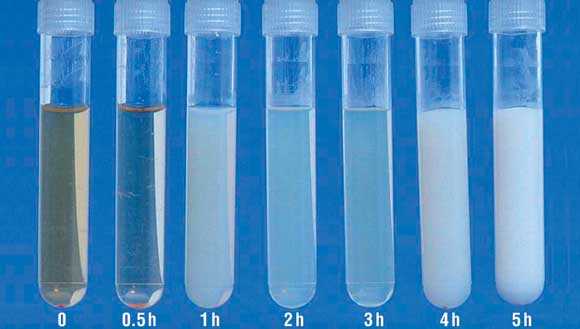
Urinalysis showed marked proteinuria, glycosuria and haematuria. The urine protein excretion rate was later confirmed to be 15.57 g/24 h (reference interval [RI], 0.02–0.15 g/24 h). Urine triglyceride measurement and lipoprotein electrophoresis confirmed the appearance of chylomicrons in the urine after an oral fat tolerance test (Box 1).
Biochemical analysis of serum showed the following levels: sodium 121 mmol/L (RI, 134–146 mmol/L), potassium 4.6 mmol/L (RI, 3.4–5.3 mmol/L), creatinine 46 μmol/L (RI, 60–105 μmol/L), glucose 19.7 mmol/L (RI, < 5.5 mmol/L), ferritin 16 mg/L (RI, 30–620 mg/L), 25-hydroxyvitamin D 11 nmol/L (RI, > 50 nmol/L), total cholesterol 5.2 mmol/L (RI, <5.5 mmol/L), and triglyceride 1.8 mmol/L (RI, < 1.8 mmol/L). The patient had marked hypoproteinaemia and hypoalbuminaemia, with a total protein level of 39 g/L (RI, 63–80 g/L) and albumin level of 21 g/L (RI, 35–50 g/L), respectively. The serum IgE level was also raised (2300 kU/L; RI, < 210 kU/L).
The patient was mildly anaemic (haemoglobin level, 120 g/L [RI, 130–170 g/L]), with a normal erythrocyte sedimentation rate and C-reactive protein level. There was lymphopenia but no eosinophilia. No microfilariae or acid-fast bacilli were detected in thick blood films taken at midnight or in a urine sample. Serological and intradermal tests for filariae were also negative.
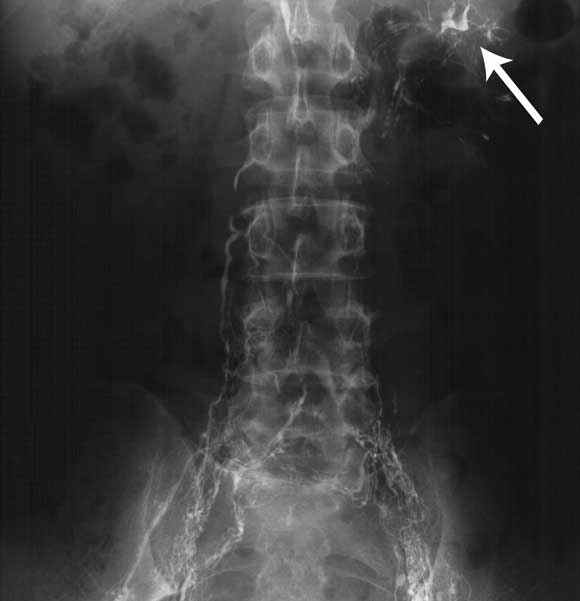
A chest x-ray and computed tomography scan of the abdomen and pelvis were normal. A biopsy of the right kidney showed evidence of mild mesangial change, consistent with diabetes mellitus. Lymphoscintigraphy showed delayed lymphatic transport, particularly on the left side, but no physical obstruction to lymphatic drainage. Contrast lymphangiography demonstrated a grossly abnormal lymphatic system in the pelvis and groin with a unilateral left-sided lymphorenal communication (Box 2).
A presumptive diagnosis of filariasis was made and the communication between the left kidney and the lymphatics was surgically disconnected. The chyluria recurred after surgery, but within 4 weeks of a therapeutic course of the antifilarial diethylcarbamazine there was complete resolution. Furthermore, the biochemical abnormalities reversed, consistent with urinary loss as the mechanism.
At 3-year follow-up, the patient remained symptom-free and without chyluria.
Discussion
Chyluria is rare in Australia but common in many parts of the world, particularly where Wuchereria bancrofti, the main agent of filariasis, is endemic. It occurs, on average, 5–10 years after the worm has died, and so there may be no evidence of active filariasis. However, a therapeutic trial of diethylcarbamazine should be considered before undertaking surgery. As spontaneous remissions of chyluria have been reported, we can not be certain whether the antifilarial therapy was responsible for resolution of the chyluria in this case.
Costs of Delivering the Hep B PAST Model of Care in Remote Australia: A Retrospective Pre–Post Study
Hoa Nguyen, Anh Le Tuan Nguyen, Paula Binks, Melita McKinnon, Emily Vintour-Cesar, Karen Wills, Nicola Stephens, Benjamin Cowie, Joshua S. Davis, Yuejen Zhao, Peter Nihill, Julie A. Campbell, Andrew J. Palmer, Jane Davies, Barbara de Graaff
Buruli Ulcer Acquired From Ringtail Possum Rescue
Daniel P. O'Brien, Naomi Clarke, Sara Bonnici, Mohammad A. Hussain
Q Fever Visceral Abscesses After Contact With Native Australian Marsupials
Samantha J. Laws, Enzo Binotto, James Stewart, Jennifer Ho, Trent Yarwood, Josh Hanson, Simon Smith
Hospital-Admitted Injection-Related Infections Among Incarcerated People Who Inject Drugs in Australia: A Retrospective Cohort Study
Andrew Palmer, Matthew Carter, Jeremy Yeo, Cecilia Shim, Jason Connor, Jeremy Hayllar, Gerald Holtmann, Naomi Moy, Elliott G. Playford, Naomi Runnegar, Paul J. Clark
The Live Attenuated Influenza Vaccine in Australia: An Additional Tool for Influenza Prevention
Cyra Patel, Alexis Pillsbury, Tran Nguyen, Xia Wang, Helen E. Quinn, Clayton K. Chiu, Allen C. Cheng, Katie L. Flanagan, Zhicheng Wang
Reflex Testing for Hepatitis D Infection: A Unique Opportunity to Reduce Hepatitis D-Related Chronic Liver Disease Deaths in Australia
Jessica Howell, Lauren Andersson, Miriam T. Levy, James O'Beirne, Leon Adams, Katharine Irvine, Avik Majumdar, Golo Ahlenstiel, Kathy Jackson, Krispin Hajkowicz, Joseph Doyle, Jane Davies, Sarah Cherian, Wayne Dimech, Alexander J. Thompson