




Volume 179 - Issue 2
An evaluation of a SAFE-style trachoma control program in central Australia
Authors: Graeme H Johnson and Donna B Mak
Med J Aust 2003; 179 (2): 116-118. || doi: 10.5694/j.1326-5377.2003.tb05453.x
Published online: 21 July 2003
Published online: 21 July 2003
Graeme H Johnson*, Donna B Mak†;
*Acting Public Health Medical Officer; †Former Public Health Medical Officer, Kimberley Population Health Unit, Derby, WA 6728. graeme.johnson@health.wa.gov.au
To the Editor: In their study of a SAFE-style trachoma control program (which included Antibiotic treatment, Facial cleanliness, and Environmental improvement, but not Surgery) in a remote Australian community, Ewald et al suggest that no systematic SAFE trachoma control program exists in Australia.1
In the Kimberley region of Western Australia, the Kimberley Public Health Unit (KPHU) has coordinated a trachoma control program since 1989. The World Health Organization SAFE strategy has been implemented since 1996, as described in the Kimberley regional trachoma control guidelines and a peer-reviewed publication.2,3
The trachoma control program in the Kimberley has been delivered by a variety of environmental health, health promotion, community and clinical health professionals employed by State and local governments, and by community-controlled and other non-government organisations. We believe a coordinated regional approach is mandatory, because of the numerous organisations involved in program delivery.
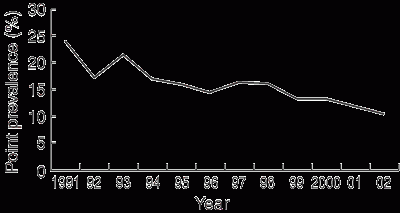
The trachoma control program in the Kimberley continues to achieve good results. The prevalences of follicular trachoma during annual screening of school-aged children in the Kimberley have been published annually in the KPHU Bulletin.4 Since 1996, in accordance with the WHO SAFE strategy, communities with trachoma prevalences of less than 5% were not screened in subsequent years and did not contribute to regional prevalence data. Thus, the observed decrease in trachoma prevalence between 1996 and 2001 is likely to be greater than that shown in the Box.
We believe the Kimberley region is well placed to achieve the WHO aim of eradicating blinding trachoma by 2020.5 However, it is a concern that other regions of Australia with endemic trachoma infection may not conduct disease control activities in a coordinated manner because of lack of leadership in trachoma control or insufficient resources, or both. The community described by Ewald et al borders the Kimberley region and has strong cultural links with several Kimberley groups. The achievements in trachoma control in the Kimberley cannot be sustained in the long term without a nationally coordinated approach. We believe that it falls within the statutory responsibilities of State and Territory departments of health to ensure that environmental and clinical health services are coordinated to achieve trachoma control in Australia.
References
- Ewald DP, Hall GV, Franks CC. An evaluation of a SAFE-style trachoma control program in Central Australia. Med J Aust 2003; 178: 65-68. <eMJA full text>
- Kimberley Public Health Unit. Trachoma control program guidelines 2000. Derby: KPHU, 2000. i1082474
- Mak DB, Plant AJ. Trichiasis in Aboriginal people of Western Australia. Clin Exp Ophthalmol 2001; 29: 7-11. i1082476
- Mahony A. Kimberley trachoma control program 2002. KPHU Bulletin 2003; 33: 18. i1082478
- World Health Organization. Program for the Prevention of Blindness and Deafness. Future approaches to trachoma control. Report of a global scientific meeting, Geneva 1996. Geneva: WHO, 1997. i1082480
Costs of Delivering the Hep B PAST Model of Care in Remote Australia: A Retrospective Pre–Post Study
Hoa Nguyen, Anh Le Tuan Nguyen, Paula Binks, Melita McKinnon, Emily Vintour-Cesar, Karen Wills, Nicola Stephens, Benjamin Cowie, Joshua S. Davis, Yuejen Zhao, Peter Nihill, Julie A. Campbell, Andrew J. Palmer, Jane Davies, Barbara de Graaff
Epidemiology and Quality of Care for Aboriginal and Torres Strait Islander Peoples Treated by Emergency Medical Services for Stroke in Victoria, Australia: Retrospective Analysis of Linked Data
Candice Menezes, Ziad Nehme, Luke J. Burchill, Tegwyn McManamny, Angela Dos Santos, Michelle Crilly, Luke P. Dawson, Benjamin Clissold, David Anderson, Emily Nehme
Hepatitis C Among First Nations Australians: A Rethink Is Required to Meet the 2030 Elimination Target
James Ward, Emily Pegler, Kellie Stacy, Stephen Harfield
Sovereignty and Survival: Understanding Lung Cancer Outcomes for Aboriginal and Torres Strait Islander People in Australia, a Case–Control Study
Alice R. T. Bergin, Luc te Marvelde, Roger L. Milne, Benjamin J. Solomon, Kris Ivanova, Peter Savas, Stephen J. Luen, Jay Hamann, Andrea Casey, Nicole Watt, Sue M. Evans, Gail Garvey, Sherene Loi
Rethinking Rheumatic Fever Diagnosis: Progress, Pitfalls and the Path Towards a Definitive Test
Anna P. Ralph, Rachel Webb, Tom Parks, Nicole J. Moreland, Asha C. Bowen, Benjamin Jones, Emma Ndagire, Andrea Z. Beaton
Not Gone but Often Forgotten: Action Needed to Address Tuberculosis in Aboriginal and Torres Strait Islander Communities
Nikkita Joshua, Emma L. Smith, Eunice (Cheeky) Love, Christopher P. Lowbridge, Nicole Tukana, Amy Bowden, Megan A. Campbell, Dawn Casey, James Ward