




Volume 197 - Issue 11
A case of retinal vein occlusion from high-altitude exposure
Authors: Holly L Hutton, Randev Mendis and Lyndell L Lim
Med J Aust 2012; 197 (11): 622-623. || doi: 10.5694/mja12.11277
Published online: 10 December 2012
Published online: 10 December 2012
To the Editor: We describe a case of unilateral central retinal vein occlusion (CRVO) in a 29-year-old woman during exposure to high altitude. She complained of blurred vision in her left eye, first noted when trekking to a maximum altitude of 6189 metres in Nepal
2 months earlier. She was not hypertensive and was not taking any medication, and had no previous history of thrombosis.
Examination using a ...
To the Editor: We describe a case of unilateral central retinal vein occlusion (CRVO) in a 29-year-old woman during exposure to high altitude. She complained of blurred vision in her left eye, first noted when trekking to a maximum altitude of 6189 metres in Nepal 2 months earlier. She was not hypertensive and was not taking any medication, and had no previous history of thrombosis.
Examination using a Snellen chart showed a visual acuity of 6/9 in the left eye and 6/6 in the right. Fundoscopy of the left eye showed a swollen optic nerve, venous tortuosity with diffuse retinal haemorrhages and macular oedema (Box 1). Optical coherence tomography confirmed the macular oedema (Box 2) and fluorescein angiography showed the CRVO to be non-ischaemic. Investigations including autoimmune screening and testing for thrombophilia, lipids, blood glucose levels and homocysteine levels did not suggest a specific underlying cause for the CRVO. Her haemoglobin level was 133 g/L (reference interval [RI], 115 –170 g/L), haematocrit was 0.4 (RI, 0.36–0.52) and platelet count was 206 × 109/L (RI, 150–500 × 109/L). Six months on, monthly intravitreal bevacizumab injections have settled the macular oedema and visual acuity has improved to 6/6.
This is the first case of CRVO occurring at altitude in an Australian patient, and the first to be successfully treated with intravitreal bevacizumab. Four previous cases have been reported. In 1989, a 63-year-old patient was diagnosed with CRVO 8 months after an expedition to Mount Everest.1 More recently, three patients aged 31, 37 and 40 years were diagnosed with CRVO after experiencing unilateral visual loss in Ladakh, a high-altitude area in Indian-administered Kashmir.2 A prospective study of young soldiers in the Indian army estimated that the rate of vascular thrombosis was increased 30-fold at altitudes greater than 3000 metres.3 Multiple factors have been postulated to account for this, but haemoconcentration in response to hypobaric hypoxia plays a key role. Dehydration may contribute to haemoconcentration — this is one of the mechanisms thought to explain CRVO in marathon runners.4 Additionally, increased turbulent retinal blood flow, which occurs at high altitude, leads to endothelial injury and platelet activation.2 The number of Australians venturing to high-altitude regions such as Nepal is growing.5 These travellers should ensure adequate hydration and consider avoiding risk factors for thrombosis, such as the oral contraceptive pill.
1 Colour fundus photograph of the left eye at presentation (A) showing signs of central retinal vein occlusion,* and 7 months later (B) showing complete resolution of the central retinal vein occlusion
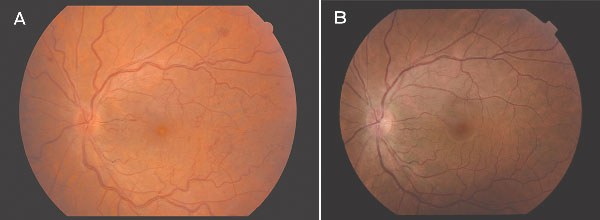
* Dilated and tortuous retinal veins, scattered intraretinal haemorrhages and mild optic disc swelling, and an abnormal foveal reflex, consistent with the presence of secondary macular oedema.
2 Spectral domain optical coherence tomography image of the left macula at presentation (A) showing gross macular oedema* and 7 months later (B) showing complete resolution of the macular oedema and a normal macular anatomy†
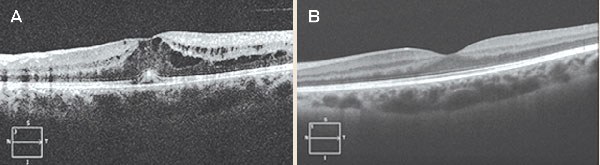
* Gross macular oedema evidenced by multiple intraretinal cysts and a thickened macula. The central macular thickness at presentation was 501 μm. † Seven months after presentation, central macular thickness was 258 μm.
Competing interests
No relevant disclosures.
References
- Butler FK, Harris DJ Jr, Reynolds RD. Altitude retinopathy on Mount Everest, 1989. Ophthalmology 1992; 99: 739-746. 0_BABHBEBJ
- Gupta A, Singh S, Ahluwalia TS, Khanna A. Retinal vein occlusion in high altitude. High Alt Med Biol 2011; 12: 393-397. 0_i1142887
- Anand AC, Jha SK, Saha A, et al. Thrombosis as a complication of extended stay at high altitude. Natl Med J India 2001; 14: 197-201. 0_i1142889
- Gaudard A, Varlet-Marie E, Monnier JF, et al. Exercise-induced central retinal vein thrombosis: possible involvement of hemorheological disturbances. A case report. Clin Hemorheol Microcirc 2002; 27: 115-122. 0_i1142893
- Government of Nepal Ministry of Culture, Tourism and Civil Aviation. Nepal tourism statistics 2011 (annual statistical report). http://tourism.gov.np/uploaded/fullpage.pdf (accessed Nov 2012).
A Diagnostic Headache
Thomas Glynn, Michelle T. Leech, Stacy K. Goergen, Emily Lin, Nadeem Toodayan, Ralph Junckerstorff
Neisseria meningitidis: an uncommon cause of conjunctivitis
Chloe Story, Tina Marinelli, Simeon Crawford, Amrita Ronnachit
Dismantling barriers to research and clinical care for individuals with a vision impairment
Eden G Robertson, Kate Hetherington, Meredith Prain, Julia Hall, Leighton Boyd AM, Rosemary Boyd OAM, Emily Shepard, Hollie Feller, Sally Karandrews, Fleur O'Hare, Kanae Yamamoto, Matthew P Simunovic, Robyn V Jamieson, Alan Ma, Lauren Ayton AM, Anai Gonzalez‐Cordero
The New South Wales Pharmacy Trial for herpes zoster: on the nose?
Christian P Pappas, Timothy R Holmes, Minas T Coroneo
Skin fragility disorder misdiagnosed as child abuse: a cautionary tale
Heather G Mack, Fred K Chen, John R Grigg
Health economic aspects of inherited retinal diseases: looking for cost‐effective treatments
Benjamin Kamien, Rachael Heath Jeffery, Fred K Chen