



In 1996, when the hand hygiene behaviour of medical staff in an Australian teaching hospital was documented, hand-washing both before and after patient contact was performed only once in every three contacts.1 Studies conducted in Australian hospitals have shown that hand hygiene compliance differs significantly across specialties2-5 and between before- and after-patient contacts.3,4,6 The location of sinks2 and time constraints4 are not predictors of compliance, but a strong predictor is the perception by staff that their peers expect them to comply.4
In 2006, the Clinical Excellence Commission (CEC), on behalf of the New South Wales Department of Health (NSW Health), developed and implemented the Clean hands save lives campaign across all public hospitals in NSW. A comparison of studies evaluating hand hygiene compliance in a variety of settings demonstrates that there was a lack of standard practice in Australia before the NSW campaign. Generally, compliance rates in studies conducted in three states (Queensland, NSW and Victoria) rarely exceeded 50% (ie, one hand hygiene event for every two patient contacts). In a study conducted across four wards in a Queensland teaching hospital, average compliance rates were 30% (range, 13%–47%) before patient contact and 44% (range, 23%–72%) after patient contact.2 A study of nursing staff from a Sydney teaching hospital reported even lower average compliance rates of 15% before patient contact and 30% after patient contact.3 Compliance rates were similar in study of a Victorian teaching hospital, with an average of 21% (range, 10%–44%) for aggregated pre- and post-contact compliance across five clinical areas prior to an intervention.5 A hand hygiene culture-change program in Victoria began as a pilot in six hospitals and was then rolled out statewide to 75 Victorian hospitals.6 In the pilot study, average compliance rose significantly, from 21% at baseline to 47% (range, 31%–75%) 24 months after the intervention. In the statewide roll-out, average compliance rose from 20% (range, 10%–44%) at baseline to 53% (range, 26%–83%) after 12 months.6
Hand hygiene habits and the lack of compliance with this basic infection control measure are complex behavioural issues and a subject of contentiousness within the health care industry. Numerous factors influencing hand hygiene compliance have been hypothesised, including time constraints, peer behaviour and peer expectations (Box 1).
Decades after the emergence of methicillin-resistant Staphylococcus aureus, the struggle continues to change the hand hygiene behaviour of health care workers (HCWs) from a focus on self-protective behaviour4 to a focus on protecting the patient. Given the numerous infection control advances since the discovery of antibiotics, the persistence of suboptimal hand hygiene rates globally could suggest that infection control has “taken its finger off the pulse” of basic practices. However, perennially low hand hygiene compliance is not simply the result of failure to implement infection control measures. Changing entrenched behaviour also involves challenging organisational culture — behaviour, values, and “the way we do things around here”.
The results and implementation of the Clean hands save lives campaign in NSW are reported in detail elsewhere.12-14 We report here on surveys of staff, patients and visitors about their perceptions of hand hygiene behaviour during the pre- and post-campaign periods. Awareness of and attitudes to the campaign material were measured to gauge the success of the introductory systematisation of a culture change towards better hand hygiene.
An earlier survey of hand hygiene practices conducted by the CEC in 2005 across a variety of hospitals in all NSW area health services (AHSs) had identified activities and strategies employed locally to improve hand hygiene (unpublished data). This information was used to assist in developing strategies for implementing the Clean hands save lives campaign. The primary aim of the campaign was to systematise hand hygiene practices with the introduction of alcohol-based hand rub (AHR) in all NSW public hospitals. Secondary goals were to increase hand hygiene compliance by HCWs and reduce health care-associated infections. Drawing on lessons learned from the 2005 pre-campaign survey, the international literature on the subject and the successful cleanyourhands campaign in the United Kingdom,15 the NSW campaign included four main strategies (Box 2).
Achievement in each of the four campaign strategy areas was measured using standardised questionnaires based on those used in the cleanyourhands campaign.15 The surveys were conducted before the Clean hands save lives campaign (in February 2006) and repeated after the campaign (in February 2007). Pre- and post-campaign surveys of staff contained four self-reported behaviour items, three patient involvement items, four staff demographic items, and one campaign awareness item, with an additional four items in the post-campaign survey relating to poster materials. Pre- and post-campaign surveys of patients and visitors contained three items on campaign awareness, four items on patient willingness to engage in the campaign, and one item on perception of staff hand hygiene compliance before and after patient contact.
Facilities were divided into peer groups based on a classification adopted by the Australian Council on Healthcare Standards and used for the NSW Health Infection Control Program quality monitoring indicators.16 Hospitals were instructed on survey sampling according to type of facility:
Group 1 (major teaching or referral hospitals). Ten staff surveys and five patient/visitor surveys were conducted in each of three wards in each data collection period. Eight hospitals were surveyed (including staff, but not patients or visitors, from the Children’s Hospital at Westmead).
Group 2 (district hospitals). Three staff surveys and five patient/visitor surveys were conducted in each of three wards in each data collection period. Eight hospitals were surveyed.
Group 3 (community-based hospitals). Three staff surveys and three patient/visitor surveys were conducted in each of two wards in each data collection period. Eight hospitals were surveyed.
Justice Health. In each data collection period, staff surveys were conducted in each of three wards or clinics having five or more staff. Justice Health determined that patient surveys were not appropriate.
The Ambulance Service of NSW. In each data collection period, staff surveys were conducted in 12 services from three divisions having four or more staff. The Ambulance Service determined that, because of the emergency status of patients, patient surveys would not be conducted.
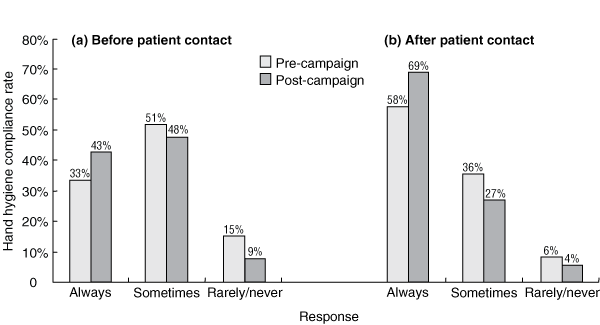
Thirty-three per cent of staff (413/1242) in the pre-campaign period and 43% (242/563) in the post-campaign period rated themselves as always complying with hand hygiene practice before patient contact (Box 3). The corresponding proportions for after-patient contact were 58% (719/1240) in the pre-campaign period and 69% (422/612) in the post-campaign period (Box 3).
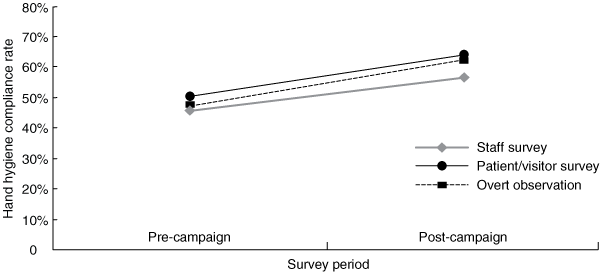
In pre-campaign surveys, an average of 46% of staff (413/1242 before patient contact and 719/1240 after patient contact) rated themselves as always complying with hand hygiene practice in all patient contacts, while patients/visitors perceived staff as always complying 50% of the time (275/545) (Box 4). This compares with 47% overall compliance determined by overt observation of staff (details reported elsewhere).13 By the post-campaign period, rates of hand hygiene compliance had risen to an average of 57% reported by staff (242/563 before patient contact and 422/612 after patient contact), 64% (234/367) perceived by patients/visitors and 62% recorded by overt observation.13
Before the campaign, the average observed hand hygiene compliance rate was 47%,13 and 76% of staff (510/671) perceived that they were likely to maintain their current hand hygiene rate. After the campaign, the observed compliance rate was 62%13 (in February 2007, the observation period closest to the survey dates), and 90% of staff (265/296) (P < 0.001; χ2 = 28.07) believed they could maintain their new compliance rate.
Hand hygiene should be part of their job, no questions asked.
As health professionals, it is their responsibility to [comply with] hand hygiene [protocol].
Hand hygiene should be the usual [practice], to wash before doing anything with a patient.
I would assume it would be common practice for staff to be hygienic and wash their hands.
The principal finding of our study was that the Clean hands save lives campaign successfully challenged existing hand hygiene practices and initiated positive changes in the understanding, values and behaviour of staff, patients and hospital visitors. The first step in initiating a new way of doing things17 is to effect acceptance and ownership of the practice.18
Other studies and campaigns examining the impact of AHR have shown an increase in staff compliance rates after the introduction of AHR.15,19 Before the placement of AHR in NSW hospitals, staff reported that the most challenging aspect of increasing the frequency of hand cleaning was the practicality of performing the task. By maintaining the availability of AHR and emphasising organisational involvement, the Clean hands save lives campaign focused on enabling staff to view hand hygiene as the healthy, safe and easy choice. Ease of access to AHR may be one factor contributing to the improvement in hand hygiene compliance, but the practice of cleaning hands before and after every patient contact was still questioned. Although staff reported they were committed to sustaining behavioural change, this commitment would be difficult without ongoing organisational support.14 This support would need to include a commitment to provide AHR at the point of patient care, timely data on infection rates, and direct and regular feedback on hand hygiene practices. Clinicians would also benefit from ongoing timely feedback on their compliance and from patients/visitor enquiries about their hand hygiene behaviour.
2 Campaign strategies
Provision of alcohol-based hand rub at point of patient care
Appointment of staff champions and project leaders
Involvement of patients, carers and visitors in the hand hygiene aspect of their care
Promotion of collateral material to market the campaign and maintain the interest of target groups in the campaign messages:
Talking walls — staff posters changed every month
Hand hygiene technique poster
Patient/visitor targeted posters
Patient/visitor brochures (translated into 22 languages)
“Teaser” stickers
“It’s OK to ask” badges
T-shirts with campaign logo
Balloons with campaign logo
3 Staff self-reported levels of hand hygiene compliance before and after contact with patients
Hand hygiene compliance rate % (95% CI) [n/N] |
|||||||||||||||
- Kimberley R Fitzpatrick1
- Annette C Pantle1
- Mary-Louise McLaws2
- Clifford F Hughes1
- 1 Clinical Excellence Commission, Sydney, NSW.
- 2 Hospital Infection Epidemiology and Surveillance Unit, School of Public Health and Community Medicine, University of New South Wales, Sydney, NSW.
Our project was a joint initiative of the CEC and NSW Health.
Mary-Louise McLaws has joined the WHO First Global Patient Safety Challenge pilot country project to provide epidemiological advice. Clifford Hughes operates the Australia and New Zealand Heart Valve Registry, which tracks patients with a Björk-Shiley convexo/concave heart valve. He distributes guidelines to these patients through their doctors as developed by the medical supervisory panel of the Bowling–Pfizer Heart Valve Settlement. He is the Principal Investigator of the On-X Heart Valve Study in Australia, for which Onyx Life Technologies pays the expenses. He has received funding from Roche Diagnostics for travel expenses to attend meetings.
- 1. Tibballs J. Teaching hospital medical staff to handwash. Med J Aust 1996; 164: 395-398. <MJA full text>
- 2. Whitby M, McLaws ML. Handwashing in healthcare workers: accessibility of sink location does not improve compliance. J Hosp Infect 2004; 58: 247-253.
- 3. Bahal A, Karamchandani D, Fraise AP, McLaws ML. Hand hygiene compliance: universally better post-contact than pre-contact in healthcare workers in the UK and Australia. Br J Infect Control 2007; 8: 24-28.
- 4. Whitby M, McLaws ML, Ross MW. Why healthcare workers don’t wash their hands: a behavioural explanation. Infect Control Hosp Epidemiol 2006; 27: 484-492.
- 5. Johnson PDR, Martin R, Burrell LJ, et al. Efficacy of an alcohol/chlorhexidine hand hygiene program in a hospital with high rates of nosocomial methicillin-resistant Staphylococcus aureus (MRSA) infection. Med J Aust 2005; 183: 509-514. <MJA full text>
- 6. Grayson ML, Jarvie LJ, Martin R, et al. Significant reductions in methicillin-resistant Staphylococcus aureus bacteraemia and clinical isolates associated with a multisite, hand hygiene culture-change program and subsequent successful statewide roll-out. Med J Aust 2008; 188: 633-640. <MJA full text>
- 7. Pittet D. Improving compliance with hand hygiene in hospitals. Infect Control Hosp Epidemiol 2000; 21: 381-386.
- 8. Sax H, Uçkay I, Richet H, et al. Determinants of good adherence to hand hygiene among healthcare workers who have extensive exposure to hand hygiene campaigns. Infect Control Hosp Epidemiol 2007; 28: 1267-1274.
- 9. Larson E, Girard R, Pessoa-Silva CL, et al. Skin reactions related to hand hygiene and selection of hand hygiene products. Am J Infect Control 2006; 34: 627-635.
- 10. Larson E, Killien M. Factors influencing handwashing behaviour of patient care personnel. Am J Infect Control 1982; 10: 93-99.
- 11. Curtis V, Biran A. Dirt, disgust, and disease. Is hygiene in our genes? Perspect Biol Med 2001; 44: 17-31.
- 12. Pantle AC, Fitzpatrick KR, McLaws ML, Hughes CF. A statewide approach to systematising hand hygiene behaviour in hospitals: Clean hands save lives, Part I. Med J Aust 2009; 191 (8 Suppl): S8-S14. <MJA full text>
- 13. McLaws ML, Pantle AC, Fitzpatrick KR, Hughes CF. Improvements in hand hygiene across New South Wales public hospitals: Clean hands save lives, Part III. Med J Aust 2009; 191 (8 Suppl): S18-S25. <MJA full text>
- 14. McLaws ML, Pantle AC, Fitzpatrick KR, Hughes CF. More than hand hygiene is needed to affect methicillin-resistant Staphylococcus aureus clinical indicator rates: Clean hands save lives, Part IV. Med J Aust 2009; 191 (8 Suppl): S26-S31. <MJA full text>
- 15. National Patient Safety Agency, National Health Service. Flowing with the go: the complete year two campaign maintenance handbook for cleanyourhands partner trusts. The sequel to Ready, steady, go. London: NPSA, 2006. http://www.library.nhs.uk/healthmanagement/ViewResource.aspx?resID=271362 (follow link under “cleanyourhands campaign”) (accessed Mar 2009).
- 16. NSW Health. Infection control program quality monitoring indicators: users’ manual. Sydney: NSW Health, 2003.
- 17. Garling P, Commissioner. Final report of the Special Commission of Inquiry into Acute Care Services in NSW Public Hospitals. Sydney: State of NSW, 2008. http://www.lawlink.nsw.gov.au/lawlink/Special_Projects/ll_splprojects.nsf/pages/acsi_finalreport (accessed Apr 2009).
- 18. Kotter J. Winning at change. Leader to Leader J 1998; 10: 27-33. http://www.leadertoleader.org/knowledgecenter/journal .aspx?ArticleID=161 (accessed Apr 2009).
- 19. Pittet D, Hugonnet S, Harbarth S, et al. Effectiveness of a hospital-wide programme to improve compliance with hand hygiene. Infection Control Programme. Lancet 2000; 356: 1307-1312.
Abstract
Objective: To present the results of surveys of staff, patients and visitors about their perceptions of hand hygiene behaviour before and after implementation of the Clean hands save lives campaign in New South Wales public hospitals.
Design and setting: Pre- and post-campaign questionnaires, disseminated through project officers in each health authority, were completed by selected staff and patients/visitors in all 208 public hospitals in NSW. Combined, de-identified results for each health authority were forwarded to the NSW Clinical Excellence Commission for analysis.
Main outcome measures: Awareness of campaign material; staff perceptions about their ability to maintain a high level of hand hygiene compliance before and after contact with patients; compliance self-reported by staff compared with compliance perceived by patients/visitors and compliance assessed by overt observation.
Results: Most staff and patients/visitors were aware of campaign materials. Eighty-six per cent of staff respondents (495/578) believed that placement of alcohol-based hand rub (AHR) close to the point of patient care had improved hand hygiene compliance, and 76% (510/671) believed they could sustain their level of compliance. Only 1 in 4 patients or visitors (106/397) were willing to question health care workers who appeared not to be complying with hand hygiene practices.
Conclusion: As the first coordinated statewide campaign to modify hand hygiene culture, the Clean hands save lives campaign successfully engendered positive attitudes and dispelled negative perceptions about the onerous nature of before- and after-patient-contact hand hygiene compliance.