



Perinatal transmission is the predominant mode of hepatitis B virus (HBV) transmission in areas of high disease prevalence, and still occurs despite immunoprophylaxis with hepatitis B immunoglobulin (HBIG) (passive immunisation) and infant HBV vaccination (active immunisation). Reported rates of transmission from mothers who are positive for hepatitis B “e” antigen (HBeAg) vary from 7%1 to 28%.2,3 Several studies have implicated high maternal viraemia as the most important factor associated with failure of neonatal vaccination.4
In Australia there is a low prevalence of HBV infection (0.49%–0.87%),5 the majority of cases being among immigrants from North and South-East Asia. Perinatal transmission in Australia has not been reported and is not routinely monitored. The Australian immunisation handbook6 has recently recommended that infants born to mothers positive for hepatitis B surface antigen (HBsAg) be screened for HBsAg and antibodies to HBsAg (anti-HBs) after completion of vaccination.
Passive and active immunoprophylaxis was given to babies according to the Australian HBV vaccination schedule.6 Within 12 hours of delivery, infants were given 100 IU HBIG by intramuscular injection (human hepatitis B immunoglobulin-VF; CSL Bioplasma) and a dose of hepatitis B vaccine (either H-B-VAX II [thiomersal-free, 5 μg recombinant HBsAg protein; CSL Biotherapies/Merck Sharp & Dohme] or ENGERIX-B [10 μg recombinant HBsAg protein; GlaxoSmithKline]). Vaccination was completed with doses at 2, 4 and 6 months of age. Completion of the vaccination schedule was assessed for each infant using child health records.
For HBsAg-positive infants, HBV DNA was extracted from the sera of each mother-and-baby pair using a QIAamp DNA mini kit (QIAGEN). The region encompassing the HBV surface gene “a” determinant was amplified and sequenced, as described elsewhere.7 HBV mutational analysis and genotyping were performed using the SeqHepB viral genome analysis program (Evivar Medical).8 Sequence alignments of mother-and-baby pairs were performed using BioEdit sequence alignment editor software (Ibis Biosciences, Carlsbad, Calif, USA).9
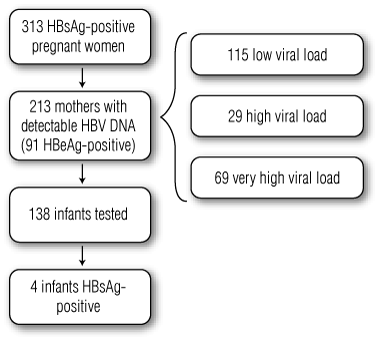
Of the 313 HBsAg-positive pregnant women, 92 (29%) were HBeAg-positive and 213 (68%) had detectable HBV DNA. The HBV DNA levels in viraemic mothers were arbitrarily stratified into three groups: 115 (54%) had levels < 105 copies/mL (low viral load), 29 (14%) had levels between 105 and 108 copies/mL (high viral load), and 69 (32%) had levels > 108 copies/mL (very high viral load). Of those with detectable HBV DNA, 91 (43%) were HBeAg-positive. HBeAg positivity was strongly correlated with a very high viral load (P < 0.001), and all patients with HBV DNA levels > 108 copies/mL were HBeAg-positive (Box 1).
Among the original 313 HBsAg-positive pregnant women, there were 213 HBV DNA-positive mothers from whom 138 babies (65%) had been born, reached 9 months of age, and returned for follow-up. These infants were the subject of our studies of perinatal transmission (Box 2). Five pregnancies did not proceed to term and 70 babies have not been tested, either because they have not reached the age of 9 months or were lost to follow-up.
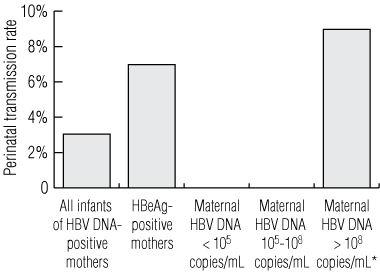
Perinatal transmission was identified in 4/138 infants (3%), indicated by HBsAg-positive and anti-HBs-negative tests. All four were born to HBeAg-positive women with HBV DNA levels > 108 copies/mL. The transmission rate was 4/47 (9%) from mothers with HBV DNA levels > 108 copies/mL and 4/61 (7%) from HBeAg-positive mothers. Perinatal transmission was not seen in babies born to mothers with HBV DNA levels < 108 copies/mL or mothers who were negative for HBeAg (Box 3). The risk of transmission was significantly higher from HBeAg-positive mothers compared with HBeAg-negative mothers (4/61 v 0/77; P = 0.039), and from mothers with a very high viral load compared with mothers with high or low viral loads (4/47 v 0/18 v 0/73; P = 0.031).
Four infants were HBsAg-positive and anti-HBs-negative, consistent with active HBV infection.
The fourth infant who had acquired HBV perinatally was born to a mother who also had a very high viral load (HBV DNA level 1.58 × 10⁹ copies/mL) and was positive for HBeAg. The baby was delivered vaginally after an episiotomy and was bottle-fed. Unfortunately, HBIG was not administered in this case, but the infant did undergo hepatitis B vaccination according to schedule. At 10 months of age, the child was HBsAg-positive and anti-HBs-negative. Examination of the sequences of the HBV envelope region showed an S gene variant, D144E, which has been associated with HBIG or vaccine escape.10 This mutation was detected in the viral sequence from both mother and baby.
Perinatal transmission of HBV still occurs in infants despite passive and active immunoprophylaxis. Rates of perinatal transmission have not previously been described in Australia. Our study revealed an overall rate of perinatal transmission from HBsAg- and HBV DNA-positive mothers of 3% and from HBeAg-positive mothers of 7%. In a Dutch study of 705 infants born to HBsAg-positive mothers,1 the rate of transmission was 1.1%, but their HBV DNA status was not disclosed. In contrast, alarmingly high rates of transmission (23%–28%)2,3 have been reported in other countries such as China, despite passive and active immunoprophylaxis. Explanations for these reported differences are unclear and may reflect variation in HBIG efficacy, varying adherence to immunisation protocols, or possibly different prevalences of vaccine escape mutations.
In our study, perinatal transmission only occurred when the mother’s viral load was > 108 copies/mL. Canho et al1 also reported that transmission only occurred when the mother’s viral load was high (> 150 pg/mL or about 3.16 × 10⁷ copies/mL). In contrast, Ngui et al11 reported that, although transmission was more likely from mothers with a higher viral load, only 7/12 reported cases of transmission came from mothers with a viral load > 108 copies/mL. Fluctuations in viral loads over time may reduce the predictive value of the HBV DNA level.
Administration of lamivudine to highly viraemic women during the third trimester of pregnancy could be beneficial, as reported in a small case–control trial.3 When highly viraemic mothers were treated with 150 mg lamivudine daily during the last month of pregnancy, perinatal transmission fell from 7/25 (28%) in historical controls to 1/8 (13%). Other interventions, such as administering HBIG to the mother in the third trimester or increasing the dose of HBIG to the newborn, have also been tried, but with variable results.2,12,13 Although caesarean section is not generally recommended as a means of preventing HBV transmission, one study reported a reduction in HBV transmission from 96/385 (20%) to 6/62 (10%).14
Variations in the S gene have been associated with failure of the HBV vaccine. Most mutations identified are amino-acid substitutions or insertions within or immediately upstream of the “a” determinant, the main target of the vaccine15 and the antibody neutralisation domain of the virus. The reported frequency of vaccine escape mutation in cases of perinatal transmission despite vaccination is 12%–39%.15-17 In our study, HBV DNA variation in the HBsAg region was identified in one of four cases of transmission. Unfortunately, this infant was not offered HBIG at the time of delivery and thus the role of the mutation in this case remains unclear.
A high proportion of infants in our study (59%) had detectable anti-HBc without anti-HBc-specific IgM. The presence of antibodies was unrelated to maternal viral load. Maternal IgG antibodies are able to cross the placenta, but the larger IgM antibodies are not. Wang et al18 reported that infant anti-HBc levels fell gradually from 100% to zero during the first 2 years of life. The source of anti-HBc is likely to be transplacental maternal immunoglobulin.
1 HBeAg status and viral load in 213 HBsAg-positive pregnant women with detectable HBV DNA
HBeAg = hepatitis B “e” antigen. HBsAg = hepatitis B surface antigen. HBV = hepatitis B virus. |
|||||||||||||||
Received 26 September 2008, accepted 27 January 2009
- Elke Wiseman1
- Melissa A Fraser1
- Sally Holden2
- Anne Glass1
- Bronwynne L Kidson1
- Leon G Heron3
- Michael W Maley4
- Anna Ayres5
- Stephen A Locarnini5
- Miriam T Levy1
- 1 Liverpool Hospital, Sydney South West Area Health Service, Sydney, NSW.
- 2 University of New South Wales, Sydney, NSW.
- 3 National Centre for Immunisation Research and Surveillance of Vaccine Preventable Diseases, The Children’s Hospital at Westmead, Sydney, NSW.
- 4 Sydney South West Pathology Service, Sydney, NSW.
- 5 Victorian Infectious Diseases Reference Laboratory, Melbourne, VIC.
Our study was supported by a Sydney South West Area Health Research Foundation grant. We thank Raymond Chan for help with initial virological assessment of one case.
None identified.
- 1. Canho R, Grosheide PM, Mazel JA, et al. Ten-year neonatal hepatitis B vaccination program, the Netherlands, 1982–1992: protective efficacy and long term immunogenicity. Vaccine 1997; 15: 1624-1630.
- 2. Xiao XM, Li AZ, Chen X, et al. Prevention of vertical hepatitis B transmission by hepatitis B immunoglobulin in the third trimester of pregnancy. Int J Gynaecol Obstet 2007; 96: 167-170.
- 3. van Zonneveld M, van Nunen AB, Niesters HG, et al. Lamivudine treatment during pregnancy to prevent perinatal transmission of hepatitis B virus infection. J Viral Hepat 2003; 10: 294-297.
- 4. Song YM, Sung J, Yang S, et al. Factors associated with immunoprophylaxis failure against vertical transmission of hepatitis B virus. Eur J Pediatr 2007; 166: 813-818.
- 5. O’Sullivan BG, Gidding HF, Law M, et al. Estimates of chronic hepatitis B virus infection in Australia, 2000. Aust N Z J Public Health 2004; 28: 212-216.
- 6. National Health and Medical Research Council. Australian immunisation handbook. 9th ed. Canberra: NHMRC, 2008.
- 7. Ayres A, Locarnini S, Bartholomeusz A. HBV genotyping and analysis for unique mutations. Methods Mol Med 2004; 95: 125-149.
- 8. Yuen LK, Ayres A, Littlejohn M, et al. SeqHepB: a sequence analysis program and relational database system for chronic hepatitis B. Antiviral Res 2007; 75: 64-74.
- 9. Hall TA. BioEdit: a user friendly biological sequence alignment editor and analysis program for Windows 95/98/NT. Nucleic Acids Symp Ser 1999; 41: 95-98.
- 10. Carman WF. The clinical significance of surface antigen variants of hepatitis B virus. J Viral Hepat 1997; 4 Suppl 1: 11-20.
- 11. Ngui SL, Andrews NJ, Underhill GS, et al. Failed postnatal immunoprophylaxis for hepatitis B: characteristics of maternal hepatitis B virus as risk factors. Clin Infect Dis 1998; 27: 100-106.
- 12. Li XM, Yang YB, Hou HY, et al. Interruption of HBV intrauterine transmission: a clinical study. World J Gastroenterol 2003; 9: 1501-1503.
- 13. Li XM, Shi MF, Yang YB, et al. Effect of hepatitis B immunoglobulin on interruption of HBV intrauterine infection. World J Gastroenterol 2004; 10: 3215-3217.
- 14. Lee SD, Lo KJ, Tsai YT, et al. Role of caesarean section in prevention of mother–infant transmission of hepatitis B virus. Lancet 1988; 2: 833-834.
- 15. Ngui SL, O’Connell S, Egin RP, et al. Low detection rate and maternal provenance of hepatitis B virus S gene mutants in cases of failed postnatal immunoprophylaxis in England and Wales. J Infect Dis 1997; 176: 1360-1365.
- 16. Lee PI, Chang LY, Lee CY, et al. Detection of hepatitis B surface gene mutation in carrier children with or without immunoprophylaxis at birth. J Infect Dis 1997; 176: 427-430.
- 17. Wang Z, Zhang J, Yang H, et al. Quantitative analysis of HBV DNA level and HBeAg titer in hepatitis B surface antigen positive mothers and their babies: HBeAg passage through the placenta and the rate of decay in babies. J Med Virol 2003; 71: 360-366.
- 18. Wang JS, Chen H, Zhu QR. Transformation of hepatitis B serologic markers in babies born to hepatitis B surface antigen positive mothers. World J Gastroenterol 2005; 11: 3582-3585.
Abstract
Objective: To determine the rate of perinatal hepatitis B virus (HBV) transmission in an Australian setting and to identify maternal virological factors associated with highest risk of transmission.
Design, participants and setting: A prospective, observational study of perinatal transmission of HBV. Participants were pregnant women attending Sydney South West Area Health Service antenatal clinics who tested positive for hepatitis B surface antigen (HBsAg), and their babies. All babies were routinely offered hepatitis B immunoglobulin (HBIG) and HBV vaccination. Babies positive for HBsAg at 9-month follow-up underwent further virological testing, including HBV DNA sequencing. The study was conducted between August 2002 and May 2008.
Main outcome measures: HBV DNA levels and demographic characteristics of HBsAg-positive pregnant women; proportion of their infants with active HBV infection at 9-month follow-up; maternal characteristics affecting transmission rate; HBV DNA sequencing of infected infants and their mothers.
Results: Of 313 HBsAg-positive pregnant women, 213 (68%) were HBV DNA-positive and 92 (29%) were positive for hepatitis B “e” antigen (HBeAg); 138 babies born to HBV DNA-positive mothers were tested for HBV infection (HBsAg positivity) at about 9 months of age. Four cases of transmission were identified. All four mothers had very high HBV DNA levels (> 108 copies/mL) and were HBeAg-positive. Three of the four infants were infected with wild-type HBV strains, with identical maternal/infant isolates. The fourth mother–infant pair had an S gene variant, HBV D144E, which has been previously reported in association with vaccine/HBIG escape. (Unfortunately, HBIG was inadvertently omitted from the immunisation schedule of this infant.) Transmission rates were 4/138 (3%) from HBV DNA-positive mothers overall, 4/61 (7%) from HBeAg-positive mothers, and 4/47 (9%) from mothers with very high HBV DNA levels. No transmission was seen in 91 babies of mothers with HBV DNA levels < 108 copies/mL.
Conclusion: In this cohort, HBV perinatal transmission was restricted to HBeAg-positive mothers with very high viral loads.