



On 1 July 2004, the Australian Government introduced a Baby Bonus payment of $3000 for the birth of a child. This payment increased incrementally to $5000 per child on 1 July 2008. The aim of the Baby Bonus was to increase family size and, at the time of its introduction, the then Australian Treasurer, Peter Costello, urged parents to have three children: “one for your husband, one for your wife and one for the country”.1
The introduction of financial incentives produced an increase in birth rates in the Union of Soviet Socialist Republics (USSR) in the 1980s,2 and more recently in Quebec, Canada,3 and France.4 The Australian Bureau of Statistics (ABS) has reported that the annual number of births has increased since 2004,5 and media reports have claimed that the Baby Bonus has led to an increase in births to teenagers6 and women in marginalised groups.7 These claims have not been investigated at a population level.
Birth data (the numerator) were obtained from the NSW Midwives Data Collection, a legislated, population-based surveillance system of all babies born in NSW of ≥ 20 weeks’ gestation or ≥ 400 g birthweight. The Midwives Data Collection includes information on total number of previous pregnancies for each mother, and is reported reliably.8,9
Population data, used as the denominator for birth-rate calculations, were obtained from ABS Estimated Residential Populations. Data were stratified into age groups and statistical local areas; the latter can be used to identify different socioeconomic and geographical regions. Parity-specific birth rates were calculated by stratifying the female population by the number of children they had given birth to. Thus, for first births, the denominator for birth rate was women who have no children, and that for second births was women who have had one child. The ABS collects information about the number of children ever born to each woman every 10 years, most recently in the 2006 Census. From unpublished ABS data10 and annual birth data, we back-projected the female population in NSW stratified by age, parity and local area for the years before 2006, using a method described by Kippen.11 Parity of the women was grouped into those having their first child, second child, and third or subsequent child.
Women were classified as residing in “metropolitan” or “rural” areas according to the Accessibility/Remoteness Index of Australia.12 Metropolitan areas comprised the capital city and large regional districts, while rural areas included small regional districts and remote regions. Women residing in metropolitan areas were then classified into three socioeconomic groups: “disadvantaged” (0–20th percentile), “average” (21st – 80th percentile) and “advantaged” (81st – 100th percentile). Women in rural areas were not differentiated by socioeconomic status because of similar trends in birth rates among socioeconomic groups.
Socioeconomic status was obtained from the Index of Relative Socio-economic Disadvantage from the Socio-Economic Indexes for Areas,13 derived from the 2006 Census and incorporating attributes such as low income, low educational attainment and high unemployment.
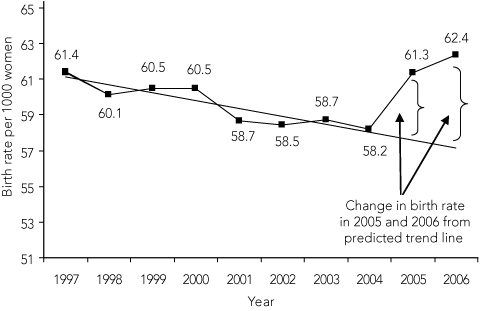
Poisson regression analysis was used to examine changes in birth rates after the introduction of the Baby Bonus. Year was treated as a continuous variable to assess the underlying time trend from 1997 to 2004. The mean annual percentage change in the birth rate was estimated for these years. We used dummy variables for the years 2005 and 2006 to assess deviations from the previous years’ trend (see trend line in Box 2). Rate ratios obtained for these dummy variables were interpreted as the change in the birth rate in that year compared with the birth rate had the trend continued. For example, a rate ratio of 1.20 in 2006 would be interpreted as a 20% increase in birth rate relative to the expected birth rate in 2006 projected from the trend before the Baby Bonus.
From 1997 to 2006, there were 861 372 women aged 15–44 years who gave birth in NSW. Of these, 853 606 women were included in our study. The women who were excluded resided outside NSW (0.01%) or had missing data for age group, birth order or statistical local area (0.9%). The number of women giving birth decreased from 85 860 in 1997 to 83 467 in 2004 (about 0.8% per annum) then increased to 89 921 in 2006. During the study period there was an increase in the proportion of women giving birth who were aged 30 years or older or of higher socioeconomic status (Box 1). From 1997 to 2004, the proportion of births that were first births increased, and then decreased from 2004 to 2006.
Annual birth rates and the underlying trend before the introduction of the Baby Bonus for the whole dataset are shown in Box 2. Birth rates for every age group increased significantly in 2005 and continued to rise in 2006. The largest change in birth rates, relative to the trend of the previous years, was seen in teenage women. Before 2004, birth rates for women aged 15–19 years were declining steeply, at an average of 4.5% (95% CI, 4.1%–5.0%) per year. Compared with this sharp decline, the birth rate for this age group increased 7.7% (95% CI, 3.2%–12.4%) in 2005 and 13.5% (95% CI, 8.5%–18.7%) in 2006. Births to women aged 35 years and older had been increasing at an average of 2.6% per year from 1997 to 2004; however, compared with this upward trend, births increased by an additional 7.2% (95% CI, 4.8%–9.6%) in 2005 and 10.9% (95% CI, 8.4%–13.6%) in 2006, the second largest increase of all age groups.
For women having their first child in 2005 or 2006, the birth rates for most age groups appear to follow the trend of the previous years. The only groups that had a significant increase in first births after the introduction of the Baby Bonus payment were teenagers of average socioeconomic status, women in rural areas in their teens or early 20s, and women aged 30–44 years living in metropolitan areas and of average or advantaged socioeconomic status (Box 3).
Birth rates for women having their second child in 2005 or 2006 deviated significantly from the previous years’ trend for young women living in metropolitan areas. For women aged 20–24 years of disadvantaged or average socioeconomic status, birth rates for second births increased in 2005 and remained about stable in 2006. Second births to teenagers of disadvantaged or average socioeconomic status increased in 2005 and continued to increase in 2006, although results for “disadvantaged” teenagers were not statistically significant as a result of small numbers. There was also a large relative increase in teenagers in rural areas having a second child in 2006 (Box 3).
Birth rates for women having a third or subsequent child were constant from 1997 to 2004, but rose significantly after 2004 for all women aged 20 years and older across all socioeconomic and geographical groups (Box 3).
These findings suggest that the Baby Bonus affected the birth rate in NSW for second, third or subsequent births, but had limited impact on first births. The increase in second births occurred predominantly among younger women of low and average socioeconomic status. The increase in third or subsequent births appears to have occurred across all age, socioeconomic and geographical groups. These findings indicate that, in the short term, a financial incentive has had an impact on the birth rate among certain subgroups of the population. Studies in other countries have shown that birth rate increases occurring immediately after the introduction of financial incentives were not sustained.3,4 Financial incentives may have a temporary effect on birth rates: couples may change the timing of births, but the resulting family size does not change.2
As pregnancy and childbirth in teenagers are associated with adverse perinatal outcomes,14,15 the increase in births to teenagers after the introduction of the Baby Bonus is of concern, and follows a steep decline in teenage birth rates in the years before 2004. Although the absolute increase in births to teenagers after 2004 was only about 40 births per year, from 1997 to 2004 teenage births were declining on average by 125 births per year. Contrary to anecdotal reports, we did not find that the increase in births only occurred in low socioeconomic or disadvantaged groups.
A large proportion of the increase in births after 2004 was among women over the age of 30 years. This group of women may have had a baby even without the bonus payment. The current Australian Government has announced that, from 1 January 2009, only families earning less than $150 000 per year will be eligible to receive the payment,16 and it remains to be seen how this restriction in policy will affect the birth rate. In 2004, the government also introduced a number of tax rebates to assist with the costs of raising children and with child care, although these tax rebates did not gain as much publicity or stimulate as much public discussion as the Baby Bonus payment. Considered together, these policies may have increased the birth rate by highlighting the importance to society of motherhood and increasing the value that is placed on children.17
The introduction of a policy such as the Baby Bonus also affects maternity services. One startling implication of the announcement of a financial incentive to be paid from 1 July 2004 was the delay of over 1000 births from June to July by rescheduling inductions and caesarean sections.18 Both this short-term disruption to maternity services and the longer-term impact of an increase in births have placed huge pressure on the health system at a time when there are decreasing numbers of practising obstetricians and a shortage of midwives.19
1 Characteristics of women giving birth in New South Wales at the start of the study period (1997), and before (2004) and after (2006) the Baby Bonus policy was introduced
2 Birth rate per 1000 women aged 15–44 years in 1997–2006 in New South Wales, and birth-rate trend line before the introduction of the Baby Bonus policy
- Samantha J Lain1
- Jane B Ford1
- Camille H Raynes-Greenow1
- Ruth M Hadfield1
- Judy M Simpson2
- Jonathan M Morris3
- Christine L Roberts1
- 1 Perinatal Research, Kolling Institute of Medical Research, University of Sydney, Sydney, NSW.
- 2 School of Public Health, University of Sydney, Sydney, NSW.
- 3 Northern Clinical School (Royal North Shore Hospital), University of Sydney, Sydney, NSW.
We acknowledge the efforts of the hospital staff who collect the data, and NSW Health Department staff for their role in the design and maintenance of the HOIST data warehouse system. Samantha Lain is the recipient of a Northern Sydney Health Research Grant for this study. Christine Roberts is supported by a National Health and Medical Research Council (NHMRC) Senior Research Fellowship. Jane Ford is supported by the Health Research and Outcomes Network, an NHMRC Capacity Building Grant in Population Health Research. Camille Raynes-Greenow and Ruth Hadfield are supported by NHMRC Australian Research Training Fellowships.
None identified.
- 1. Australian Broadcasting Corporation LateLine. Costello hands down ninth Budget [TV program transcript]. Broadcast 11 May 2004. http://www.abc.net.au/lateline/content/2004/s1106256.htm (accessed Dec 2008).
- 2. Lesthaeghe R. Europe’s demographic issues: fertility, household formation and replacement migration. New York: Population Division, Department of Economic and Social Affairs, United Nations Secretariat, 2000.
- 3. Milligan K. Backgrounder. Quebec’s Baby Bonus: can public policy raise fertility? Toronto, Ontario: CD Howe Institute, 2002. http://www.cdhowe.org/pdf/Milligan_Backgrounder.pdf (accessed May 2008).
- 4. Grant J, Hoorens S, Sivadasan S, et al. Trends in European fertility: should Europe try to increase its fertility rate, or just manage the consequences? Int J Androl 2006; 29: 17-24.
- 5. Australian Bureau of Statistics. Births, Australia, 2006. Canberra: ABS, 2007. (ABS Catalogue No. 3301.0.)
- 6. Horin A. Young to be warned about the hidden costs of parenthood. Sydney Morning Herald 2007; 9 May. http://www.smh.com.au/news/budget2007/young-to-be-warned-about-the-hidden-costs-of-parenthood/2007/05/08/1178390314967.html (accessed Dec 2008).
- 7. Skelton R. Where babies are a mixed bonus. Sydney Morning Herald 2008; 17-18 Mar: 33.
- 8. NSW Health Department. New South Wales Mothers and Babies 1998. Part 8: Validation study NSW Midwives Data Collection 1998. NSW Public Health Bull Suppl 2000; 9 (S-2): 97-99.
- 9. Pym M, Taylor L. Validation study of the NSW Midwives Data Collection 1990. NSW Public Health Bull Suppl 1993; 8: 1-6.
- 10. Australian Bureau of Statistics. 2006 Census: number of children ever born by age of mother for Statistical Local Areas in NSW. ABS data available on request (accessed May 2008).
- 11. Kippen R. Trends in age- and parity-specific fertility in Australia. Working Papers in Demography, No. 91. Canberra: The Australian National University, Demography and Sociology Program, Research School of Social Sciences, 2003. http://adsri.anu.edu.au/pubs/demog-pubs/WorkingPapers/91.pdf (accessed May 2008).
- 12. Australian Institute of Health and Welfare. Rural, regional and remote health: a guide to remoteness classification. Rural Health Series No. 4. Canberra: AIHW, 2004. http://www.aihw.gov.au/publications/index.cfm/title/9993 (accessed May 2008).
- 13. Australian Bureau of Statistics. An introduction to Socio-Economic Indexes for Areas (SEIFA). Information Paper, 2006. (ABS Catalogue No. 2039.0.) http://www.ausstats.abs.gov.au/ausstats/subscriber.nsf/0/D729075E079F9FDECA2574170011B088/$File/20390_2006.pdf (accessed May 2008).
- 14. Robson S, Cameron CA, Roberts CL. Birth outcomes for teenage women in New South Wales, 1998-2003. Aust N Z J Obstet Gynaecol 2006; 46: 305-310.
- 15. van der Klis KA, Westenberg L, Chan A, et al. Teenage pregnancy: trends, characteristics and outcomes in South Australia and Australia. Aust N Z J Public Health 2002; 26: 125-131.
- 16. Australian Government. Budget 2008-2009. Canberra: Australian Government, 2008. http://www.budget.gov. au (accessed Jun 2008).
- 17. Gray M, Qu L, Weston R. Fertility and family policy in Australia. Research Paper no. 41. Melbourne: Australian Institute of Family Studies, 2008. http://www.aifs.gov.au/institute/pubs/rp41/rp41.html (accessed Jun 2008).
- 18. Gans J, Leigh A. Born on the first of July: an (un)natural experiment in birth timing. Discussion Paper No. 529. Canberra: Centre for Economic Policy Research, Research School of Social Sciences, Australian National University, 2006. http://econrsss.anu.edu.au/~aleigh/pdf/BabyBonus.pdf (accessed Jun 2008).
- 19. Weaver EW, Clark KF, Vernon BA. Obstetricians and midwives modus vivendi for current times [editorial]. Med J Aust 2005; 182: 436-437. <MJA full text>
Abstract
Objective: To assess the change in birth rates, both overall and in age, parity, socioeconomic and geographical subgroups of the population, after the introduction of the Baby Bonus payment in Australia on 1 July 2004.
Design and setting: Population-based study using New South Wales birth records and Australian Bureau of Statistics population estimates for the period 1 January 1997 – 31 December 2006.
Participants: All 853 606 women aged 15–44 years with a pregnancy resulting in a birth at ≥ 20 weeks’ gestation or a baby ≥ 400 g birthweight.
Main outcome measure: Change in birth rate in 2005 and 2006 compared with the trend in birth rates before the introduction of the Baby Bonus.
Results: The crude annual birth rate showed a downward trend from 1997 to 2004; after 2004 this trend reversed with a sharp increase in 2005 and a further increase in 2006. All age-specific birth rates increased after 2004, with the greatest increase in birth rate, relative to the trend before the Baby Bonus, being seen in teenagers. Rates of first births were not significantly affected by the bonus; however, rates of third or subsequent births increased across all age, socioeconomic and geographical subgroups.
Conclusions: In the first 2 years after the introduction of the Baby Bonus, birth rates increased, especially among women having a third or subsequent birth. This could represent an increase in family size and/or a change in the timing of births.