



Emergency department presentations for injuries resulting from assault are common, and are often related to drugs or alcohol.1-3 Some studies report that up to 20% of admissions to the emergency department are for non-accidental injury and that these patients consume a high percentage of medical resources.1,4
Most victims of assault are young men.5,6 The resultant — mostly preventable — injuries vary in severity, but can result in significant long-term physical and mental health issues.7,8 Although an Australian Bureau of Statistics survey reported a drop in the number of assaults between 2002 and 2005,9 media reports of stabbings and shootings suggest an increasing incidence of assault and interpersonal violence.10 Anecdotal evidence based on presentations to the emergency department also supports the idea that violence is on the rise.
Victoria has a population of 5.1 million people, with a large urban population of 3.7 million in Melbourne.11 The state is serviced by three Melbourne-based major trauma centres (two adult and one paediatric).
We reviewed data from the VSTR collected prospectively between 1 July 2001 and 30 June 2007. Inclusion criteria for the registry include any of the following: death due to injury, Injury Severity Score (ISS) > 15, intensive care unit (ICU) stay longer than 24 hours requiring mechanical ventilation, or urgent surgery.12
Since July 2005, all adult (age ≥ 15 years) major trauma patients who survived to discharge have been followed up by telephone at 6 months. We measured patients’ functional outcome using the Extended Glasgow Outcome Scale (GOS-E), which classifies functioning on an eight-point scale from one (death) to eight (full recovery) using a valid, reliable and standardised questionnaire.13
We extracted demographic data, injury event details, clinical observations, management and outcomes for analysis. The type of trauma was categorised as either blunt (eg, caused by a fist or baseball bat) or penetrating (such as gun-shot or knife wounds). For patients with both blunt and penetrating injuries coders assigned a trauma category according to the mechanism that caused the most severe injury. We used the ISS as an overall measure of the severity of a patient’s injuries, and the Abbreviated Injury Scale (AIS) diagnosis code (1 = minor to 6 = max-imum) to quantify the severity of specific injuries.14,15
The outcome measures of interest were inhospital mortality, length of hospital stay, ICU stay, and the GOS-E at 6 months after injury. For between-group comparisons, we used χ2 tests for categorical data, and continuous variables were analysed with the Mann–Whitney U test. Population-based incidence rates (95% CIs) were calculated for each financial year based on the total population at the end of each June for the years 2002–2007.16 We used Poisson regression to test for increasing incidence by assuming a linear increase in the logarithm of the rate with time, using population as the exposure. For all tests, a P value < 0.05 was considered significant.
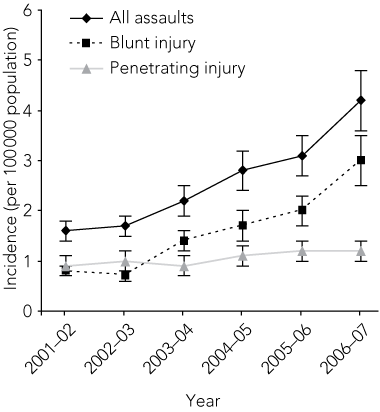
The yearly rate of assault resulting in major trauma rose overall (incidence rate ratio [IRR], 1.21 [95% CI, 1.16–1.26]) and for blunt assault cases (IRR, 1.33 [95% CI, 1.26–1.41]), but the rate of penetrating major trauma assaults did not increase significantly over the study period (IRR, 1.06 [95% CI, 0.99–1.13]) (Box 1).
More than 90% of patients were men and over half were younger than 35 years. Age and sex did not differ by trauma type (Box 2). There was an association between the type of trauma and ISS (P < 0.001), with penetrating trauma being less severe than blunt trauma. Discharge to inpatient rehabilitation was more common for blunt than penetrating trauma cases (P = 0.002). However, the inhospital death rate was higher for penetrating trauma than for blunt trauma (11% v 5%; P = 0.001). Median (interquartile range [IQR]) length of stay for blunt trauma was 5 days (3–11 days) compared with 6 days (3–9 days) for penetrating trauma (P = 0.94). Overall, 326 patients (41%) spent time in the ICU.
Serious head injury (AIS score > 2) was a common outcome of assault, with 82% of patients who had sustained blunt trauma having a serious head injury. Most patients with serious head injury (64%) were discharged directly home, but 24% required inpatient rehabilitation, compared with 5% of patients without a serious head injury (P < 0.001) (Box 3). There was no difference between patients with and without head injury with respect to age (P = 0.07), length of hospital stay (P = 0.52) or ICU stay (P = 0.42).
Forty-two patients (19%) had completely recovered at 6-month follow-up (GOS-E, upper good recovery) (Box 4). Three patients remained in a vegetative state at follow-up. Outcomes were worse in the 153 follow-up patients who had sustained blunt trauma, with 20% (30 patients) unable to return to independent living by 6 months compared with 9% of patients (6 of 67 patients) with penetrating trauma (P = 0.047).
Data from the Victorian Emergency Minimum Dataset (VEMD) (requested from Monash University Accident Research Centre) suggest only a small increase in assault-related presentations to emergency departments: from 7886 in 2001 to 8134 in 2006. However, VEMD data were not available for the 2006–07 data-collection year when the large rise was noted by VSTR. Police statistics17 report an 18% rise in assaults in recent years, from 30 782 in 2002–03 to 36 358 in 2006–07, supporting the findings of our study.
The incidence of assault-related penetrating trauma was stable over the 6-year study period, findings that contradict those from a report18 from a major trauma centre in Melbourne of a near doubling in the rate of abdominal stabbings between March 2005 and March 2006. This report’s findings probably reflect a concentration of stabbing cases in a single hospital rather than the overall state trend.
The smaller rise in penetrating injuries compared with blunt-trauma injuries may also be the result of regulations introduced in 2000 to restrict the number of weapons in the community. The National Firearms Monitoring Program19 and legislative reforms to restrict the sale and possession of knives and other weapons20 have strengthened restrictions on firearm ownership and possession and knives carried in public places.
Some limitations of our study include a lack of information about alcohol and drug consumption by both the victim and the attacker, which have been identified as contributing factors in assaults.2,21-23 Another drawback of our study is that it did not include deaths at the scene because these incidents are not recorded by the VSTR. Data collected by the National Coroners Information System registry were incomplete as many cases were still open at the time of conducting this study. Thus, tracking of year-on-year trends was not possible.
Loss to follow-up at 6 months after injury was higher than that in the general trauma population;24 nevertheless, a comparison of responders with non-responders revealed no obvious bias. Finally, as the study included only major trauma cases, the ability to generalise these findings to minor injuries is limited.
Community-based interventions to reduce high-risk alcohol consumption and assist in harm reduction include responsible beverage service, limiting underage access to alcohol, and increasing local enforcement of drinking and driving laws.25 Key areas for further investigation are the identification of precipitating factors in assaults, development of effective assault-prevention strategies, and improvement of long-term outcomes for assault victims.
3 Basic characteristics by classification of head injury
ISS = Injury Severity Scale. ICU = intensive care unit. LOS = length of stay. |
|||||||||||||||
4 Functional outcomes of patients with assault-related major trauma 6 months after injury (n = 232)
- Phebe A O’Mullane1
- Antonina A Mikocka-Walus2
- Belinda J Gabbe2
- Peter A Cameron2
- 1 Trauma and Emergency Centre, Alfred Hospital, Melbourne, VIC.
- 2 Department of Epidemiology and Preventive Medicine, Monash University, Melbourne, VIC.
We thank Andrew Hannaford and Sue McLellan for their assistance with data extraction, the VSTR Steering Committee and the data collectors. Belinda Gabbe was supported by a Career Development Award from the National Health and Medical Research Council (NHMRC) during preparation of this manuscript.
None identified.
- 1. Luna G, Adye B, Haun-Hood M, et al. Intentional injury treated in community hospitals. Am J Surg 2001; 181: 463-465.
- 2. Savola O, Niemelä O, Hillbom M, et al. Alcohol intake and the pattern of trauma in young adults and working aged people admitted after trauma. Alcohol Alcohol 2005; 40: 269-273.
- 3. Swanson SM, Sise CB, Sise MJ, et al. The scourge of methamphetamine: impact on a level I trauma center. J Trauma 2007; 63: 531-537.
- 4. Luna GK, Kendall K, Pilcher S, et al. The medical and social impact of nonaccidental injury. Arch Surg 1988; 123: 825-827.
- 5. Fothergill NJ, Hashemi K. A prospective study of assault victims attending a suburban A&E department. Arch Emerg Med 1990; 7: 172-177.
- 6. Shepherd JP, Shapland M, Pearce NX, Scully C. Pattern, severity and aetiology of injuries in victims of assault. J R Soc Med 1990; 83: 75-78.
- 7. Boström L. Injury panorama and medical consequences for 1158 persons assaulted in the central part of Stockholm, Sweden. Arch Orthop Trauma Surg 1997; 116: 315-320.
- 8. Brennan IR, Moore SC, Shepherd JP. Non-firearm weapon use and injury severity: priorities for prevention. Inj Prev 2006; 12: 395-399.
- 9. Australian Bureau of Statistics. Crime and safety, Australia. Canberra: ABS, 2005. (ABS Cat. No. 4509.0.)
- 10. Munro P. Just another hot, bloody night in the city. The Age (Melbourne) 2007; 23 Dec. http://www.theage.com.au/articles/2007/12/22/1198175413377.html (accessed Dec 2008).
- 11. Spatial Analysis and Research, Victorian Department of Planning and Community Development. Victorian population bulletin — special edition. Melbourne: DPCD, 2007. http://www.dse.vic.gov. au/DSE/dsenres.nsf/LinkView/0E019FE9FE43A 13FCA2573DA000A2FCC9CF72632FC3C8899CA256D1900232D11 (accessed Nov 2008).
- 12. Cameron PA, Finch CF, Gabbe BJ, et al. Developing Australia’s first statewide trauma registry: what are the lessons? ANZ J Surg 2004; 74: 424-428.
- 13. Wilson JT, Pettigrew LE, Teasdale GM. Structured interviews for the Glasgow Outcome Scale and the extended Glasgow Outcome Scale: guidelines for their use. J Neurotrauma 1998; 15: 573-585.
- 14. Baker SP, O’Neill B, Haddon W Jr, Long WB. The injury severity score: a method for describing patients with multiple injuries and evaluating emergency care. J Trauma 1974; 14: 187-196.
- 15. Rating the severity of tissue damage. I. The abbreviated scale. JAMA 1971; 215: 277-280.
- 16. Australian Bureau of Statistics. Population by age and sex, Australia. Canberra: ABS, 2008. (ABS Cat. No. 3235.0.)
- 17. Victorian Police. Crime statistics 2006–2007. http://www.police.vic.gov.au/statistics (accessed Jul 2008).
- 18. Rozen WM, Ma EH, Jones IT, Judson RT. Emerging epidemic in Australia: abdominal stab wounds. Twenty-four months at a major trauma centre. Emerg Med Australas 2007; 19: 262-268.
- 19. National Firearms Monitoring Program. Canberra: Australian Institute of Criminology, 2007. http://www.aic.gov.au/research/projects/0002.html (accessed Nov 2008).
- 20. Minister for Police and Emergency Services. Swords to become prohibited weapons [media release]. 8 Mar 2004. http://www.legislation. vic.gov.au/domino/Web_Notes/newmedia.nsf/bc348d5912436a9cca256cfc0082d800/53facb21ce5501ecca256e51007dd9be!OpenDocument (accessed Dec 2008).
- 21. Stein DJ, Boshoff D, Abrahams H, et al. Patients presenting with fresh trauma after interpersonal violence. Part I. Alcohol and substance abuse. S Afr Med J 1997; 87: 996-998.
- 22. Sumner BB, Mintz ER, Brown PL. Injuries caused by personal violence. Injury 1987; 18: 258-260.
- 23. Wright J, Kariya A. Assault patients attending a Scottish accident and emergency department. J R Soc Med 1997; 90: 322-326.
- 24. Gabbe BJ, Cameron PA, Williamson OD, et al. The relationship between compensable status and long-term patient outcomes following orthopaedic trauma. Med J Aust 2007; 187: 14-17. <MJA full text>
- 25. <eMJA full text> JAMA 2000; 284: 2341-2347.
Abstract
Objective: To describe the incidence and outcomes of assault resulting in serious injury in Victoria.
Design and setting: Analysis of population-based data from the Victorian State Trauma Registry for assaults between 1 July 2001 and 30 June 2007.
Main outcome measures: Overall trends in the rate of assault-related major trauma, inhospital mortality, and functional outcomes 6 months after injury as measured by the Extended Glasgow Outcome Scale.
Results: The rate of assault-related major trauma rose significantly over the 6-year study period (incidence rate ratio [IRR], 1.21 [95% CI, 1.16–1.26]), particularly for blunt assault (IRR, 1.33 [95% CI, 1.26–1.41]). There were 803 admissions for major trauma related to assault: 484 (60%) were for blunt trauma and 319 (40%) for penetrating trauma. Most patients were young men. Compared with penetrating trauma, blunt trauma was associated with more severe injury; 396 patients (82%) with blunt trauma had serious head injuries, and 102 (24%) of these required inpatient rehabilitation. A higher percentage of patients with penetrating trauma died in hospital compared with those with blunt trauma (35 [11%] v 23 [5%]; P = 0.001). Follow-up at 6 months showed that only 19% of respondents (42 patients) had made a complete recovery; outcomes at 6 months were worse for patients with blunt trauma than for those with penetrating trauma.
Conclusions: The incidence of assault resulting in severe trauma rose significantly between 2001–02 and 2006–07, mostly due to a rise in assault resulting in blunt trauma. The increase in incidence, the young age of the victims, and the potential for high burden of injury and poor outcome, combined with the preventable nature of assault, highlight the importance of developing effective assault-prevention strategies.