|
Home | Issues | eMJA shop | Classifieds | Contact | More... | Topics | Search | Login | Buy full access |
→ Contents list for this issue
→ Contents list for this supplement
→ More articles on Administration and health services
Introduction
—Diagnosing the problems with planned arrivals
—Pattern of planned arrival flows
—Managing planned arrivals
—Waiting list control and management
—Operating theatre and procedure room utilisation
—Applying clinical services redesign to the planned patient journey
—The redesigned planned patient journey
—Planned surgery
—Waiting list management
—Preadmission processes
—Bed management for planned procedures
—Theatre utilisation
—Postprocedure processes
—Support services
—Results from redesign of planned arrivals
—Conclusions
—Acknowledgements
—Competing interests
—Author details
—References
Competing demands of planned and unplanned arrivals present major challenges for hospitals.
Applying clinical process redesign methods to the planned patient journey allows management to recognise the blocks and inefficiencies in the journey and facilitates the development of solutions for improvement.
Redesign of the planned patient journey in New South Wales has promoted the expansion of the extended day-only model of care, reformed the waiting times policy, standardised patient preadmission assessment and preparation, and targeted operating theatre use.
Improved performance management at Area Health Service and local facility levels has accompanied the redesign of planned arrival processes.
The results in redesign of surgery undertaken by the Area Health Services in 96 NSW hospitals have been impressive, with results within 2 years of commencing the clinical services redesign program showing:
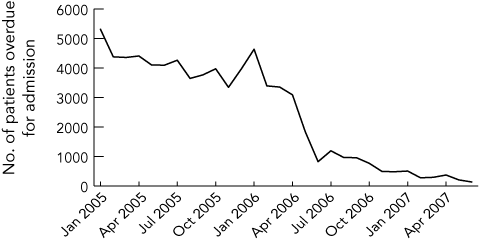
a 97% reduction in the numbers of patients in Category 1 (admission desirable within 30 days) whose surgery was overdue, from 5308 in January 2005 to 135 in June 2007; and
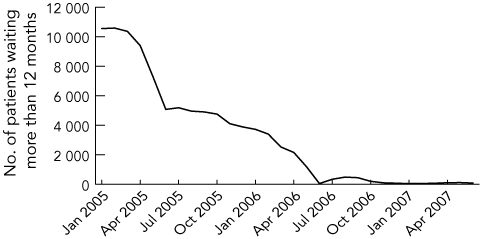
a 99% reduction in the number of patients who have waited > 365 days for surgery, from 10 551 in January 2005 to 84 in June 2007.
Improved surgical service efficiency, safety and quality justify the continuation of the redesign program.
Lack of focus on the need to balance the hospital resources required for both emergency and planned demands often leads to emergency patients taking precedence in being admitted, and the resultant cancellation of planned admissions. This had been the situation in the New South Wales health system for many years. The interminable increase in the waiting list size is the inevitable consequence.
Over the past few decades, advances in technology in both surgery and anaesthesia have facilitated shorter lengths of stay in hospital for patients undergoing planned procedures. Many patients require only a few hours in hospital, or a stay of less than 24 hours. Much of the growth in demand for surgery could be accommodated by more use of day-only or extended day-only models of care.
The previous article in this supplement (→ Clinical process redesign for unplanned arrivals in hospitals) discussed redesign solutions for unplanned arrivals at hospitals.1 Here, we will consider the application of the Clinical Services Redesign Program to planned arrivals in NSW hospitals.
A number of factors contributing to the problems resulting from planned arrivals have been elucidated in the diagnostic phase of the redesign method. They are discussed in the following sections.
As the previous article in this supplement (→ Clinical process redesign for unplanned arrivals in hospitals) shows, unplanned hospital demand is predictable over time, and the degree of randomness or variability is relatively small.1 On the other hand, analysis of the planned hospital demand over time commonly shows large variability in the patient flows on a daily basis.
Planned arrivals are largely scheduled to suit clinician preference rather than being spread evenly across the full working week. The result is a high planned patient load early in the week and a lighter load at the end of the week. Unfortunately, the unplanned demand also peaks at the beginning of the week because of a reduced discharge rate at weekends.
Smoothing out the variability in the scheduling of planned arrivals will reduce this potential source of capacity stress in hospitals and will improve the overall ability of the hospital to deal with the natural variability of arrivals.2,3
NSW hospitals have lacked a purposeful approach to managing the demand for planned surgical procedures. An essential component of managing any system is information about internal and external influences to make it possible to track and predict changes in demand. To date, good management information (eg, waiting list profiles, theatre session utilisation lists) has not been readily available to managers or staff.
Categorising patients on the waiting list requires more precision than has previously been used. The categories used are: Category 1 (admission desirable within 30 days); Category 2 (admission desirable within 90 days); and Category 3 (admission desirable within 365 days). Placing large numbers of patients in Category 1 (considered “urgent”) places considerable stress on the system to schedule their surgery within 30 days; this inevitably increases waiting times for patients not in the urgent category.
Patients are prioritised on a waiting list in order of urgency, but they frequently have their surgery performed in a more random order based on clinicians’ preferences related to their operating theatre (OT) lists. This queue jumping leads to longer waiting times for many patients.
In NSW, the number of patients waiting more than 12 months for planned surgery had continued to increase between 1995 and 2004, reaching an unacceptable level of 10 551 patients in January, 2005.
Efficient preadmission and OT processes are necessary to avoid cancellation of planned procedural or operative interventions. Cancellation rates resulting from bed unavailability, patients being medically unfit or not arriving, and emergency surgery load were 10%–15% in some facilities. The resultant financial cost to the system of a fully staffed and equipped OT remaining idle is considerable, and patients and their families bear a significant social and financial burden (Box 1).
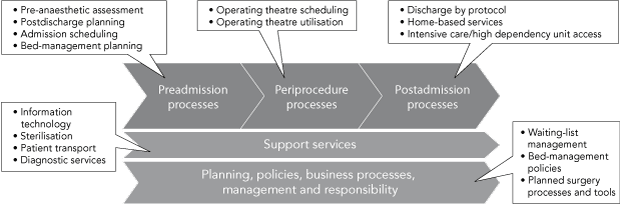
There are multiple steps in the redesign of the journey for a patient being admitted for a planned procedure. The main components for the redesign of the planned patient journey, whether for a short stay or a more prolonged admission, are shown in Box 2. This simple schema covers the patient journey from referral through to discharge.
The main components of the planned patient journey, once redesigned, will facilitate the management of an efficient, cost-effective, safe and high-quality service. Integrating the components requires that management take responsibility for the whole patient journey, avoiding multiple managers and multiple interfaces. The components of the patient journey are described below.
An essential component in managing planned arrival demand is ensuring that the capacity of the system, including beds, staff, equipment, and OT sessions are matched with the demand. Inhouse software programs have now been developed to provide managers with the ability to estimate future planned and unplanned demand based on trended demand data for the state and for individual hospitals. An additional inhouse software program monitors the waiting list and forewarns managers about patients nearing their maximum waiting time at facility level, and ensures that patients on the waiting list have a planned admission date.
Waiting list management should ensure that all patients have their procedures in an appropriately prioritised and timely manner. In NSW, major changes were made to waiting list processes as part of the Clinical Services Redesign Program, and resulted in the 2006 publication of NSW Health’s Waiting times and elective patient management policy.4
In addition to this policy, specific guidelines for prioritisation of urgent conditions have been developed, and only patients with these diagnoses are automatically placed in Category 1 by booking-office staff.5 An opt-out system is in place and altered priority categorisation can be organised through the Area Director of Surgery, who is a surgeon. The Area Director makes the final decision, usually after consultation with the clinician concerned.
A patient is not placed on the waiting list if his or her surgeon does not have sufficient OT time available to do the surgery within the required timeframe. Instead, discussions are held with the surgeon to determine how additional OT time could be made available, or the patient is referred to a surgeon who can perform the surgery within the timeframe.
Implementation of this policy ensures that the patient is admitted in the shortest time within their priority category and prevents queue jumping.
The Pre-Procedure Preparation Toolkit (PPPT)6 is an essential determinant for success and defines the processes to prepare the patient medically, socially and administratively. In the Clinical Services Redesign Program, it was recognised that patients should not be required to visit the facility for anaesthetic assessment unless absolutely necessary. Thus, a triage system has been adopted which uses a standardised patient health questionnaire — this is an internationally accepted practice.
The preadmission process is also used to assess patients’ postdischarge needs and to ensure that appropriate plans and resources are in place when patients are ready for discharge after their procedures (eg, home-based rehabilitation following hip replacement surgery, home help, etc).
The number of beds needed for planned procedures is relatively small if the advances in technology that reduce the length of inpatient stay are applied effectively.
One way of ensuring that planned demand requirements are met is to use admission configurations more suited to the planned arrivals than the unplanned arrivals. The extended day-only (EDO) model mandates a stay of less than 24 hours with patients being managed according to agreed protocols. Under the EDO model, patients are less likely to have their procedures cancelled and discharge is predetermined by a specific protocol.7
In NSW, the identification of diagnosis-related groups (DRGs) suitable for the EDO model, together with policy support, has led to a significant increase in these designated DRGs going through as EDO admissions in line with the expectations of reaching the 80% target.
It is well recognised that efficiency in managing planned procedures relies heavily on OT efficiency. Cancellation rates increase as OT efficiency decreases, with resulting costs to the system and to patients and their families. Late starts and overruns are acknowledged to contribute significantly to a lower level of OT efficiency.
Since the Clinical Services Redesign Program was implemented, theatre staff have been working with surgeons to improve the accuracy of theatre lists so that the number of cases listed is appropriate for the time available (Box 3).
Moving appropriate procedures (eg, endoscopy, flexible cystoscopy) out of the operating suites reduces competition with major surgical procedures for a limited number of sessions. Where possible, patients undergoing these procedures should continue to recover in the OT recovery suite for efficient use of resources.
The emphasis on protocol-based management of patients throughout their journey provides significant benefits to both patients and staff in terms of certainty of purpose and the perception of a well organised experience. Discharge planning and protocol-based patient management are part of the PPPT, and are essential components of the EDO model of care.
Information technology is required in the OT environment to provide the necessary data for information management. Planning of sterilising services, transport services and radiological services, to name a few, also need to be integrated into OT scheduling.
The management of OTs has been hampered by the variable quality of data management systems, thus making review of OT utilisation difficult. The electronic medical record scheduling system currently being rolled out across NSW will improve the quality of OT scheduling, and the improved information technology support will assist in more automated and integrated data collection.
The initial results from the clinical process redesign of planned arrivals are impressive. Within a relatively short time there has been a significant increase in more timely patient access to treatment. It is anticipated that the redesign processes will continue to improve the delivery of services for planned arrivals. The results of the redesign are summarised below.
The total waiting list has been reduced from 68 451 in January 2005 to 56 640 in June 2007.
A 97% reduction in the numbers of patients in the Category 1 (admission desirable within 30 days) whose surgery was overdue, from 5308 in January 2005 to 135 in June 2007 (Box 4). This improvement was sustained through the winter period.
A 99% reduction in the number of patients who have waited more than 365 days for surgery, from 10 551 in January 2005 to 84 in June 2007 (Box 5).
Between January 2005 and June 2007, average waiting times for patients on the waiting list in categories 1, 2 and 3 decreased: Category 1, 70 days to 12 days; Category 2, 141 days to 72 days; and Category 3, 226 days to 122 days.
Applying clinical redesign methods to the planned patient journey has successfully allowed management to recognise the blocks and inefficiencies, and to facilitate the development of solutions for improvement. The redesign solutions require committed clinician support and strong managers to ensure their implementation, and a robust performance management system for sustainability. With these in place, the improvements are unquestionably impressive, not only in terms of efficiency, safety and quality gains but also for enhancing patients’ experiences.
1 Gains from improving efficiency of operating theatre use
In one Area Health Service, it was determined that the total operating theatre (OT) time unused or poorly used because of late starts, delays and overruns was approximately 11 600 hours across all their facilities. It was estimated that if this waste was decreased by 10%, there would be sufficient sessional OT capacity to halve that Area’s waiting list without increased staffing or resources.
3 Simple solution to improve operating theatre efficiency
Sydney South West Area Health Service (AHS) successfully improved efficiency by planning an increase of one procedure per operating theatre in every second session. Across the hospitals in that AHS, this would increase the number of procedures by 7000 per annum without changing the number of sessions or the amount of staffing. Coupled with better defined processes concerning surgery start time, they also successfully reduced overruns.
We acknowledge the critical input and advice of Professor John Marley in preparing this article, and Dr Deborah Lloyd for her editorial work on this article and her assistance in preparing this supplement.
2 Surgical Services Taskforce, Department of Surgery, Nepean Hospital, Sydney, NSW.
3 Sustainable Access Performance Taskforce, Department of Surgery, Royal Prince Alfred Hospital, Sydney, NSW.
Correspondence: kamcgATdoh.health.nsw.gov.au
|
Home | Issues | eMJA shop | Terms of use | Classifieds | More... | Contact | Topics | Search |
©The Medical Journal of Australia 2008 www.mja.com.au PRINT ISSN: 0025-729X ONLINE ISSN: 1326-5377