



Persistence with long-term medication in patients with hypertension or dyslipidaemia is generally unsatisfactory outside the context of controlled trials.1-7 Of 32 000 Australian patients initiated on a lipid-modifying drug in a single month of 1999, 30% had discontinued therapy within 6 months.5 European and North American studies have estimated that around 50% of all patients using antihypertensive (AHT) drugs had discontinued within 6 months to 4 years.3,8,9
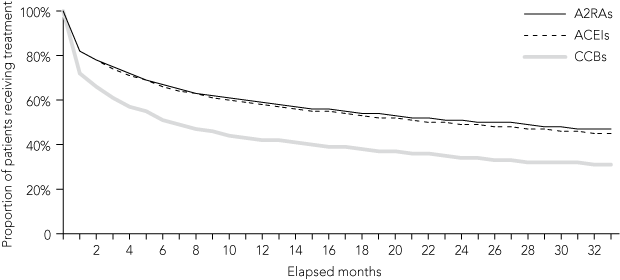
Persistence curves for the three drug classes are shown in Box 1, and key derived statistics are summarised in Box 2. Apparent persistence was unsatisfactory for all drug classes, but poor persistence was notably higher in patients prescribed CCB therapy. Compared with patients taking A2RAs, 57% more patients who began on CCBs had discontinued therapy by the end of the period studied (log-rank P < 0.001). There were no major differences in persistence patterns between patients taking A2RAs and ACEIs. Poor persistence in this analysis was defined as complete cessation of all AHT drugs.
Key persistence statistics for individual drugs are summarised in Box 3 (this analysis is specific to the drug prescribed and takes no account of switching to an alternative drug). Within the A2RA class, patients commencing on candesartan or telmisartan showed the best apparent persistence (by a margin of 10%–20%); within the ACEI class, patients prescribed perindopril showed the best apparent persistence (about 25% better than other class members); and within the CCB class, patients prescribed lercanidipine showed the best apparent persistence (at least 25% better than other class members). Median MPRs (based on the assumption that patients are prescribed, and take, one dose per day) were close to 100%, with the notable exception of captopril (72%).
Key persistence statistics, by age and sex, are shown in Box 4. Poor persistence in this analysis was defined as complete cessation of all AHT drugs. The best apparent persistence data were observed in the age group 60–69 years, the poorest in patients aged under 40 years. There were no major differences between male and female patients, or according to prescriber (GP or specialist prescriber) (data not shown).
Our results confirm that long-term persistence with AHT drugs (44% of patients) is still relatively unsatisfactory. On the other hand, patients who continue with therapy seem to adhere to the treatment regimen reasonably well. Our findings are consistent with the observation that hypertension worldwide is poorly controlled in many patients,7 despite the availability of safe and effective drugs to treat the condition.4,7,10
Persistence analyses were recently published by the Australian Institute of Health and Welfare (AIHW).11 Persistence was examined only in patients who had filled a minimum of two prescriptions (in contrast with our study, which had no such restriction). Given the high proportion of patients in our study who failed to fill a second prescription, the AIHW analysis would have produced a more optimistic outcome than ours. For example, persistence at 24 months on A2RAs and ACEIs was about 75%–77% in the AIHW analysis, compared with around 50% in our study. The AIHW report did present directly comparable data on the proportions of patients using A2RAs and ACEIs who failed to collect a second prescription (15% and 18%, respectively) — proportions that were in close agreement with our own findings.
Our approach had certain limitations: we did not know patients’ medical histories; some patients may have used AHT medications for indications other than hypertension; and only concession card holders were studied (nevertheless, they represent about 65% of Australian patients using these medications — a highly meaningful proportion). Patients without concession cards are likely to be younger, to make higher copayments and to be poorer compliers (as suggested in Box 4). We have also made the broad assumption that patients in our study were new to AHT therapy. It is possible that some patients were actually returning to therapy after previous cessation.
Adverse events associated with AHT drugs may contribute to poor persistence with therapy.3 In one study, more than 40% of patients changed their AHT therapy because of adverse events.12 In our study, we observed broadly similar apparent persistence whether patients were initiated on A2RAs or ACEIs, yet there was poorer persistence in those initiated on CCBs. This pattern, reported previously,3,4,11,13 is probably related to the propensity of some CCBs to induce peripheral oedema.14 Brand price premiums attached to CCBs could also affect patients’ willingness to persist in using them. It is a therapeutic challenge that the poorest persistence was in the youngest and oldest age groups, but some of the oldest patients may have died during the time period studied.
Does poor persistence affect clinical outcomes? Analysis of cardiovascular disease outcomes in the Second Australian National Blood Pressure Study showed a 20%–23% higher event rate in patients reporting poor compliance with medication.15 A North American study of patients with diabetes and coronary disease reported 40% lower mortality in patients complying with “cardioprotective” medications, while those poorly compliant had the same mortality rate as their peers not using medications.16
1 Persistence curves for the three main classes of antihypertensive drugs initiated in Australia, January 2004 to September 2006
 | |||||||||||||||
- Leon A Simons1
- Michael Ortiz2
- Gordon Calcino3
- 1 Lipid Research Department, University of New South Wales, St Vincent’s Hospital, Sydney, NSW.
- 2 Solvay Pharmaceuticals Australia, Sydney, NSW.
- 3 HI Connections Pty Ltd, Canberra, ACT.
Our project was commissioned by Solvay Pharmaceuticals Australia and conducted by Leon Simons and Gordon Calcino as independent contractors.
Leon Simons received contract fees to design and report our study, and has also received speaker fees (unrelated to our study). Michael Ortiz is an employee of Solvay Australia. Gordon Calcino received contract fees to perform data reduction and analysis.
- 1. DiMatteo MR. Variations in patients’ adherence to medical recommendations: a quantitative review of 50 years of research. Med Care 2004: 42: 200-209.
- 2. Osterberg L, Blaschke T. Adherence to medication. N Engl J Med 2005; 353: 487-497.
- 3. After the diagnosis: adherence and persistence with hypertension therapy. Am J Manag Care 2005; 11 (13 Suppl): S395-S399.
- 4. Elliott WJ, Plauschinat CA, Skrepnek GH, Gause D. Persistence, adherence, and risk of discontinuation with commonly prescribed antihypertensive drug monotherapies. J Am Board Fam Med 2007; 20: 72-80.
- 5. Simons LA, Simons J, McManus P, Dudley J. Discontinuation rates for use of statins are high [letter]. BMJ 2000; 321: 1084.
- 6. Benner JS, Glynn RJ, Mogun H, et al. Long-term persistence in use of statin therapy in elderly patients. JAMA 2002; 288: 455-461.
- 7. Messerli FH, Williams B, Ritz E. Essential hypertension. Lancet 2007; 370: 591-603.
- 8. Caro JJ, Salas M, Speckman JI, et al. Persistence with treatment for hypertension in actual practice. CMAJ 1999; 160: 31-37.
- 9. Degli Espositi E, Sturani A, Di Martino M, et al. Long-term persistence with antihypertensive drugs in new patients. J Hum Hypertens 2002; 16: 439-444.
- 10. Conlin PR, Gerth WC, Fox J, et al. Four-year persistence patterns among patients initiating therapy with the angiotensin II receptor antagonist losartan versus other antihypertensive drug classes. Clin Ther 2001; 23: 1999-2010.
- 11. Senes S, Penm E. Medicines for cardiovascular health: are they used appropriately? Canberra: Australian Institute of Health and Welfare, 2007. (AIHW Cat. No. CVD 36; Cardiovascular Disease Series No. 27.) http://www.aihw.gov.au/publications/cvd/mfchatua/mfchatua-c00.pdf (accessed Dec 2007).
- 12. Lip GY, Beevers DG. Doctors, nurses, pharmacists and patients — the Rational Evaluation and Choice in Hypertension (REACH) survey of hypertension care delivery. Blood Press Suppl 1997; 1: 6-10.
- 13. Thaker D, Frech F, Gause D, Zhang W. Patient adherence and persistence with antihypertensive agents: a comparison of agents in different therapeutic classes [abstract]. Am J Hypertens 2005; 18 (5 Suppl 1): A117.
- 14. Lund-Johansen P, Stranden E, Helberg S, et al. Quantification of leg oedema in postmenopausal hypertensive patients treated with lercanidipine or amlodipine. J Hypertens 2003; 21: 1003-1010.
- 15. Nelson MR, Reid CM, Ryan P, et al. Self-reported adherence with medication and cardiovascular disease outcomes in the second Australian National Blood Pressure Study (ANBP2). Med J Aust 2006; 185: 487-489. <MJA full text>
- 16. Ho PM, Magid DJ, Masoudi FA, et al. Adherence to cardioprotective medications and mortality among patients with diabetes and ischemic heart disease. BMC Cardiovasc Disord 2006; 6: 48.
Abstract
Objective: To study persistence and adherence with the use of common antihypertensive (AHT) medications.
Design, setting and participants: Longitudinal assessment of Pharmaceutical Benefit Scheme claim records covering the period January 2004 to December 2006. We analysed a 10% random sample of all Australian long-term health concession card holders who had been commenced on an angiotensin II receptor antagonist (A2RA), an angiotensin-converting enzyme inhibitor (ACEI) and/or a calcium channel blocker (CCB), but for whom no AHT medication had been dispensed in the previous 6 months.
Main outcome measures: Proportion of patients failing to fill a second prescription; median persistence time with medication (ie, non-cessation of therapy); persistence with medication over 33 months; median medication possession ratio (MPR, defined as the proportion of prescribed medication actually consumed by patients persisting with treatment).
Results: The database yielded information relating to 48 690 patients prescribed AHT medication. Nineteen per cent of patients failed to collect a second prescription. The median persistence time was 20 months. The data were little different from the population average with respect to A2RAs or ACEIs, but persistence was 57% poorer with respect to CCBs (log-rank P < 0.001) (28% of patients prescribed CCBs failed to collect a second prescription; median persistence time, 7 months). There were differences in persistence between individual drugs in the respective classes, the best outcomes being with candesartan and telmisartan (A2RAs; 10%–20% better), perindopril (ACEI; 25% better) and lercanidipine (CCB; 25% better). Median MPRs were generally around 100%, indicating that most patients who collected prescriptions also showed good adherence to treatment regimens.
Conclusion: There is an ongoing problem of poor persistence with commonly used AHT medications. This may represent a diminished opportunity for cardiovascular disease prevention.