

|
Home | Issues | eMJA shop | Classifieds | Contact | More... | Topics | Search | Login | Buy full access |
→ Contents list for this issue
→ More articles on Dermatology
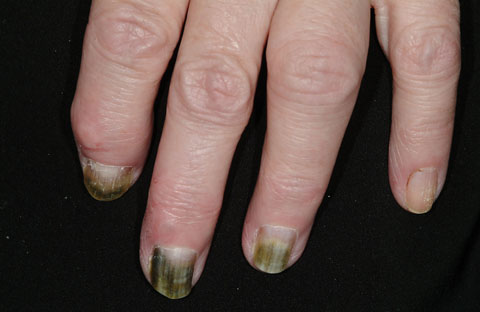
A 75-year-old woman had a 2-year history of severe onycholysis and chloronychia (olive green discolouration) of most of her fingernails (Figure). Fungal infection had been excluded by microscopy and culture of nail scrapings. Some nails had superficial ridges and pits, as well as translucent orange-brown discolouration of the nail beds (the “oil drop” sign). This, along with a well defined, red, scaly plaque over her right elbow, led to a diagnosis of limited plaque psoriasis.
The green discolouration was a classic sign of a secondary bacterial infection caused by Pseudomonas aeruginosa. Treatment was to consist of vinegar soaks (10 parts water and 1 part white vinegar applied topically for 5–10 minutes twice daily for 5 days) for the Pseudomonas infection, followed by a course of dexamethasone iontophoresis to treat the psoriatic onycholysis. (In the latter process, the fingers are held in contact with a dexamethasone solution and a low electrical current stimulates the transdermal migration of dexamethasone ions into the nail beds.)
|
Home | Issues | eMJA shop | Terms of use | Classifieds | More... | Contact | Topics | Search |
©The Medical Journal of Australia 2007 www.mja.com.au PRINT ISSN: 0025-729X ONLINE ISSN: 1326-5377