

eMJA     The Medical Journal of Australia

Home | Issues | eMJA shop | My account | Classifieds | Contact | More... | Topics | Search   

Snapshot

“Lesionnaire’s syndrome”

Dennis Velakoulis, Christos Pantelis and Mark Walterfang
MJA 2005; 183 (11/12): 679

The explosion in psychiatric neuroimaging research has led to the establishment of stressful and dark neuroimaging laboratories in which young researchers sweat in front of computer monitors performing laborious and tedious imaging analysis. These conditions have contributed to the development of a new psychiatric syndrome, described below.

Diagnostic criteria

“Lesionnaire’s syndrome” predominantly affects younger researchers examining magnetic resonance imaging (MRI) scans of the brain. These researchers:

(a) Work in large institutions;

(b) Have a fixed belief that volume change in a brain structure causes schizophrenia;

(c) Feverishly spend hours tracing brain structures to prove this belief;

(d) Alter their beliefs if their attempts are unsuccessful and begin work on a different brain structure or new method;

(e) Attribute negative findings to “methodological limitations”;

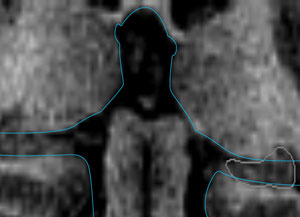
(f) Begin to see non-brain images in brain scans on which they are working.

The diagnosis may only be made if the patient satisfies criterion (f) and any three of criteria (a)–(e). The diagnosis cannot be made if the MRI scan has revealed an organic disorder.

Case report

A 38-year-old psychiatrist had spent hundreds of hours tracing hippocampal volumes on MRI scans. He would lock himself in a darkened room, staring at a computer monitor, often listening to ’80s music in an attempt to relieve the mind-numbing tedium of the repetitive tracing behaviour. After tracing scans for 4–5 years, he revealed to his colleagues that he had discovered religious images — in particular, a vision of the Crucifixion (Box).

He was successfully treated with complete tracing abstinence, but has had episodic relapses of his delusional visions, during which he has been heard to cry out “Maybe if I trace a few more it will reach statistical significance”.

In order to ensure that the syndrome was related to the tracing behaviour rather than the music, a further trial was undertaken. Fortunately, re-exposure to ’80s music outside the imaging laboratory did not lead to a relapse in his symptoms.

(Received 23 Oct 2005, accepted 3 Nov 2005)

Melbourne Neuropsychiatry Centre, University of Melbourne and Melbourne Health, Parkville, VIC.

Dennis Velakoulis, MB BS, FRANZCP, Clinical Director; Christos Pantelis, MD, MRCPsych, FRANZCP, Professor and Scientific Director; Mark Walterfang, MB BS, FRANZCP, Research Fellow.

Correspondence: Dr Dennis Velakoulis, Melbourne Neuropsychiatry Centre, Royal Melbourne Hospital, Grattan Street, Parkville, VIC 3050. dennis.velakoulisATmh.org.au

AntiSpam note: To avoid spam, authors' email addresses are written with AT in place of the usual symbol, and we have removed "mail to" links. Replace AT with the correct symbol to get a valid address.

Home | Issues | eMJA shop | My account | Classifieds | More... | Contact | Topics | Search

The Medical Journal of Australia    eMJA  

©The Medical Journal of Australia 2005 www.mja.com.au PRINT ISSN: 0025-729X ONLINE ISSN: 1326-5377