



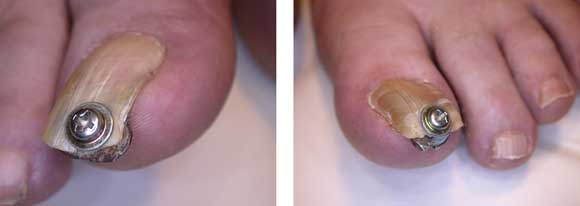
An elderly man attending a dermatology outpatient clinic for an unrelated skin complaint proudly insisted on demonstrating his simple do-it-yourself (DIY) solution to a deformity of his great toenails (pincer nail) that he had endured for many years. As he slipped off his socks, a number of medical students observing the consultation turned ashen (see Figures).
Pincer nails are a transverse overcurvature of the nail, commonly caused either by degenerative osteoarthritis of the distal interphalangeal joints or by ill-fitting shoes. Less commonly, they may be associated with subungual tumours or ingestion of β-blockers. Treatment options for pincer nail usually include bracing (with steel or plastic devices that exert countertension on the nail), surgery to ablate the lateral horns of the nail matrix, or permanent removal of the nail either chemically or surgically.1
Our patient found that, by inserting a stainless steel screw through the free edge of each of his overgrown and overcurved great toenails and into a small broad nut, he was able to satisfactorily correct his deformity by making a series of tightening adjustments over a period of months.
Our patient’s novel approach, which is quite unlike that of usual bracing devices, exerted countertension on the ventral aspect of the free edge of the nail. Korean authors have recently described a similar technique using custom-fitted aluminium splints. These are bound with cyanoacrylate adhesive to the ventral nail plate after separating the affected great toenail longitudinally using CO2 laser vaporisation.2
Our patient’s device might begin to create some discomfort as the nail grows longer, requiring repositioning (proximally) to maintain the effect on moulding nail growth, although these considerations were not discussed in the brief consultation with our patient!
- Alex Chamberlain1
- Annika Smith2
- Adrian Mar3
- Dermatology Department, Alfred Hospital, Prahran, VIC.