

|
Home | Issues | eMJA shop | My account | Classifieds | Contact | More... | Topics | Search |
→ Previous article in this issue
→ View contents list for this issue
→ Search PubMed for related articles
→ More articles on Drugs and alcohol
Snapshot
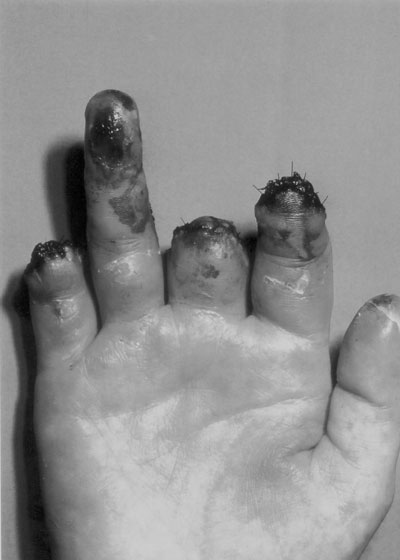
A 29-year-old unemployed man presented with pain and swelling of the right hand. He reported two occasions of intravenous drug use during the previous three days: a single heroin dose, followed by temazepam (4 × 10 mg gel capsules, dissolved in hot water). He was right-handed. On both occasions he injected into a superficial blood vessel on the back of the right hand. On presentation, the clinical diagnosis was inadvertent intra-arterial injection of temazepam, with vascular endothelial damage secondary to macrogols (used to increase viscosity in gel capsule manufacture). The patient's condition was managed with elevation of the forearm, aspirin, heparin anticoagulation, empirical parenteral antibiotics and analgesia. Over three days the patient showed substantial improvement, allowing discharge with follow-up in one week. Four days later, he returned with increasing pain. He denied further intravenous drug use. He had normal arterial pulses, but the distal fingers were cool. Fingertip sensation and capillary refilling were diminished. To improve perfusion and limit further thrombus development, an alprostadil infusion and oral nifedipine were introduced. Over 10 days, necrotic areas, involving index, middle and little fingers, developed and required amputation. The picture shows the patient's hand after surgical debridement and amputation of necrotic areas, three weeks after injection of temazepam.*
*In December 2001, the Pharmaceutical Benefits Advisory Committee recommended that prescribing of temazepam capsules be restricted to people who have failed to respond to the tablets because of concerns about misuse by intravenous drug users (see <http://www.health.gov.au/pbs/listing/pbacrec/pbacrecdec.htm>, accessed 20 March 2002, no longer available).
Princess Alexandra Hospital, Woolloongabba, QLD.
Gerald FX Feeney, MB BCh BAO FRACP, Medical Director, Alcohol and Drug Assessment Unit; Harry H Gibbs, MB BS FRACP, Director, Department of Vascular Medicine.Correspondence: Dr Gerald F X Feeney, Princess Alexandra Hospital, Ipswich Road, Woolloongabba, QLD 4102. Gerald_FeeneyAThealth.qld.gov.au
AntiSpam note: To avoid spam, authors' email addresses are written with AT in place of the usual symbol, and we have removed "mail to" links. Replace AT with the correct symbol to get a valid address.
|
Home | Issues | eMJA shop | My account | Classifieds | More... | Contact | Topics | Search |
©The Medical Journal of Australia 2002 www.mja.com.au PRINT ISSN: 0025-729X ONLINE ISSN: 1326-5377