| Research
Erectile dysfunction in the community: a prevalence study
Carole B Pinnock, Alan M F Stapleton and Villis R Marshall
MJA 1999; 171: 353-357
For editorial comment see Lowy
Abstract - Introduction - Methods - Results - Discussion - Acknowledgements - References - Authors' details
- - More articles on Urology
| |
| Abstract |
Objective: To investigate the prevalence of erectile dysfunction (ED) in the South Australian community, and the influence of demographic and other risk factors.
Design: Survey by mailed questionnaire (based on the University of California, Los Angeles prostate cancer index) of a subset (men who agreed to participate) of a probability sample of the South Australian community who completed a multiuser interview survey.
Participants and setting: Men over the age of 40 in South Australia.
Main outcome measures: Sexual desire, orgasm, ability to have an erection, adequacy (firmness) of erections for intercourse, frequency of erections when wanted, frequency of intercourse, nocturnal or morning erections, and history of prostate surgery; total sexual function score based on these.
Results: 612 men (86.7%) agreed to answer the sexual function survey; 427 (69.8%) returned questionnaires. ED was strongly correlated with age in all seven domains of sexual function. Erections inadequate for intercourse affected 3% of 40-49-year-olds, increasing to 64% of 70-79-year-olds. The frequency of intercourse considered normal for age by men 50-69 years was 1-6 times weekly; the disparity between this and reported frequency increased in men over 60 years, as did the difference between sexual desire and potency. A history of vigorous exercise was protective across all ages. High triglyceride levels, blood pressure medication and non-cancer surgery for prostate disease were independent predictors of poor sexual function at older ages. High cholesterol level was an independent predictor of impotence.
Conclusions: We found similar or higher levels of ED than in comparable overseas studies. Disparity between potency and desire was greatest, and hence the age group in whom demand for treatment may be highest, in those 60 years and older. Cardiovascular risk factors were predictors of ED in these older men, suggesting that prevention may benefit sexual function. Non-cancer prostate surgery may be a greater contributor to ED than previously realised.
|
|
| Introduction |
Establishing the prevalence of erectile dysfunction (ED) in the community is difficult,1 but important for understanding the need for services, establishing functional expectations of men as they age and for determining the influence of demographic and preventable risk factors. An understanding of community prevalence of ED is useful when evaluating treatments for prostate disease which carry high risks of ED. Community prevalence has been examined in international, but not Australian, studies.1-4 One Australian study of ED prevalence in a Perth general practice population has been reported in conference proceedings.5 We undertook this study to establish the prevalence of erectile dysfunction among Australian men, and to investigate the influence of risk factors.
|
|
| Methods |
Questions were included in the spring 1997 Omnibus survey, a multiple-user household interview survey which provides a representative sample of the South Australian population. We have reported the methods of and results from this annual survey previously.6-8
The Omnibus survey included questions about age, educational attainment, marital status, household income, area of residence, blood pressure group (low, normal, borderline, high), cholesterol group (low, normal, high), alcohol intake by frequency (days per week) and volume (standard drinks per day when drinking), doctor's report of high triglyceride levels, body mass index (BMI), whether vigorous exercise was undertaken in the past two weeks, current and previous smoking status, and number of cigarettes per day usually smoked. Also included were questions about the presence of lower urinary tract symptoms (LUTS) such as nocturia, frequency, urgency, and a visit to a doctor for LUTS, as reported previously.6
In addition, men aged 40 years and over were asked if they would be prepared to answer a further, mailed questionnaire on urological issues. This comprised an introductory letter explaining the purpose of the survey,7 questions on sexual function and one on history of prostate surgery.
To provide an indication of men's expectations of intercourse frequency across age groups, the first question asked what frequency of intercourse the respondent considered normal for a man of his age. Respondents were then offered the opportunity to return the questionnaire without answering further questions if they considered these too intrusive.
Sexual function questions were derived from the UCLA (University of California, Los Angeles) prostate cancer index developed by Litwin et al.9,10 These applied to the previous three months and covered seven domains: (i) sexual desire, (ii) orgasm, (iii) ability to have an erection, (iv) frequency of erections when wanted, (v) frequency of intercourse, (vi) frequency of morning or nocturnal erections, and (vii) firmness of erections. The first six of these had five response options ("nil", "poor", "fair", "good", "very good" for domains i-iii; "never had an erection when I wanted one", "less than half the time when I wanted one", "about half the time I wanted one", "whenever I wanted one" for domain iv; "once or more daily", "1-6 times weekly", "1-3 times monthly", "less than once a month", "not at all" for domain v; "never", "seldom [less than a quarter of the time]", "not often [less than half the time]", "often [more than half the time]", "very often [more than 75% of the time]" for domain vi), while the seventh had four ("no erections at all", "not firm enough for any sexual activity", "firm enough for masturbation and foreplay only", "firm enough for intercourse"). Additional questions involved history of prostate surgery (for cancer and for non-cancerous conditions). Ethical consideration for the study was by Repatriation General Hospital's Research Ethics Committee.
|
| Analysis |
We defined sexual dysfunction as a response of one of the two lowest response categories (eg, "nil" or "poor") in each of the first six domains. Confidence intervals were adjusted for a design effect of 1.1 to allow for clustering.11 Dysfunction in the seventh domain (firmness of erections) was termed "impotence", defined as "usual quality of erections during the past three months not firm enough for intercourse" (corresponds with National Institutes of Health definition)12 -- one of the three lowest response options for this domain. A total erectile function score was derived by adding scores for each of the seven domains. The resulting score out of a possible 34 was expressed as a percentage; a score of 0 indicated worst possible function and 100% indicated best possible function in all domains. The reliability coefficient (Cronbach's alpha) of this seven-item score was 0.940.
The association of demographic and cardiovascular risk factors with total sexual function (expressed as a continuous variable) and with impotence (a dichotomous variable) was examined after allowing for the effects of age by means of analysis of variance and logistic regression. For analysis, data were weighted by household size, age, sex and geographic region to benchmarks derived from the resident South Australian population in August 1996. We used SPSS for Windows13 for statistical analysis.
|
|
| Results |
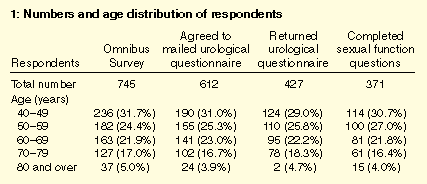
The numbers and age breakdown of respondents are shown in Box 1. The mean age of respondents was 57.5 years (standard error, 0.58). Of the 745 men aged 40 years and over who responded to the Omnibus survey (representing a response rate of 70.8%), 612 (82.1%) agreed to complete a further, mailed questionnaire on urological issues. These questionnaires were returned by 427 respondents (69.8%), 371 (86.9%) of whom agreed to answer the full questionnaire. Box 1 shows that the age distribution was the same in all of these groups. We weighted further analyses to reflect the age distribution in the South Australian community; marginal totals thus do not correspond to the totals in Box 1.
A comparison of respondents who agreed to answer the sexual function questions with those who did not agree to a further survey, did not respond to the mailed form or did not agree to answer the sexual function questions showed no significant differences in age, marital status, blood pressure, cholesterol and triglyceride levels, blood pressure medication or visit to a doctor for LUTS. Men who answered the sexual function questions were more likely to report vigorous exercise in the past two weeks (25.0% v 15.4%; P = 0.001), and more likely to drink alcohol five or more times per week (34.2% v 25.3%; P = 0.026) than those who did not answer these questions.
|
| Frequency of intercourse |
| |
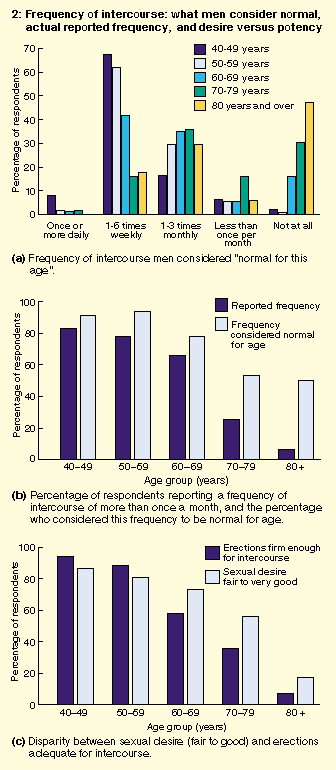
The frequency of intercourse considered by respondents as normal for their age, shown in Box 2(a), and actual reported frequency of intercourse were strongly correlated (Spearman's correlation coefficient, 0.62; P < 0.0001). Most 40-60-year-olds considered that intercourse 1-6 times per week was normal for their age and most reported this frequency of intercourse. In older men, however, a discrepancy emerged: most 70-79-year-olds considered 1-3 times per month to be normal for their age, but most reported an actual frequency of less than once per month. Box 2(b) illustrates this more clearly. In younger age groups, the reported frequency approximated that considered normal for age, but in older age groups it was substantially lower. Similarly, Box 2(c) shows that, while potency exceeds desire in men aged 40-59 years, after age 60 years desire exceeds potency.
|
| Prevalence of erectile dysfunction |
| |
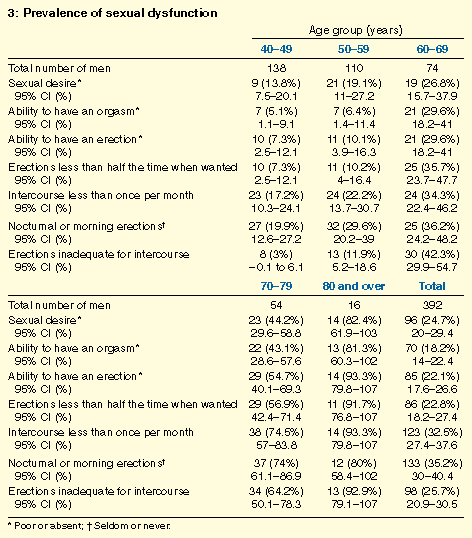
Erectile dysfunction was strongly correlated with age across all seven domains (Box 3). The prevalence of impotence (defined above) increased sharply from 3% in 40-49-year-olds to 42% in 60-69-year-olds and 64% in 70-79-year-olds. Other domains of sexual function, including morning or nocturnal erections, followed this pattern of steep decline in the fifth and sixth decades. Total sexual function scores ranged from 17% to 97%, with a mean of 68.1% (standard error, 1.1); 21% of respondents had a score of 50% or less. The sexual function score was also strongly correlated with age (Pearson's correlation coefficient, 0.63; P < 0.0001).
|
| Demographic risk factors |
| |
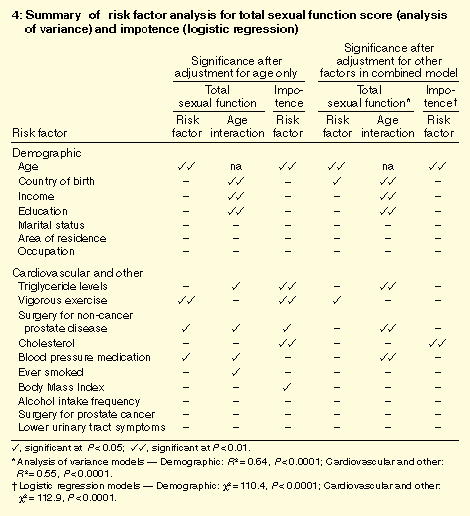
Age, income, education, marital status, area of residence, occupation and country of birth were examined for their association with total sexual function and impotence. By far the strongest contributor to total sexual function score was age, and so the contribution of other factors was examined singly after first accounting for the effects of age in analysis of variance models, including first-order interactions (sexual function) and logistic regression (impotence). Where factors or their first-order interactions were significant, a combined model was examined. A summary of these analyses is given in Box 4.
Men with lower socioeconomic status (income, education, occupation) tended to have lower sexual function, and this association was seen particularly in older men. In the 70-79 years age group, the total sexual function score varied from 47.1 in the lowest education category to 61.7 in the highest. Sexual function tended to be lower in Australian-born than overseas-born respondents. When tested in a model containing cardiovascular risk factors, this association remained. No demographic factors, apart from age, were significant contributors to impotence.
|
| Cardiovascular and other risk factors |
| |
The cardiovascular risk factors shown in Box 4, as well as presence of LUTS, doctor visit for LUTS and surgery for prostate disease (cancer or non-cancer), were examined for their effects on total sexual function and impotence, as described for demographic factors.
A number of factors were significantly (P < 0.05) associated with decreased sexual function after controlling for the effects of age. For total sexual function, these were ever having smoked, taking blood pressure medication and having had surgery for non-cancer prostate disease. A history of vigorous exercise was protective. Risk factors for impotence were high body mass index, high levels of triglycerides and cholesterol, and surgery for non-cancer prostate disease. Again, a history of vigorous exercise was protective.
When combined models were constructed with these factors, the number that remained independently significant was reduced (Box 4). For total sexual function, these were vigorous exercise, high triglyceride levels, blood pressure medication, and surgery for non-cancer prostate disease. The combined model for total sexual function explained 55% of the variance. The observed power was low for all non-significant factors. The effects of cardiovascular risk factors were stronger in older age groups. For example, men in their 60s with high triglyceride levels had a total sexual function score of 41% (95% CI, 31%-52%), compared with 64% (95% CI, 59%-70%) for men of the same age who did not have this risk factor.
|
|
| Discussion |
Few international or Australian studies of the prevalence of sexual dysfunction have surveyed the general community.1 Our study was based on a representative sample of the South Australian community, and employed rigorous methods which have been previously used in other prevalence studies.1,8 The study was undertaken before the recent introduction of the drug oral sildenafil for erectile dysfunction.
The subsample who answered questions on sexual function were similar in terms of most demographic and risk factor variables tested, but did report undertaking more vigorous exercise, and more frequent alcohol consumption. They may therefore reflect a more physically active subgroup, and our estimates of erectile dysfunction are likely to be conservative.
Relative to other studies with comparable methods and measures of sexual dysfunction, the prevalences we found were similar or higher. For example, a study of frequency of sexual activity reported that 34.7% of married 60-65-year-old people did not have sexual intercourse within the preceding month,14 while we found that 34.3% of 60-69-year-old men reported having intercourse "less than once a month". A survey of 1240 men attending general practices in Perth found a 45% prevalence of "complete ED [erectile dysfunction]" in 70-79-year-old men,5 compared with our finding of impotence in 64.2%, and 64.3% in a study by Diokno et al.15 The frequently quoted Massachusetts Male Aging Study reports a prevalence of complete impotence of 9.6% for a 40-70-year-old population;2 the corresponding figure in our study was 16%.
As expected, frequency of intercourse considered normal for age was strongly correlated with the frequency of intercourse reported (Figure 2). Solstad and Hertoft found that, while 40% of interviewed Danish men reported some kind of sexual dysfunction, only 7% considered their problems abnormal for their age,16 implying that men tend to see their own functional level as normal. Nevertheless, in our study, the discrepancy between reported frequency of intercourse and that considered normal for age increased with age. It was greatest in men 70 years and older, suggesting that it is older men who may be most concerned about their sexual function. Consistent with this, potency exceeded desire in younger age groups, but the relationship was reversed in men aged 60 years and over. About one in five men over the age of 50 experience good to very good sexual desire, but nil to poor erectile function; these men may be more likely to seek treatment. If the goal of treatment is to achieve perceived "normal function for this age", this may be a frequency of intercourse of 1-3 times monthly for 70-79-year-olds and weekly in the case of 40-69-year-olds.
The effects of demographic risk factors such as income and education were more apparent in older age groups and were consistent with lower sexual function in lower socioeconomic groups. No reason is immediately apparent for the lower sexual function of Australian-born men compared with their overseas-born counterparts.
Cardiovascular and medical risk factors reflected a conventional pattern.1,17 Predictors of low total sexual function scores after controlling for age only were smoking, blood pressure medication, high triglyceride levels and non-cancer prostate surgery, while a history of vigorous exercise provided a protective effect. In a combined model, smoking was no longer significant. Predictors of impotence after controlling for age only were high body mass index, high triglyceride levels, high cholesterol level, surgery for non-cancer prostate disease, while vigorous exercise was again protective. In a combined model, only high cholesterol remained significant. However, it is likely that small numbers of respondents limited the power of our study to investigate all these factors simultaneously.
Our findings suggest that men experience poor sexual function as a deficit in the same age ranges in which cardiovascular risk factors are major determinants of that function, raising the possibility of prevention. It would be interesting to know whether, for men 60 years and over, improving cardiovascular risk factor profile would also reduce the prevalence of sexual dysfunction.
Also of interest is the consistent and independent effect of non-cancer prostate surgery on sexual function. While its effects are small relative to age, it may point to a higher impotence rate than is commonly believed to result from this type of surgery,18 and this warrants further investigation.
|
Acknowledgements |
| |
We thank Living Health and Quitline for generously sharing their data on cardiovascular risk factors, and the AntiCancer Foundation for funding the prostate cancer questions. We would also like to thank the Behavioural Epidemiology Unit, South Australian Department of Human Services, and Lynne Giles, Flinders University, for assistance with aspects of the statistical analyses.
|
|
| References |
- Bortolotti A, Parazzini F, Colli E, Landoni M. The epidemiology of erectile dysfunction and its risk factors. Int J Androl 1997; 20: 323-334.
- Feldman HA, Goldstein I, Hatzichristou DG, et al. Impotence and its medical and psychosocial correlates: results of the Massachusetts Male Aging Study. J Urol 1994; 151: 54-61.
- Helgason AR, Adolfsson J, Dickman P, et al. Factors associated with waning sexual function among elderly men and prostate cancer patients. J Urol 1997; 158: 155-159.
- Jonler M, Moon T, Brannan W, et al. The effect of age, ethnicity and geographical location on impotence and quality of life. Br J Urol 1995; 75: 651-655.
- Chew K, Burio C, Stuckey B, Jamrozik K. Erectile dysfunction in general medical practice. A study in Perth, Australia. Int J Impotence Res 1997; 9 (Suppl 1): S36.
- Pinnock C, Marshall V. Troublesome urinary symptoms in the community: a prevalence study. Med J Aust 1997; 167: 72-75.
- Weller D, Pinnock C, Silagy C, et al. Prostate cancer testing in South Australian men: influence of sociodemographic factors, health beliefs and lower urinary tract symptoms. Aust N Z J Public Health 1998; 22: 400-402.
- Pinnock C, Weller D, Marshall V. Self-reported prevalence of prostate specific antigen (PSA) testing in South Australia: a community study. Med J Aust 1998; 169: 25-28.
- Litwin MS, Hays RD, Fink A, et al. Quality-of-life outcomes in men treated for localized prostate cancer. JAMA 1995; 273(2): 129-35. [See comments.]
- Litwin MS, Nied RJ, Dhanani N. Health-related quality of life in men with erectile dysfunction. J General Intern Med 1998; 13: 159-166.
- Kish L. Estimates of unit variance: design effect. Survey sampling. New York: John Wiley and Sons, 1965: 257-263.
- NIH Consensus Conference. Impotence. NIH Consensus Development Panel on Impotence. JAMA 1993; 270: 83-88.
- SPSS for Windows [computer program], version 6.1. Chicago, Ill: SPSS Inc, 1996.
- Marsiglio W, Donnelly D. Sexual relations in later life: a national study of married persons. J Gerontol 1991; 46(6): S338-S344.
- Diokno AC, Brown MB, Herzog AR. Sexual function in the elderly. Arch Intern Med 1990; 150: 197-200.
- Solstad K, Hertoft P. Frequency of sexual problems and sexual dysfunction in middle-aged Danish men. Arch Sexual Behavior 1993; 22: 51-58.
- Helgason AR, Adolfsson J, Dickman P, et al. Waning sexual function -- the most important disease-specific distress for patients with prostate cancer. Br J Cancer 1996; 73: 1417-1421.
- Clinical practice guidelines for the management of uncomplicated lower urinary tract symptoms in men. Canberra: National Health and Medical Research Council, 1997.
(Received 30 Nov 1998, accepted 28 Jun 1999)
|
|
| Authors' details |
Repatriation General Hospital, Daw Park, Adelaide, SA.
Carole B Pinnock, PhD, Principal Research Scientist, Division of Surgery;
Alan M F Stapleton, PhD, FRACS, Director, Urology Unit;
Villis R Marshall, MD, FRACS, Head, Division of Surgery, and Head, Department of Surgery, Flinders Medical Centre.
Reprints will not be available from the authors.
Correspondence: Dr C B Pinnock, Division of Surgery, Repatriation General Hospital, Daws Road, Daw Park, SA 5041. carole.pinnockAThealth.sa.gov.au
|
|
| |
 |
| |
Back to text
|
| |
 |
| |
Back to text
|
| |
 |
| |
Back to text
|
| |
 |
| |
Back to text
|
|



