



A 54-year-old man presented with a 3-year history of non-inflammatory pain in his lower back, and his hip and knee joints. He also had black discolouration of the palms, cheeks and sclerae (Box 1A) and his urine turned black on alkalinisation (Box 1B). Spinal x-rays showed intervertebral disc calcification (Box 1C). A diagnosis of alkaptonuria (ochronosis) was made.
Features pointing to the diagnosis of ochronosis
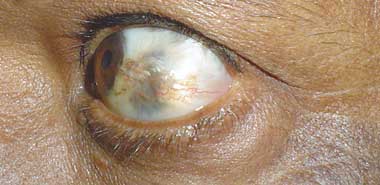 A: Discolouration of the sclerae. 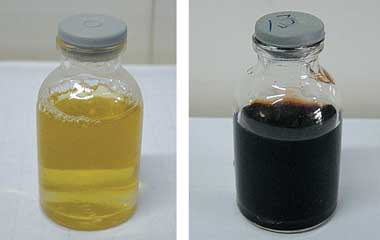 B: Urine sample before (left) and after (right) alkalinisation. 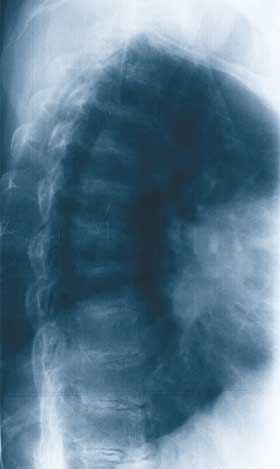 C: Spinal x-ray showing intervertebral disc calcification. |
- Aman Sharma1
- Shefali K Sharma2
- Ajay Wanchu1
- Manish Kumar1
- Surjit Singh1
- Pradeep Bambery1
- 1 Post Graduate Institute of Medical Education and Research (PGIMER), Chandigarh, India.
- 2 All India Institute of Medical Sciences (AIIMS), New Delhi, India.
Correspondence: amansharma74@yahoo.com
Online responses are no longer available. Please refer to our instructions for authors page for more information.